



1. What Are Solvent Waste Recycling Services?
Solvent waste recycling services are professional solutions that take used solvent, remove impurities such as resins, paints, oils and water, and return usable clean solvent or dispose of residues safely. They can be:
- Off‑site commercial recyclers that collect drums or IBCs of solvent waste.
- On‑site service providers that install and maintain a solvent recycler at the facility.
According to a report by the European Environment Agency, improving solvent recycling and substitution could reduce VOC emissions by more than 40% across some industrial sectors by 2030. This aligns with the growing pressure from regulations (such as VOC limits and hazardous waste rules) and corporate sustainability goals.
Answer from the author: Not always. At very low waste volumes, transport plus service fees may still be cheaper than investing in equipment. Once monthly waste is above roughly 200–300 L and the solvent is relatively clean (e.g. paint thinner, acetone, alcohols), in‑house recovery almost always brings a better return within 1–2 years.
2. How Solvent Recovery Machines Work (In Simple Terms)
Most industrial solvent recyclers are based on distillation. The principle is straightforward:
- Solvent waste is loaded into a heated tank.
- The clean solvent evaporates at a controlled temperature.
- Vapour passes into a condenser, cools down and turns back into liquid solvent.
- Contaminants (resins, pigments, oils) stay as a residue in the tank.
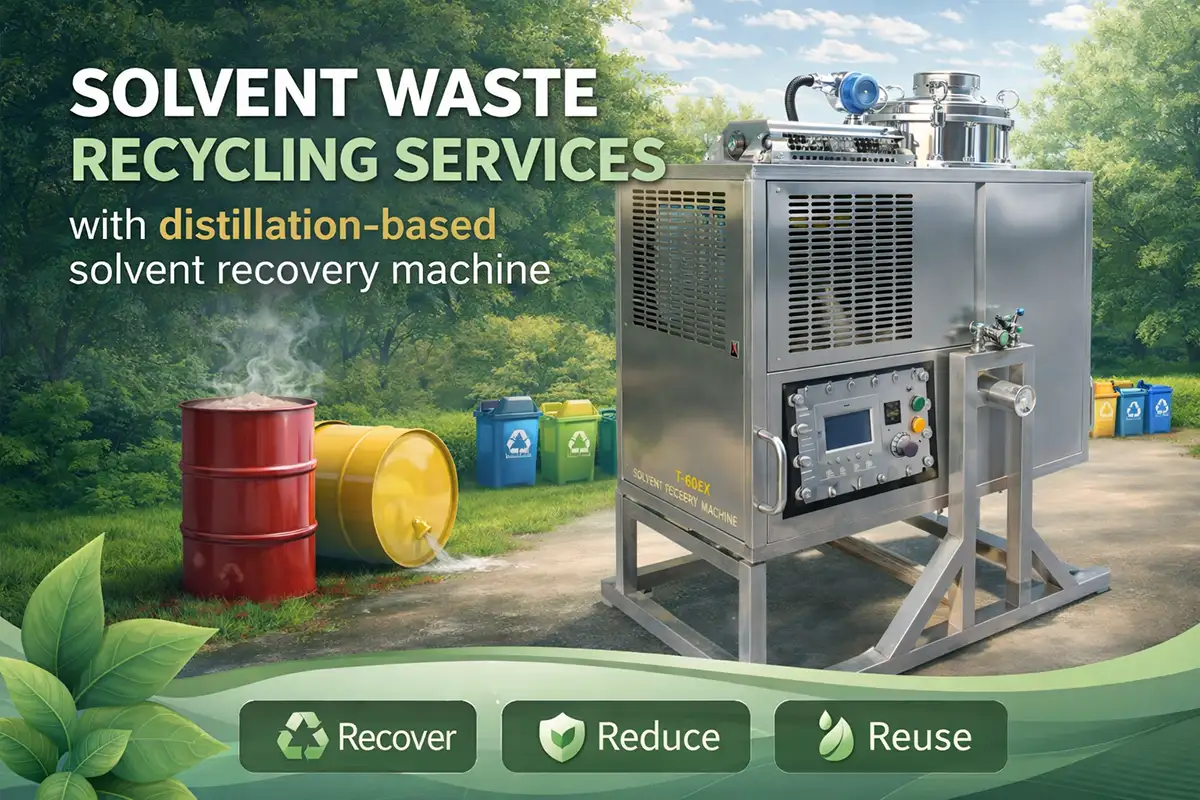
Typical distillation‑type solvent recycler used in coating and printing plants.
Modern systems are designed for safety and efficiency. For example, the T‑series explosion‑proof solvent recyclers operate up to 200 °C with a typical recovery rate around 95% for suitable waste streams.
3. Services vs In‑House Solvent Recovery: Which Is Better?
When external solvent waste recycling services make sense
- Very low solvent waste volume (for example, <200 L per month).
- Highly mixed or unknown waste streams that are hard to distill safely.
- Sites without staff available to operate equipment, even briefly.
- Short‑term or pilot production where long‑term ROI is uncertain.
When in‑house solvent recovery is usually better
- Consistent, single‑type waste: paint thinner, acetone, isopropanol, ethanol, etc.
- Medium to high volume solvent use (hundreds of litres per month or more).
- Desire to reduce hazardous waste shipments and improve ESG scores.
- Need for quick turnaround of clean solvent instead of waiting for pickups.
As a manufacturer, I often see companies start with services, then move to an internal solvent recycling machine once they know their typical waste volume and composition. This staged approach reduces risk and makes investment decisions more data‑driven.
Answer from the author: If the recovery is done correctly and only compatible waste is recycled, the regenerated solvent typically behaves like virgin solvent for many applications. For critical processes (pharmaceutical, electronics), it is recommended to separate recycled solvent for cleaning and non‑critical steps, keeping fresh solvent for high‑precision stages.
4. Key Benefits of Solvent Waste Recycling
4.1 Cost savings
The economics are the main driver. A typical plant might save:
- 70–90% of solvent purchase cost by reusing recovered solvent.
- 30–80% of hazardous waste disposal fees.
For example, if 1000 L of thinner per month costs US$1.5/L and disposal costs US$0.5/L, the total monthly cost is about US$2000. Recovering 95% in‑house means buying only 50 L fresh and disposing of 50 L residue, cutting the cost to roughly US$200–300 plus electricity. Even after adding maintenance and labour, payback for a mid‑size machine is typically under two years.
4.2 Environmental impact
Responsible use of solvents is increasingly measured and reported. Studies from the U.S. EPA show that source reduction (including on‑site recycling) can reduce overall hazardous waste generation by 25–50% compared with traditional “use‑and‑dispose” practices in some sectors. Internal solvent recycling:
- Reduces total solvent consumption.
- Lowers VOC emissions from storage and handling.
- Cuts transport risk by reducing waste shipments.
4.3 Compliance and brand image
Many customers now ask suppliers to demonstrate environmental management. Installing a documented solvent recovery system and using certified solvent waste recycling services where needed helps with:
- ISO 14001 and similar environmental certifications.
- Compliance with local hazardous waste and VOC regulations.
- Answering sustainability questionnaires from key customers.
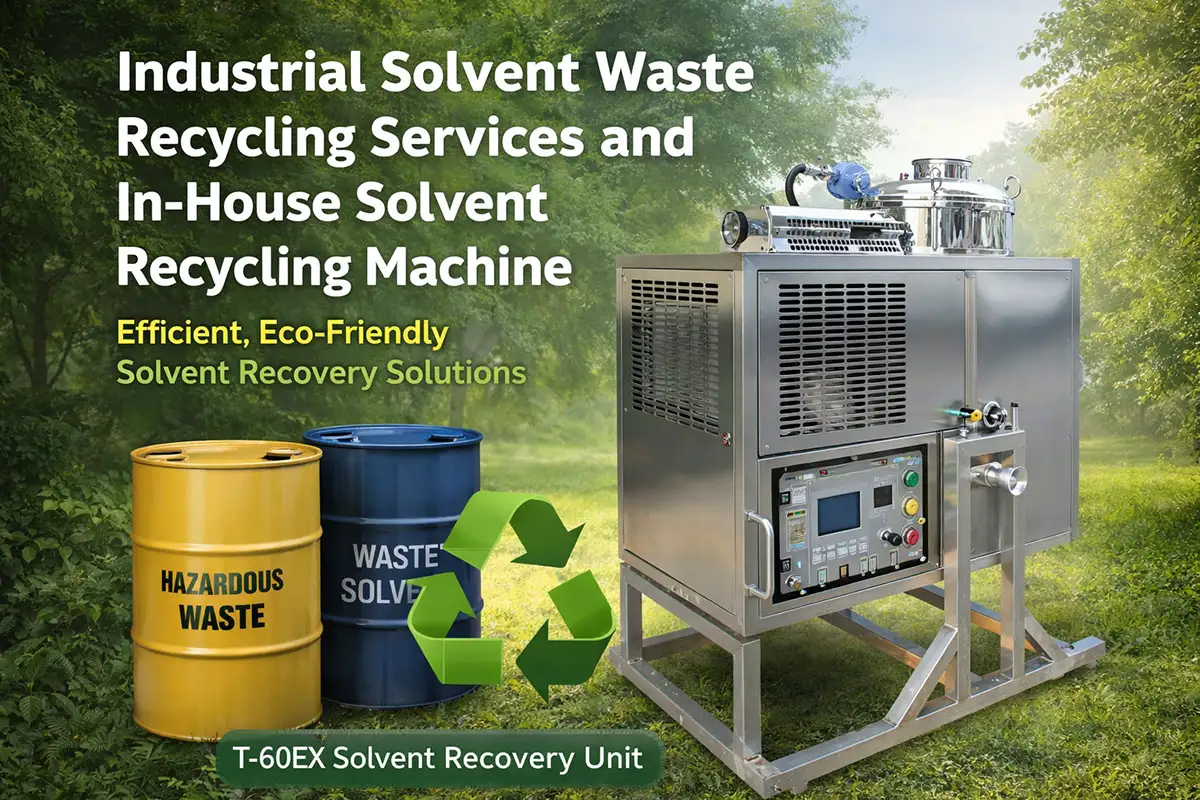
Combining external solvent waste recycling services with in‑house recovery often gives the best overall result.
5. Choosing the Right Solvent Recovery Machine Capacity
Once the decision is made to recover solvent on‑site, capacity selection is the next practical question. Below is a simplified overview of several explosion‑proof models suitable for paint shops, automotive, furniture and printing applications.
| Model | Feed Capacity (L) | Power Supply (ACV) | Heating Power (kW) | Temperature Range (°C) | Typical Treatment Time (min) | Recovery (%) | Machine Weight (kg) | Machine Size (mm) |
|---|---|---|---|---|---|---|---|---|
| T‑20Ex | 20 | 380 | 2 | RT–200 | 120 | 95 | 153 | 860 × 760 × 1190 |
| T‑60Ex | 60 | 380 | 4 | RT–200 | 150 | 95 | 170 | 1160 × 870 × 1260 |
| T‑80Ex | 80 | 380 | 5 | RT–200 | 180 | 95 | 200 | 1180 × 850 × 1290 |
| T‑125Ex | 125 | 380 | 6 | RT–200 | 210 | 95 | 280 | 1250 × 920 × 1450 |
| T‑250Ex | 250 | 380 | 16 | RT–200 | 240 | 95 | 520 | 2600 × 1200 × 1950 |
| T‑400Ex | 400 | 380 | 32 | RT–200 | 270 | 95 | 1200 | 1990 × 1850 × 2090 |
In practice, capacity is chosen based on daily or shift solvent waste volume and available time:
- T‑20Ex / T‑60Ex: small workshops, R&D labs, or low‑volume paint booths.
- T‑80Ex / T‑125Ex: medium factories with regular cleaning and flushing cycles.
- T‑250Ex / T‑400Ex: large coating lines, automotive plants, high‑volume printing.
Answer from the author: Add annual solvent purchase and disposal costs related to the waste stream, then estimate 80–90% savings if recovery is around 95%. Divide machine price plus estimated annual maintenance by the annual savings. If the result is under 2–3 years, the project is usually attractive. External solvent recycling machines for sale often include ROI calculators to support this step.
6. Combining Services and In‑House Recycling for Best Results
In reality, most sites do not choose between solvent waste recycling services and equipment as a strict either–or decision. A hybrid strategy is often the most practical:
- Use in‑house solvent recovery for clean, predictable waste streams (e.g. paint gun wash solvent).
- Send complex or small‑volume mixed wastes to external recyclers or licensed disposal.
- Periodically send samples of recycled solvent for third‑party verification if required by quality systems.
This approach maximizes savings where recovery is efficient, while keeping safety and compliance under control for problematic waste streams.
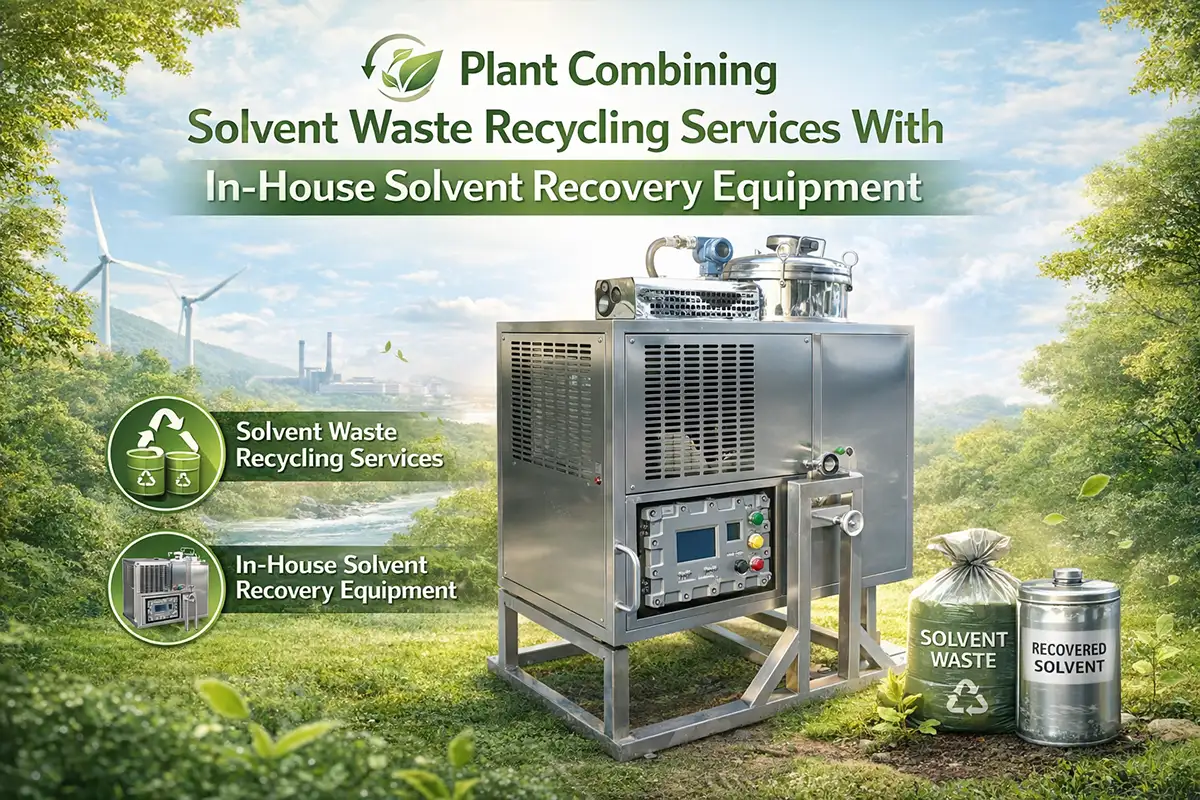
Hybrid approach: simple streams recovered on‑site, complex waste handled by external services.
7. Practical Checklist Before Starting
Before contacting a provider or investing in a machine, it is helpful to prepare the following:
- List of solvents currently used (names, safety data sheets, boiling points).
- Estimated monthly waste volume for each solvent or mixture.
- Current costs: purchase price per litre and disposal cost per litre.
- Space and power availability for installing equipment (e.g. 380 V supply).
- Safety requirements (explosion‑proof area, ventilation, zoning).
With this information, both external solvent waste recycling services and equipment suppliers can quickly recommend whether outsourcing, in‑house recovery, or a combination will be the most efficient solution.