




How to Avoid Protein Inactivation During Spray Drying: How to Choose Inlet Temperature, Protectants, and Atomization Parameters?
Protein powders are widely used in pharmaceuticals, food ingredients, nutraceuticals, enzymes, probiotics, and specialty biomaterials. But one challenge always comes first: how to dry proteins fast without destroying their activity. This is exactly why many buyers compare spray drying of proteins manufacturers before choosing equipment. Good spray drying is not only about making powder. It is about protecting structure, activity, solubility, and long-term stability.
Why proteins become inactive during spray drying
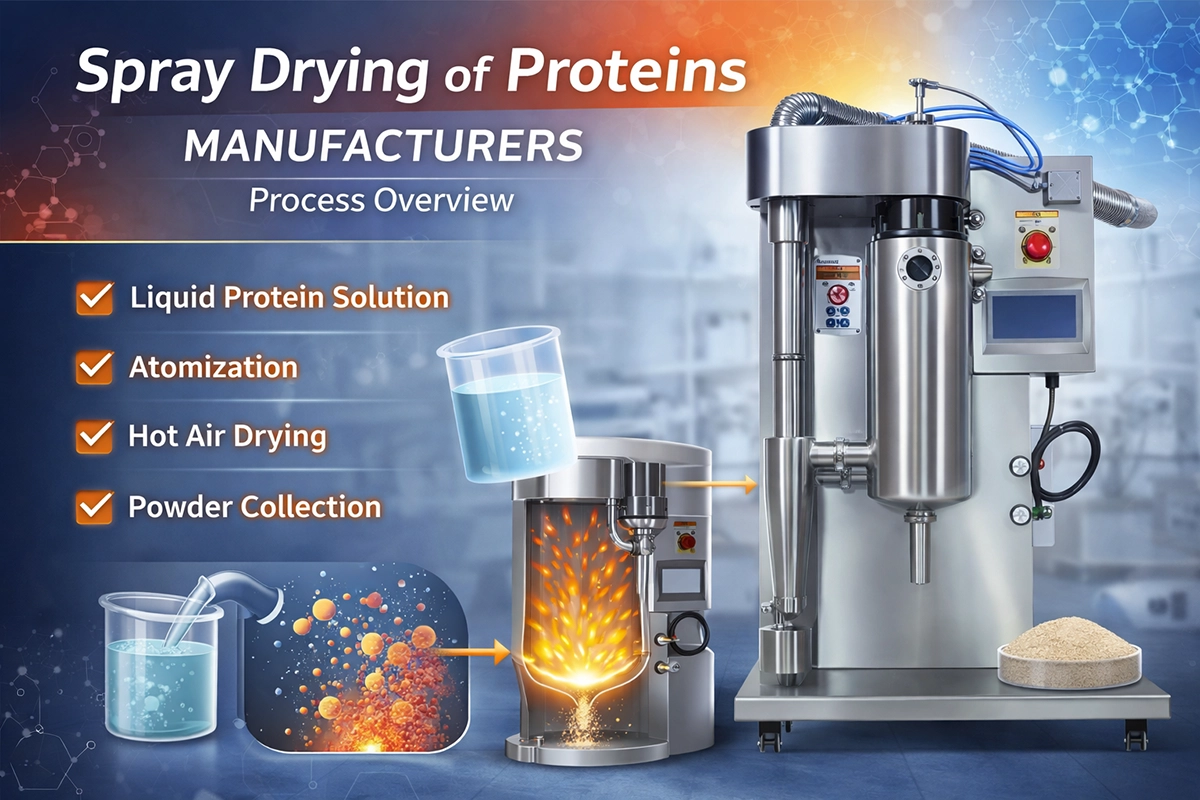
Protein inactivation usually happens because proteins are sensitive to heat, air-liquid interfaces, shear force, oxidation, and moisture changes. During spray drying, liquid feed is atomized into tiny droplets and meets hot drying air. Water evaporates in about 1.0 to 1.5 seconds on many small laboratory systems, according to the equipment parameters provided for compact spray dryers such as the SD-2L and LPG-3L models. That short time is useful because it limits long exposure, but the process is still intense enough to unfold fragile biomolecules if settings are not chosen carefully.
According to a review published in Advanced Drug Delivery Reviews, proteins can lose activity during drying because interfacial stress and dehydration may disrupt their native conformation. In practical terms, this means a protein may still look like powder after drying, but its biological function can already be reduced.
How to choose inlet air temperature without causing major protein damage
This is often the first question buyers ask, and it should be. High inlet temperature sounds dangerous for proteins, but the answer is more nuanced. The actual particle temperature is usually lower than the inlet air temperature because evaporation cools the droplet surface. That is why some proteins can still be spray dried successfully even when inlet settings look high on paper.
Would a lower inlet temperature always be safer?
Not always. From the author’s perspective, very low inlet temperature can slow drying, increase residual moisture, cause sticky wall deposition, and expose proteins to stress for a longer time. A balanced condition is usually safer than simply choosing the lowest possible value.
For small laboratory equipment, practical ranges can be quite wide. For example:
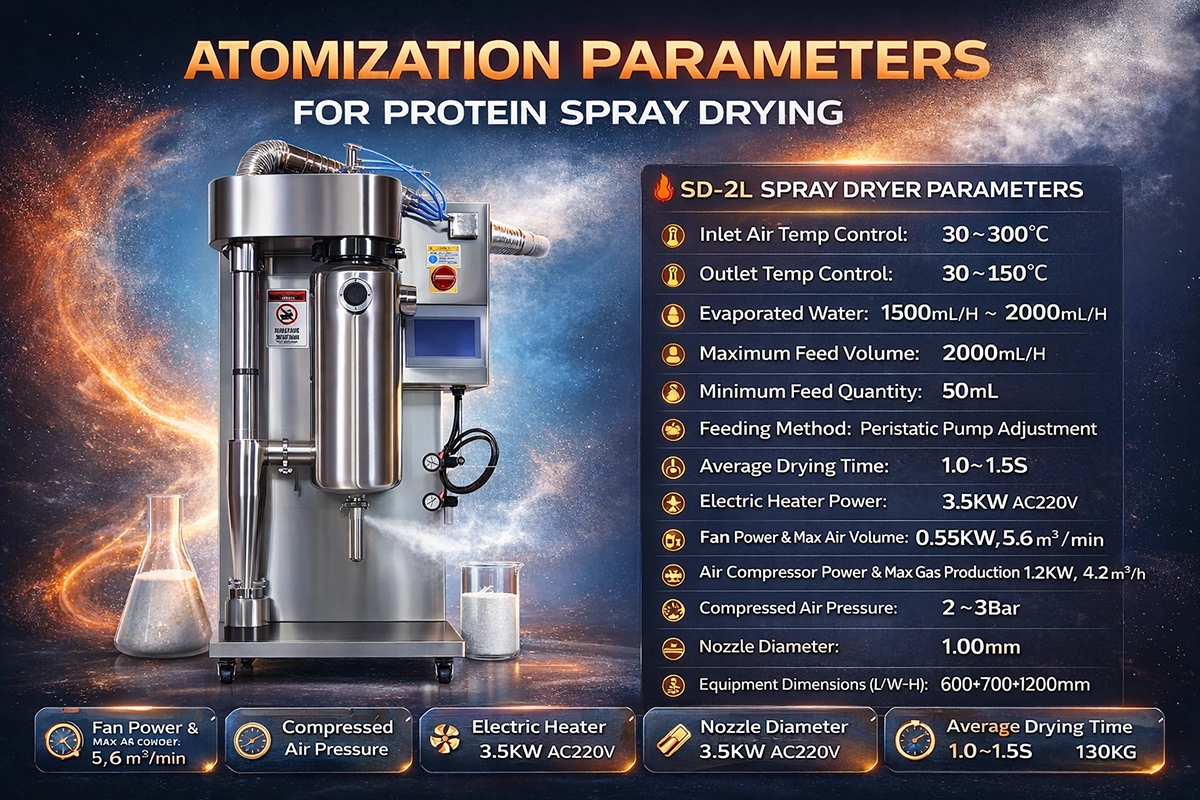
- SD-2L: inlet air temperature control 30–300℃, outlet 30–150℃
- LPG-3L: inlet 30–300℃, outlet 30–140℃, temperature control accuracy ±1℃
- LPG-5L: inlet from room temperature to 330℃, outlet from room temperature to 140℃
That does not mean proteins should be dried near the top limit. In real formulation work, many sensitive proteins are screened at moderate inlet conditions and monitored by outlet temperature, moisture content, yield, and activity retention. In many cases, keeping the outlet temperature under tighter control matters more than focusing on inlet temperature alone, because outlet temperature better reflects the thermal state of the exiting particles.
A practical strategy is to start with a moderate inlet temperature, then adjust feed rate so the outlet temperature stays in a gentler range. When feed enters too slowly, droplets dry too aggressively. When feed enters too fast, moisture rises and particles may remain sticky. On bench systems that use peristaltic pump adjustment, this balance is easier to test in small batches.
If a broader comparison of general drying principles is useful, related reading on spray drying equipment and process differences can help frame why spray drying is faster and more controllable than many traditional methods.
Why protectants are often the real key to keeping proteins active
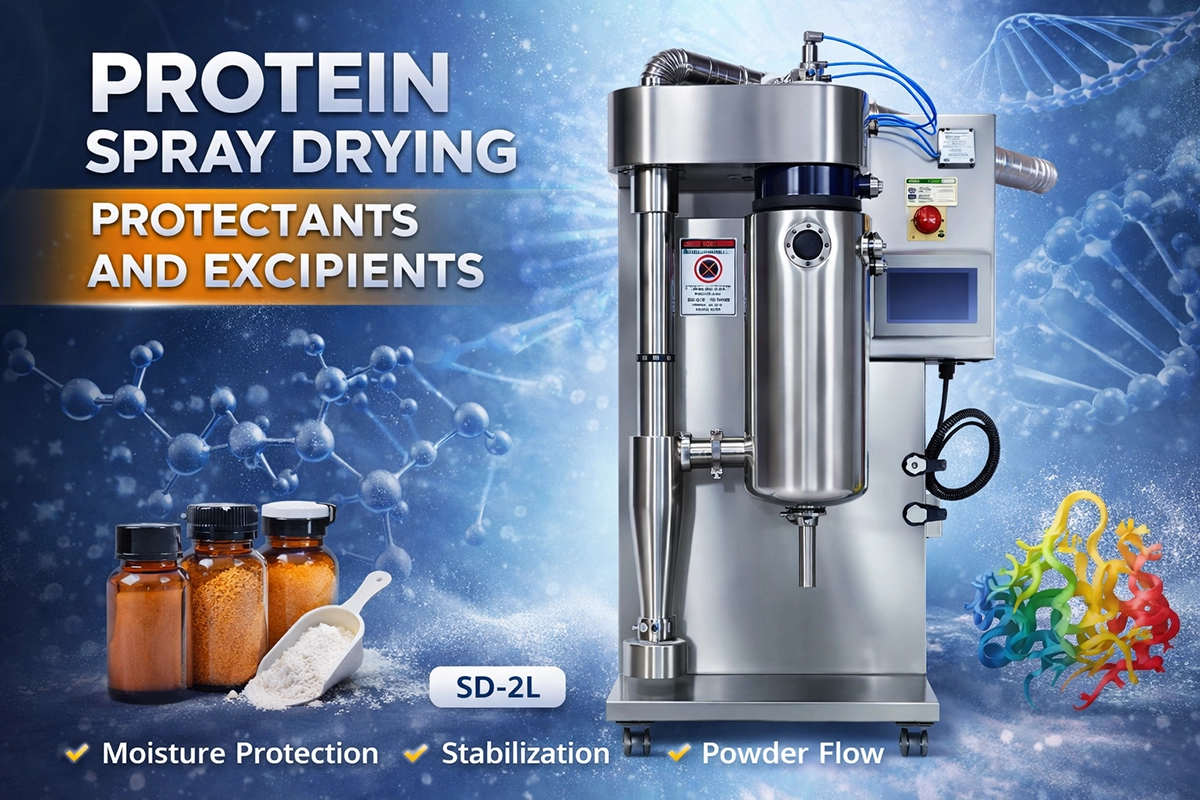
Many failed protein drying trials are not caused by temperature alone. They fail because the formula does not protect the protein structure. Protectants, also called stabilizers or excipients, create a safer microenvironment during drying and storage. Common options include sugars such as trehalose, sucrose, lactose, and mannitol, as well as polymers and amino acids depending on the formulation goal.
According to research published in the Journal of Pharmaceutical Sciences, disaccharides such as trehalose and sucrose are widely used because they can replace water interactions around biomolecules and form an amorphous glassy matrix after drying, which helps preserve protein structure.
In simple terms, protectants do three jobs:
- They reduce structural collapse when water leaves the protein.
- They lower interfacial damage during atomization.
- They improve powder stability during storage by controlling moisture and glass transition behavior.
Can a good protectant compensate for imperfect temperature settings?
To some extent, yes. From the author’s perspective, a strong formulation can make the whole process more forgiving. But it should not be treated as a substitute for proper drying conditions. Best results come from matching formulation and equipment parameters together.
For anyone turning liquids into stable powders, the logic is similar across many materials: control heat exposure, improve solids formulation, and create particles that dry quickly. A helpful example can be seen in this article on how liquid is turned into powder in seconds.
How atomization parameters affect protein survival
Atomization is where the liquid becomes droplets, and droplet size decides much of the drying behavior. Smaller droplets dry faster, but they also create more surface area, which can increase interfacial stress. Larger droplets reduce surface exposure, but they may dry incompletely if airflow and temperature are not adjusted correctly.
On the provided equipment data, nozzle diameter options include 1.00 mm with optional 0.7, 1.5, and 2.0 mm on the LPG-3L system, while the SD-2L uses a 1.00 mm nozzle. Larger industrial-style models may use centrifugal atomization instead of a pressure nozzle.
What should be considered when choosing atomization settings?
- Nozzle size: smaller nozzles usually create finer droplets and faster drying, but may increase shear stress.
- Feed viscosity: higher-viscosity protein solutions may need larger nozzles or adjusted solids content.
- Compressed air flow or atomizer speed: too aggressive atomization can damage very fragile biomolecules.
- Feed rate: must match heating capacity and airflow, otherwise wet powder or overheating may occur.
Is the smallest droplet always the best droplet?
No. From the author’s point of view, the best droplet is the one that dries completely without exposing the protein to unnecessary shear or interfacial stress. That is why atomization should be optimized together with formulation solids and outlet temperature.
Practical equipment data for laboratory screening
When comparing laboratory systems from spray drying of proteins manufacturers, buyers usually want to know whether the machine can support gentle temperature control, low minimum sample volume, flexible nozzle options, and stable feed adjustment. The following summary is based on the provided equipment parameters.
| Model | Inlet Temperature | Outlet Temperature | Evaporation Capacity | Feed Method | Notable Features |
|---|---|---|---|---|---|
| SD-2L | 30–300℃ | 30–150℃ | 1500–2000 mL/h | Peristaltic pump | Average drying time 1.0–1.5 s, minimum feed 50 mL, 1.00 mm nozzle |
| LPG-3L | 30–300℃ | 30–140℃ | 1500–3000 mL/h | Peristaltic pump | ±1℃ control accuracy, minimum feed 50 mL, optional nozzle sizes 0.7–2.0 mm |
| LPG-5L | Room temp to 330℃ | Room temp to 140℃ | About 6 L/h | Depends on configuration | Centrifugal atomization, 304 stainless steel, indoor installation |
On mobile devices, the table can be scrolled horizontally for easier viewing.
A practical selection path for protein spray drying projects
For most protein applications, the best development path is not complicated:
- Start with a stable protein solution and screen protectants first.
- Choose a moderate inlet temperature and watch outlet temperature closely.
- Use a feed rate that avoids both overheating and wet powder.
- Test nozzle size or atomization strength to control droplet size.
- Measure activity retention, moisture, particle size, and powder recovery after each run.
That is also why laboratory spray dryers with small minimum sample requirements are valuable. When the minimum feed amount is only 50 mL, formulation screening becomes faster and less expensive, especially for high-value proteins, enzymes, peptides, or biologics.
Teams evaluating laboratory spray dryer options often focus on this exact point: whether the machine is flexible enough for early-stage process development, not just for simple drying.
Final answer: what matters most?
If the goal is to avoid protein inactivation during spray drying, three things matter most:
- Temperature control: do not judge by inlet temperature alone; monitor outlet temperature and actual drying behavior.
- Protective formulation: sugars and other stabilizers often determine whether structure and activity survive.
- Atomization balance: choose droplet size and nozzle conditions that support quick but gentle drying.
In short, successful protein drying is not about chasing one “safe number.” It is about matching formulation, airflow, feed rate, and atomization into one stable process. That is what separates ordinary powder production from truly reliable biomaterial drying.
For buyers comparing spray drying of proteins manufacturers, equipment should be evaluated not only by maximum temperature, but by temperature accuracy, feed control, minimum sample consumption, nozzle flexibility, and the ability to run repeatable trials. Those details are what make protein spray drying practical, scalable, and commercially valuable.