




How Can a Bromination Reactor Be Designed More Safely: How Should Temperature Control, Dosing, Sealing, and Off-Gas Absorption Be Configured?
Bromination can be efficient and highly useful in chemical synthesis, but it is also a reaction that needs careful control. A well-designed stainless steel bromination reactor helps reduce thermal risk, improve dosing accuracy, maintain tight sealing, and manage harmful tail gas in a much safer way. This article explains the key points in plain English, so readers can quickly understand what really matters when choosing or designing the right reactor.
Why does bromination need a more careful reactor design?
Bromination reactions are often exothermic, which means heat can be released quickly. In many cases, bromine is also corrosive, volatile, and irritating. If temperature rises too fast, or if bromine is added too quickly, the system may generate excessive vapor, pressure fluctuation, product degradation, or even unsafe operating conditions.
That is why reactor design should not start from volume alone. The real starting point is process safety: how to remove heat, how to feed bromine at a controlled rate, how to prevent leakage, and how to absorb tail gas before it reaches the environment.
For users comparing different reactor types, it may also help to review broader reactor selection ideas in this related article on stainless steel chemical reactors.
How should temperature control be configured?
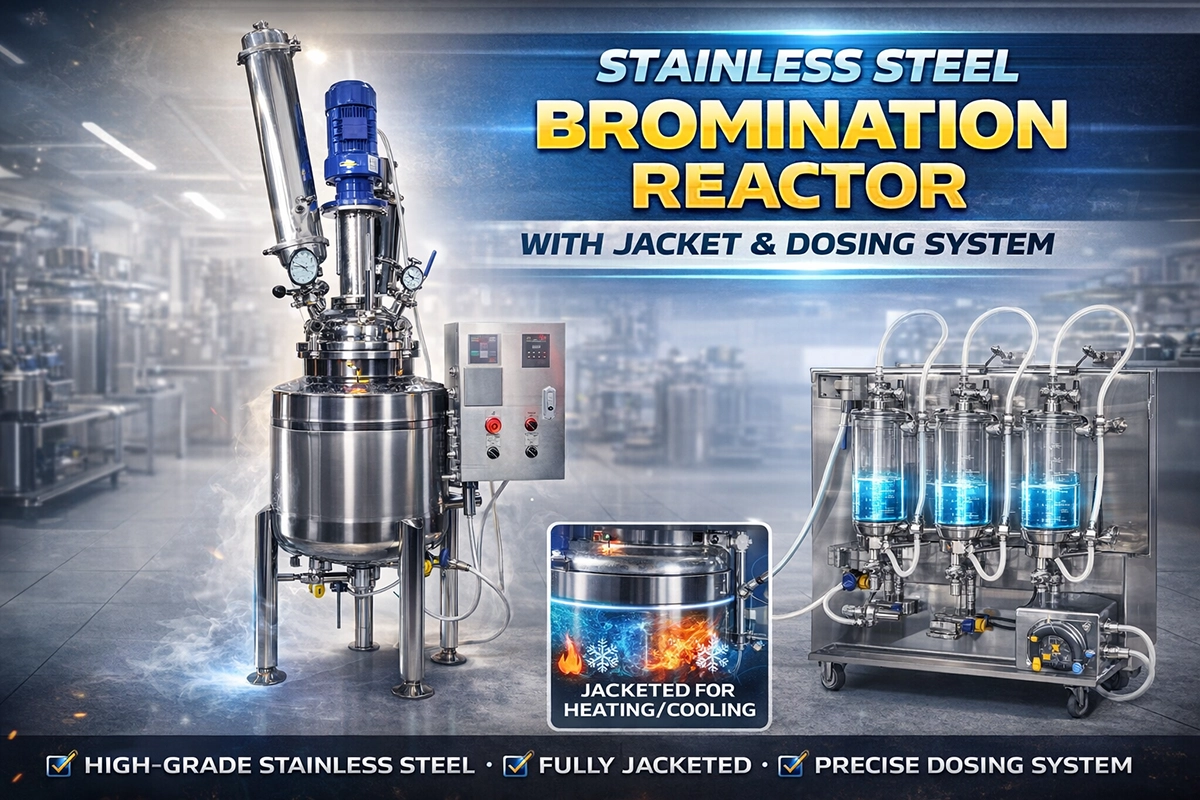
The first requirement of a safer stainless steel bromination reactor is strong and stable temperature control. Because bromination may release heat rapidly, the reactor should usually be equipped with a jacket or double-wall structure for circulation heating and cooling. In practice, cooling performance is often more important than heating performance during bromination.
A suitable stainless steel reactor should support a wide operating range. For example, based on the provided stainless steel reactor parameters, some models offer kettle reaction temperatures from -100°C to 250°C or even -100°C to 299°C. This wide range is useful because some bromination steps need low-temperature operation to slow reaction rate and improve selectivity.
- Use a jacketed vessel with circulating thermal fluid for rapid heat removal.
- Install a PT100 temperature sensor with digital display for accurate reading.
- Prefer automatic interlock logic so feed slows or stops if temperature rises too quickly.
- Keep enough heat transfer area between reactor volume and jacket capacity.
Is a wider temperature range always better?
The answer is not simply “the wider, the better.” In the author’s view, what matters more is whether the cooling system can respond fast enough under the real bromination heat load. A broad temperature range is valuable, but stable control and fast heat removal are even more important.
If the process begins at low temperature and bromine is fed slowly, thermal runaway risk is much lower. This is one reason jacketed stainless steel designs are preferred in many chemical applications. Compared with less robust materials, stainless steel offers mechanical strength and practical durability for industrial use.
Why is the feeding system just as important as the reactor itself?
In bromination, the reagent feeding method can decide whether the process stays calm or becomes unstable. A reactor with a constant pressure funnel port or a metering pump connection is extremely useful because bromine should usually be added slowly and evenly, not dumped in all at once.
The provided stainless steel reactor parameters mention multiple lid openings such as a stirring port, solid material port, temperature measurement port, pressure gauge port, constant pressure funnel port, and condensation reflux port. This multi-port design is ideal for bromination because it supports controlled dosing and better process observation.
- Use a metering pump or pressure-equalized addition funnel for controlled feed rate.
- Link feed rate to actual reactor temperature rather than using only a fixed time setting.
- Add bromine below the liquid surface when appropriate to reduce vapor release.
- Combine dosing with efficient agitation to avoid local concentration spikes.
Stirring also matters. Several supplied models support 0–600 rpm variable frequency speed control, while some 20L configurations list frequency conversion speed regulation as well. Variable-speed agitation helps improve mixing and reduces “hot spots” where bromine concentration becomes too high in one local area.
Can a simple manual feed still work for bromination?
In the author’s opinion, manual feed may work only in very small-scale and low-risk trials, but it is not the safer choice for repeatable production. A controlled dosing system gives more stable temperature behavior, better consistency, and much lower operator exposure risk.
What sealing arrangement makes a bromination reactor safer?
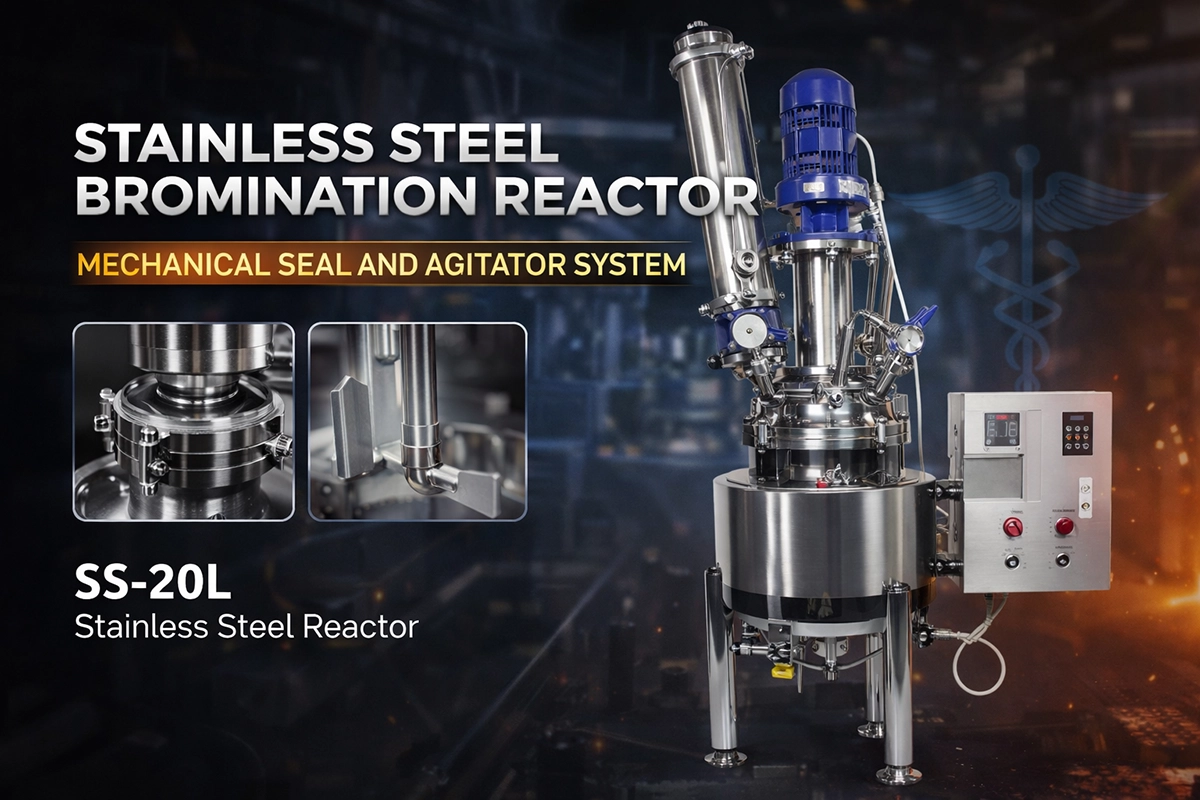
Bromine vapor leakage is one of the biggest practical hazards in bromination work. So, sealing is not a small accessory issue. It is a central safety issue. Based on the supplied reactor information, several stainless steel models use mechanical seals, including ceramic combined mechanical seals and PTFE mechanical seals. These are much more suitable than simple low-grade sealing structures when the process involves corrosive media and rotating shafts.
Material selection also matters. The 5L parameter sheet specifies 316 stainless steel for the reactor material, with 304 stainless steel used for the frame and pipes. For bromination service, 316 stainless steel is usually the better wetted material choice because it offers improved corrosion resistance compared with standard 304 in many chemical environments.
A practical sealing package for a bromination reactor should include:
- Mechanical shaft seal with chemically resistant faces and elastomers.
- PTFE or other corrosion-resistant sealing components where appropriate.
- Reliable threaded union or better sealed interface connections.
- Pressure gauge and vacuum monitoring to detect abnormal behavior early.
The supplied stainless steel reactors also show working pressure capability around -0.1 MPa to 0.5 MPa and vacuum performance up to -0.098 MPa. This is useful because some processes need slight vacuum control, inerting, or vapor management. If a process includes vacuum-assisted steps, users may also be interested in related support equipment such as a lab vacuum pump.
How should tail gas absorption be matched to the reactor?
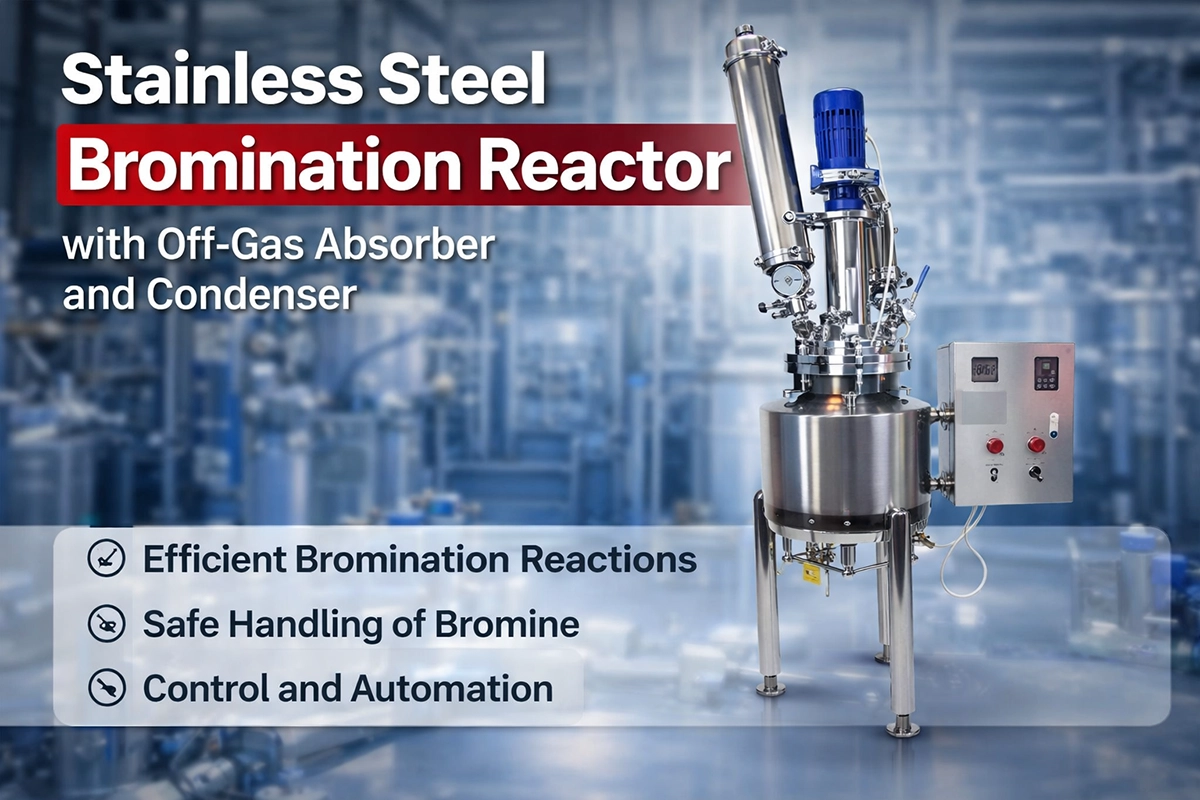
Even if the reactor itself is strong and well sealed, bromination safety is incomplete without proper tail gas treatment. Bromine vapor and acid gas should not be released directly. A safer setup normally includes a condenser first, followed by an absorption unit such as an alkali scrubber.
The condenser reflux port listed in the supplied reactor configuration is especially helpful here. First, the condenser can reduce vapor load by cooling and returning condensable material to the reactor. Then, the remaining gas can pass into an absorption bottle, packed scrubber, or multi-stage alkali wash system.
- Place a condenser directly after the reactor gas outlet.
- Use corrosion-resistant tubing and connectors in the tail gas line.
- Install one or two alkaline absorption stages for bromine-containing exhaust.
- Design the scrubber capacity based on worst-case feed and vapor generation, not only normal operation.
Is a condenser alone enough for bromine off-gas?
Usually, no. In the author’s view, a condenser helps reduce vapor volume, but it should not be treated as a complete safety solution. Bromine-containing gas often still requires chemical absorption after condensation, especially where environmental compliance and operator safety are important.
This approach is consistent with good process engineering practice: reduce vapor at the source, recover what can be condensed, and then neutralize what remains.
A practical stainless steel bromination reactor configuration
For many lab, pilot, and small production bromination tasks, a good setup is not just one vessel. It is a coordinated system. Based on the supplied parameter sheets, a practical recommendation would include a jacketed stainless steel reactor with variable speed stirring, digital temperature display, mechanical seal, multi-port lid, pressure monitoring, and quick discharge valve.
| Safety Function | Recommended Configuration | Why It Helps |
|---|---|---|
| Heat removal | Double-wall or jacketed stainless steel reactor | Controls exotherm and keeps temperature stable |
| Temperature reading | PT100 sensor with digital display | Improves accuracy and response |
| Dosing | Constant pressure funnel or metering pump port | Supports slow and uniform bromine addition |
| Mixing | Frequency-controlled stirring, 0–600 rpm where suitable | Reduces local overheating and concentration spikes |
| Sealing | Mechanical seal with PTFE-compatible sealing parts | Reduces shaft leakage and vapor escape |
| Pressure handling | Pressure gauge and vacuum/pressure-rated vessel | Improves monitoring and system stability |
| Off-gas control | Condenser + alkali absorption system | Captures bromine vapor and tail gas more safely |
| Material | 316 stainless steel for wetted parts when feasible | Provides better corrosion resistance |
Which reactor size is suitable?
Reactor size depends on batch volume, heat release rate, and the space needed for safe headroom. It is not wise to fill a bromination reactor too full. Enough free space is needed for agitation, vapor control, and feed buffering. The provided stainless steel models range from 5L to 300L, which is useful for moving from research scale to pilot or small production.
For example:
- 5L can be suitable for laboratory development and process screening.
- 20L may fit pilot trials or teaching laboratories with better observation of scale effects.
- 50L to 100L and above are more appropriate where heat removal, feeding strategy, and off-gas treatment need to be verified closer to real production conditions.
If a buyer is comparing stainless steel solutions, the product direction may also be reviewed here: stainless steel jacketed reactor.
Final answer: what makes a safer stainless steel bromination reactor?
A safer stainless steel bromination reactor is not defined by stainless steel alone. It is defined by how well the whole system controls heat, dosing, sealing, and exhaust.
In simple terms, the best bromination reactor is the one that stays calm when the chemistry becomes active. That is exactly where a properly configured stainless steel reactor shows its real value.