



Solvent distillation recycling turns dirty solvent back into clean, reusable solvent. This guide explains how it works, what recovery rate to expect, and how to choose the right machine size.
1. What Is Solvent Distillation Recycling in Simple Terms?
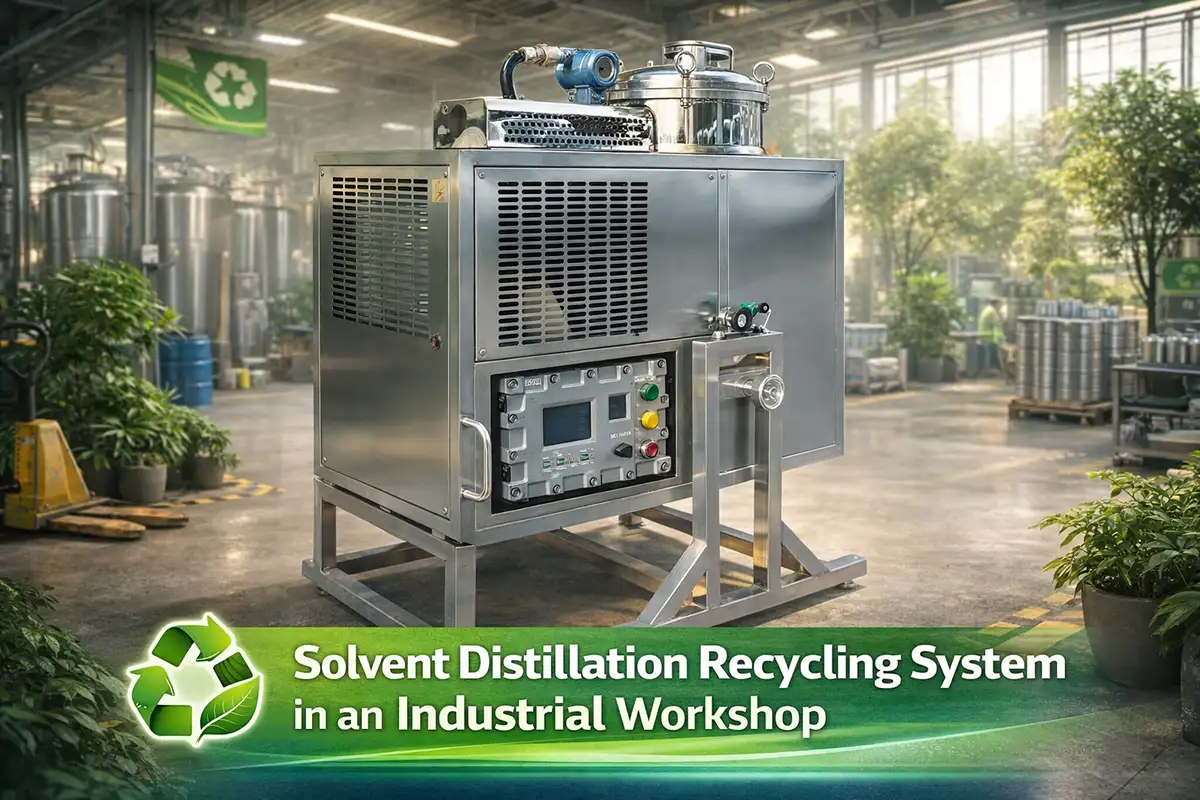
Solvent distillation recycling is the process of taking used, contaminated solvent from painting, printing, degreasing, or chemical processes and separating out the pure solvent using heat and condensation. The result: clean solvent that can be reused, and a much smaller volume of waste sludge that needs disposal.
Instead of paying to buy new solvent and paying again to dispose of dirty solvent, a solvent recycler machine combines both steps in one closed, safe unit.
In practice, this is exactly what a modern solvent recovery system does: it heats the used solvent, turns it into vapor, then condenses that vapor back into a clean liquid.
2. How Does a Solvent Recycler Machine Work?
Although models differ, most solvent distillation recycling units follow the same core steps:
- Feed: Used solvent (with paint, oil, resins, inks, etc.) is poured or pumped into a stainless-steel boiling tank.
- Heating: The system heats the solvent to its boiling point (for many organic solvents, often between 60–160 °C).
- Evaporation: The solvent vapor rises and leaves behind heavier contaminants.
- Condensation: The vapor passes through a cooled condenser and returns to liquid form.
- Collection: Clean solvent drips into a collection container, ready to be reused.
- Residue removal: A much smaller volume of concentrated sludge remains in the tank for disposal.
Is the process safe when dealing with flammable solvents like acetone, toluene, or paint thinner?
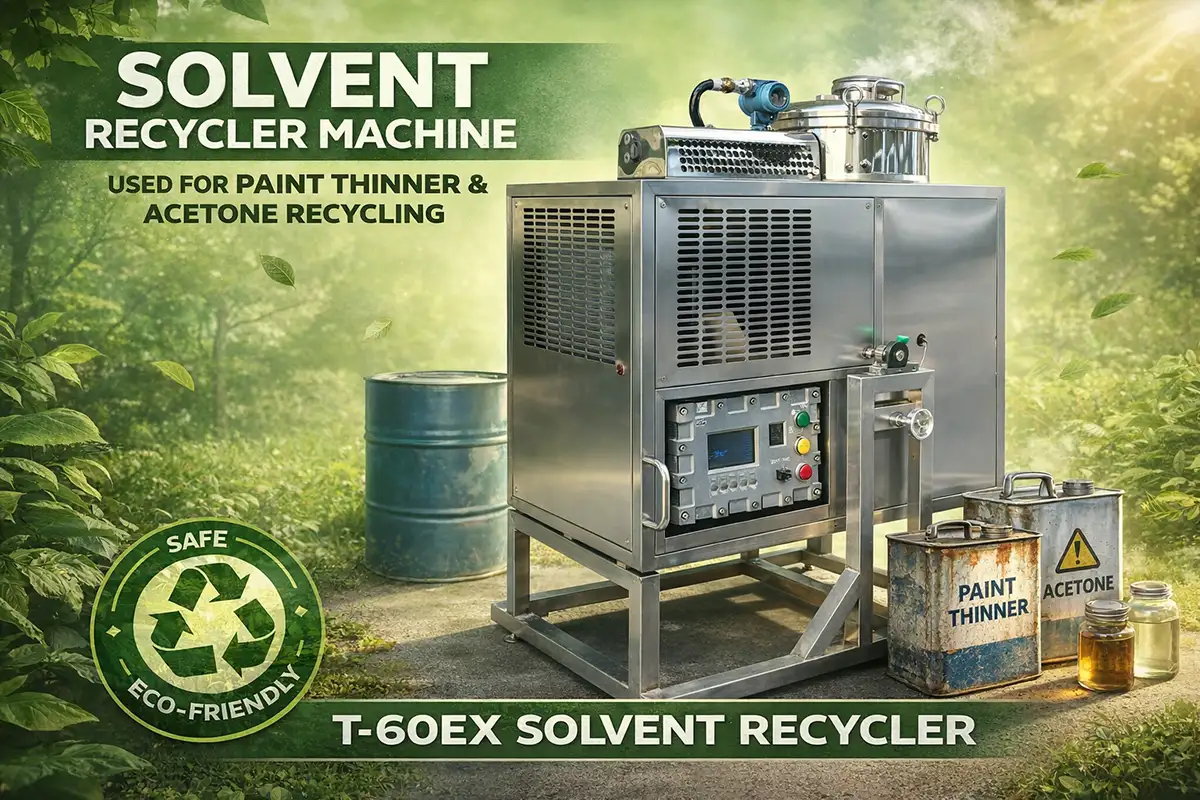
Safety depends on using explosion-proof (Ex) certified equipment, proper ventilation, and correct grounding. Modern solvent recycling machines use temperature control, over-temperature protection, and sealed systems to minimize vapor leakage and ignition risk. For example, our T‑250Ex series is designed specifically for flammable organic solvents.
3. What Recovery Rate Can Be Expected?
One of the most important questions about solvent distillation recycling is:
How much clean solvent can be recovered from a batch of dirty solvent?
Under typical conditions, well-designed recyclers achieve around 95 % recovery for many common organic solvents, assuming contamination levels and boiling ranges are suitable for distillation. This means that from 100 L of used solvent, about 95 L of clean solvent can often be obtained, while only 5 L becomes concentrated waste.
4. Key Technical Parameters of a Solvent Distillation Recycling Unit
Below is an example of an explosion-proof solvent recycling series designed for organic solvents commonly used in painting, coating, and cleaning operations. These models share a similar structure but offer different feed capacities.
| Model | Feed Capacity (L) | Power Supply (AC V) | Heating Power (kW) | Temperature Range (°C) | Typical Treatment Time (min) | Recovery (%) | Machine Weight (kg) | Machine Size (mm) |
|---|---|---|---|---|---|---|---|---|
| T-20Ex | 20 | 380 | 2 | RT–200 | 120 | 95 | 153 | 860 × 760 × 1190 |
| T-60Ex | 60 | 380 | 4 | RT–200 | 150 | 95 | 170 | 1160 × 870 × 1260 |
| T-80Ex | 80 | 380 | 5 | RT–200 | 180 | 95 | 200 | 1180 × 850 × 1290 |
| T-125Ex | 125 | 380 | 6 | RT–200 | 210 | 95 | 280 | 1250 × 920 × 1450 |
| T-250Ex | 250 | 380 | 16 | RT–200 | 240 | 95 | 520 | 2600 × 1200 × 1950 |
| T-400Ex | 400 | 380 | 32 | RT–200 | 270 | 95 | 1200 | 1990 × 1850 × 2090 |
The feed capacity determines how many liters of dirty solvent can be treated in each batch. For example, T‑20Ex is well suited for small workshops or spray booths, while T‑400Ex targets larger paint lines or central solvent rooms.
How to decide which capacity is appropriate for a specific factory or lab?
A practical rule is to look at the average daily dirty solvent volume and choose a model that can handle one day’s volume in one or two batches. For example, if about 120 L of waste solvent is generated per day, a T‑60Ex running two cycles or a T‑125Ex running one cycle can both be suitable options.
5. Where Is Solvent Distillation Recycling Used?
Solvent distillation recycling fits a wide range of industries where organic solvents are heavily used:
- Automotive and industrial painting: Paint thinner, cleaning solvent, gun wash solvents.
- Printing and packaging: Ink cleaning solvents and wash solutions.
- Metal parts cleaning: Degreasing solvents and cleaning agents.
- Chemical and pharmaceutical labs: Recovery of organic solvents after reactions or extractions.
- Resin and composite manufacturers: Cleaning of resin containers and tools.
For facilities that already use equipment like rotary evaporators or short-path distillation for high-purity lab work, a dedicated recycler provides a more robust and cost-effective solution for bulk, dirty solvent. For high-value ethanol, for example, dedicated ethanol recycling equipment can be combined with a solvent distillation unit for a complete recovery strategy.
6. Economic Benefits: What Does Solvent Distillation Recycling Actually Save?
When considering a solvent recycler machine, the core question is often economic:
How quickly can the investment pay for itself?
Payback time depends on solvent price, waste disposal cost, daily solvent usage, and local regulations. In many applications, payback periods of 6–24 months are common because:
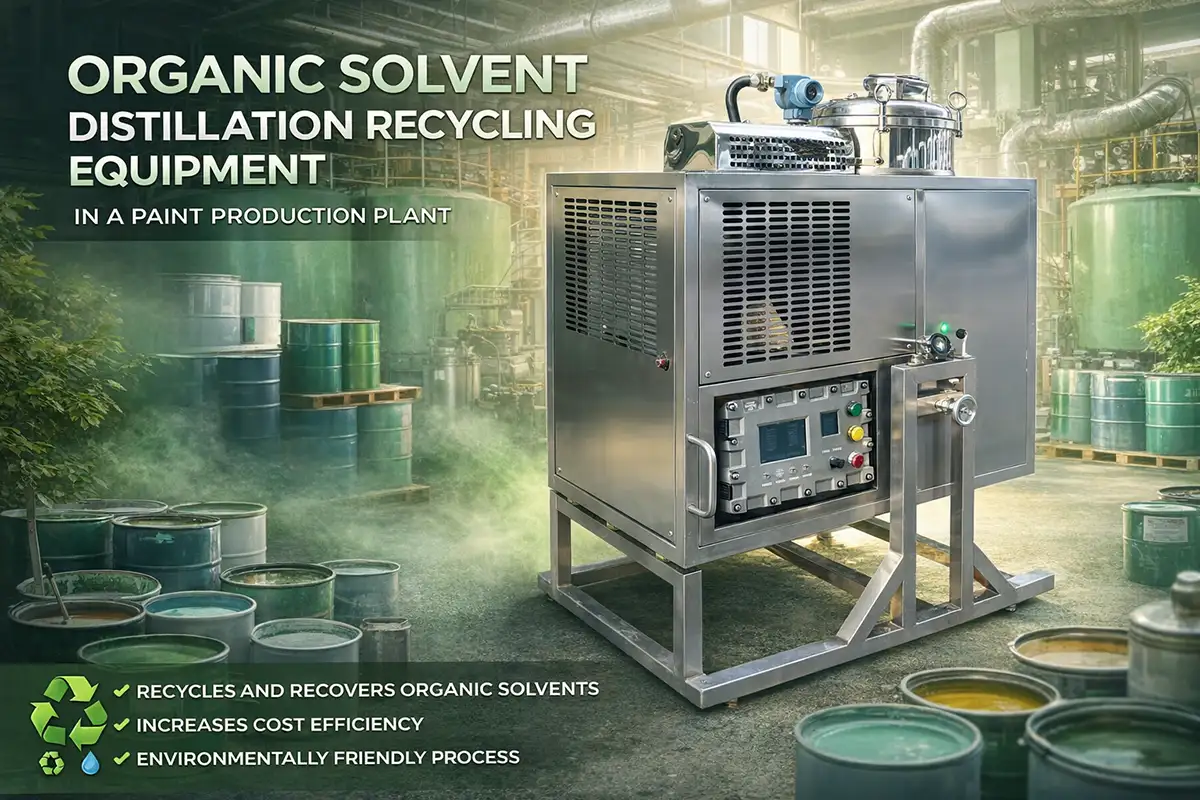
- Up to 95 % of solvent is recovered, sharply reducing new solvent purchases.
- Hazardous waste volume drops, lowering disposal and transport fees.
- Better control of solvent inventory reduces losses and accidental spillage.
For example, a workshop consuming 100 L of solvent per day at a cost of $2 per liter spends $200 per day, or about $60,000 per year (assuming 300 operating days). If 80–90 % of that volume becomes recoverable through distillation, annual spending on fresh solvent can be reduced dramatically.
7. Practical Selection Tips for Solvent Distillation Recycling Equipment
When choosing a solvent recycling machine, several practical factors matter more than looking only at feed volume:
- Solvent type: Ensure compatibility with flammable organic solvents (e.g., acetone, toluene, MEK), including Ex-proof design when required.
- Boiling point range: Mixed solvents with very different boiling points may need adjusted process parameters or multi-step recycling strategy.
- Contaminant type: Heavy solids or resins may require optimized cleaning cycles or liners in the boiling tank.
- Heating power: Higher kW generally means faster batch times, important for high-throughput users.
- Available space: Check machine dimensions and ensure safe clearance, ventilation, and service access.
- Local regulations: Some regions have strict rules regarding VOC emissions, explosion-proof classifications, and waste handling; equipment should match these requirements.
For users already exploring different solvent recyclers, it can be useful to compare them with complete solvent recycling machines for sale on the same site, so all technical parameters and certifications can be evaluated side by side.
8. Why Solvent Distillation Recycling Is Becoming Standard Practice
Beyond cost savings, solvent distillation recycling is increasingly seen as a standard part of responsible industrial practice for three main reasons:
- Environmental responsibility: Less fresh solvent, less waste, and lower emissions align with corporate sustainability goals.
- Regulatory pressure: Many regions are tightening limits on VOC emissions and hazardous waste disposal, encouraging on-site recovery.
- Supply security: Volatile chemical prices and supply chain disruptions make internal recycling a valuable buffer.
When combined with good storage, handling, and ventilation practices, a well-chosen solvent recycler machine turns a continuous cost and environmental burden into a controlled, predictable process.