




What Parameters Must Be Confirmed Before You Buy Glass Reactors to Avoid Port Mismatch and Seal Leakage?
When companies buy glass reactors, the biggest problems often do not come from the glass vessel itself. They come later, during installation: the pipe does not fit, the stirring shaft does not match, the vacuum line leaks, or the seal fails after only a short time. These issues waste time, increase cost, and can delay research or production. The good news is that most of them can be avoided by checking a few key parameters before placing an order.
Why parameter confirmation matters before purchase
A glass reactor is not just a container. It is a complete system that includes the vessel, stirring assembly, sealing parts, motor, frame, and utility connections. If even one of these details is overlooked, the whole setup may become difficult to use. In many labs, the real issue appears only after delivery, when existing condensers, vacuum pumps, thermometers, or feeding parts cannot connect properly.
According to the U.S. Department of Energy, compressed air and vacuum leaks can significantly reduce system efficiency in industrial and laboratory environments, sometimes causing energy losses of 20% to 30% in poorly maintained systems. While a glass reactor is a different type of equipment, the lesson is very relevant: even a small leak can become a big operating problem.
The first parameter to confirm: reactor capacity
Capacity sounds simple, but it affects almost everything else. The provided specifications cover models from 1L to 100L. Smaller models such as S-1L, S-2L, S-3L, and S-5L are floor-type units with 60W stirring power and a 12 mm stirring shaft diameter. Larger units such as S-10L to S-100L use 120W or 250W stirring power, and some models move from a 12 mm shaft to a 15 mm shaft.
This matters because many buyers focus only on working volume. In practice, larger volume usually means higher material viscosity, higher torque demand, and stronger sealing requirements. A 5L reactor and a 100L reactor may look similar in photos, but their mechanical demands are very different.
Question: Is choosing a bigger capacity always safer for future use?
Not really. From an equipment selection point of view, an oversized reactor can create unnecessary costs, reduce mixing efficiency for small batches, and complicate sealing and accessory matching. The better choice is a capacity that fits normal batch size, headspace requirement, and future process expansion.
Port size and interface type: the main reason for mismatch problems
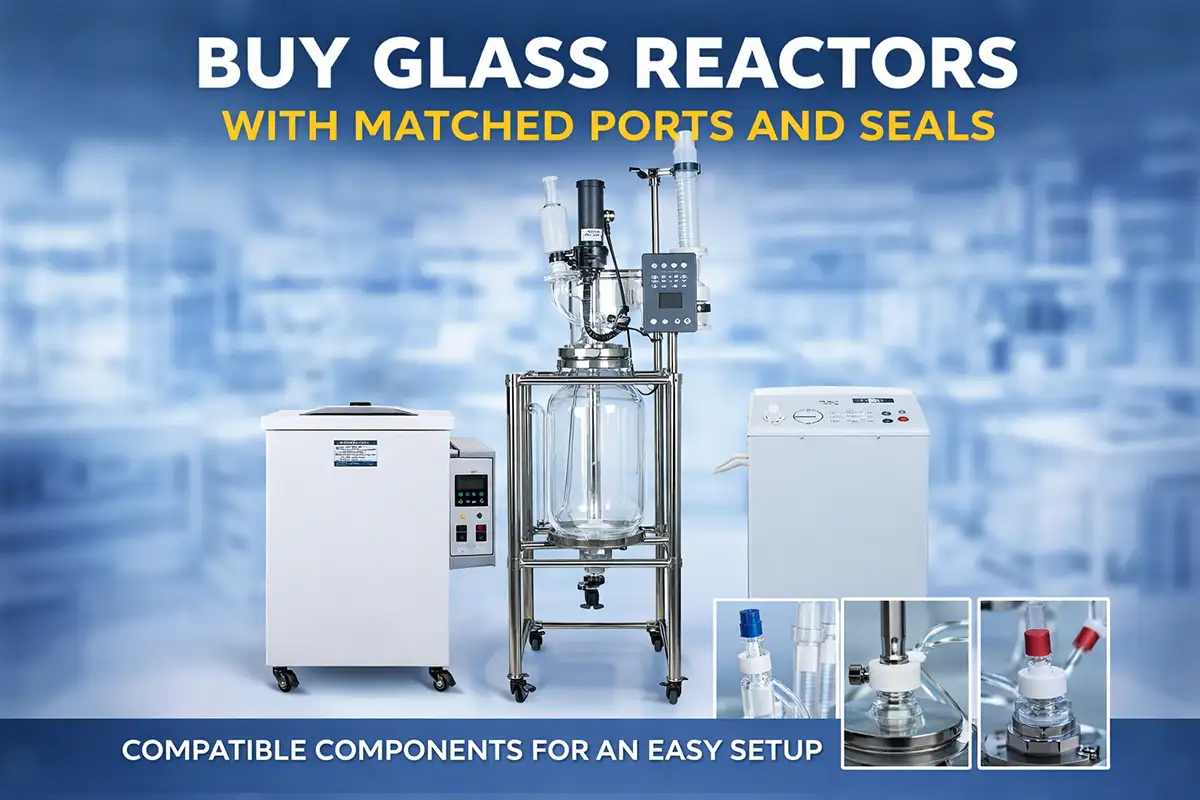
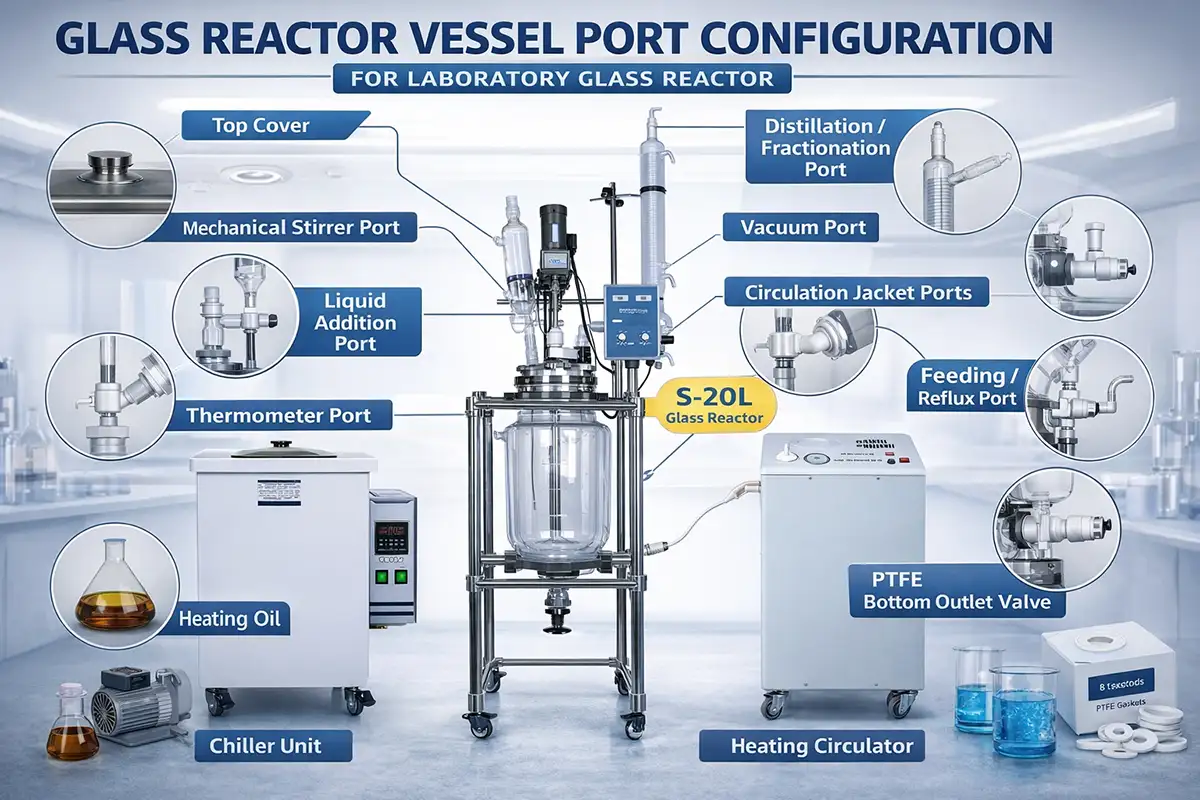
If the goal is to buy glass reactors without installation trouble, port information must be confirmed in detail. A buyer should never ask only for “a glass reactor.” The exact number, size, and function of the ports must be listed clearly. This includes:
- Main vessel opening size
- Stirrer neck specification
- Feeding port size
- Temperature probe port size
- Condensing or reflux connection size
- Vacuum port and vent port details
If existing lab accessories will be reused, this step becomes even more important. A mismatch of only a few millimeters may force the use of adaptors, and too many adaptors often increase leakage risk. For readers comparing different vessel structures, this guide to jacketed glass reactor vessel basics gives helpful background on common reactor configurations.
Sealing structure: the real key to avoiding gas leakage
Many users think leakage only comes from poor workmanship. In fact, leakage often comes from an incorrect match between sealing method and operating conditions. Before ordering, these points should be confirmed:
- Seal material compatibility with solvent, acid, alkali, and temperature
- Whether the reactor will work under vacuum, slight positive pressure, or normal pressure
- Stirring speed range and whether high speed increases wear on the seal
- Stirring shaft diameter and mechanical fit
- Whether an explosion-proof configuration is required
The supplied parameter sheet shows a stirring speed of 0~600 rpm, with maximum 1300 rpm. High speed can improve mixing, but it also places more stress on the seal. If the medium is volatile and vacuum is used, sealing quality becomes far more important than many buyers expect.
Question: If the seal looks tight during a short test, does that mean long-term leakage will not happen?
No. A short no-load test cannot fully represent real operation. Once heat, solvent vapor, continuous stirring, and pressure changes are introduced, weak sealing points may appear. That is why seal type, material, and shaft matching must be confirmed before shipment, not after installation.
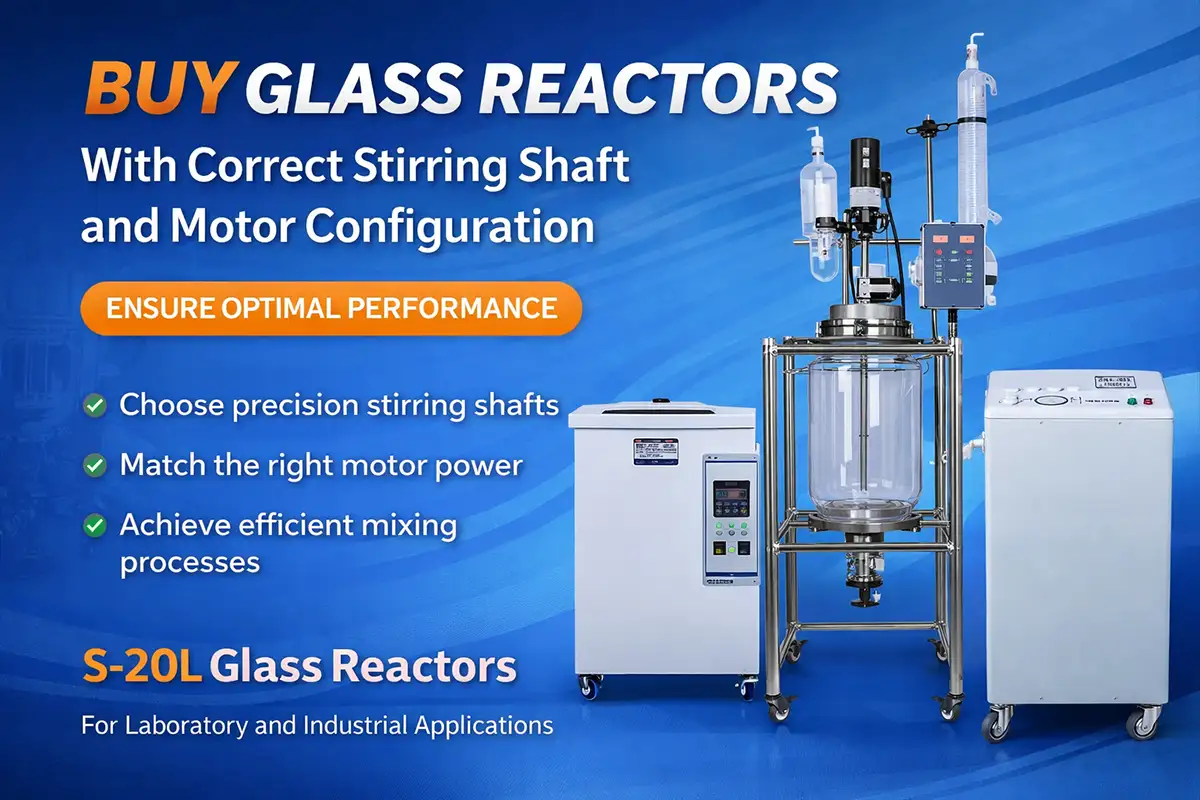
Stirring power, torque, and shaft diameter must match the process
Another common buying mistake is paying attention to motor power while ignoring torque. In glass reactors, torque often matters more when dealing with viscous liquids, suspensions, crystallization, or multi-phase materials.
Based on the provided specifications:
| Model Range | Capacity | Stirring Power | Speed | Shaft Diameter | Motor Torque | Notes |
|---|---|---|---|---|---|---|
| S-1L to S-5L | 1L / 2L / 3L / 5L | 60W | 0~600 rpm (Max. 1300) | 12 mm | 2000 / 2400 / 4800 g·cm | Floor type, explosion-proof optional |
| S-10L to S-100L | 10L / 20L / 30L / 50L / 100L | 120W / 250W | 0~600 rpm (Max. 1300) | 12 mm / 15 mm | 1000 / 1200 / 1500 / 3000 g·cm | 304 stainless steel frame, explosion-proof optional |
If the process material is thick, sticky, or likely to form crystals, the shaft diameter and torque must be checked carefully. A weak shaft or underpowered motor can create unstable stirring, vibration, and faster seal wear.
Power supply and explosion-proof requirements should never be assumed
The specification sheet shows standard power supply as 220V, 50/60Hz, with some models supporting 110V/60Hz customization. This should be confirmed before manufacturing, especially for overseas orders.
In addition, some projects require explosion-proof design. If solvents such as ethanol, acetone, or other flammable media are used, this requirement must be stated clearly at the inquiry stage. Retrofitting later is usually more expensive and less convenient.
For buyers comparing reactor styles for lab use, this product page on laboratory glass reactor options can help clarify what configurations are available in practice.
A simple pre-purchase checklist
Before sending a purchase order, the following details should be confirmed one by one:
- Required capacity and actual working volume
- Exact port number, size, and function
- Condenser, thermometer, vacuum, and feeding connection compatibility
- Stirring speed range and maximum operating speed
- Motor power, torque, and shaft diameter
- Seal type and seal material compatibility
- Operating pressure and vacuum requirements
- Power supply standard for the destination country
- Explosion-proof requirement
- Frame material and structural preference
Question: What is the fastest way to reduce the risk of buying the wrong reactor?
The most effective method is to provide a complete application description together with existing accessory dimensions. In practical purchasing work, a simple layout drawing or a list of connection sizes often prevents more problems than a long generic inquiry.
Final takeaway
To successfully buy glass reactors, the most important step is not only comparing price or vessel volume. The real decision should focus on whether the reactor is mechanically and functionally matched to the process. Port size, sealing structure, shaft diameter, torque, speed range, and power supply are the parameters that most often decide whether installation will be smooth or frustrating.
If these details are confirmed in advance, the chance of “interface mismatch” and “seal leakage” can be greatly reduced. And if a more detailed comparison is needed for larger capacities, the page on double jacketed glass reactor vessels is also worth reviewing before making a final choice.