




A 20 liter rotary evaporator sits in a “sweet spot” between bench-scale rotovaps and larger 50 L systems. This guide explains when it makes sense in pilot runs, and how vacuum and chilling capacity determine whether the rated evaporation numbers become real, repeatable productivity.
1) Which pilot-scale jobs are a 20L rotary evaporator actually good at?
In pilot-scale work, “good at” usually means three things at once: stable repeatability, reasonable batch cycle time, and manageable operator workload. A 20 liter rotary evaporator is a practical choice when a process has moved beyond benchtop flasks but still needs flexibility before committing to large-scale evaporation equipment.
Common mid-pilot scenarios
- Extract concentration (botanical, nutraceutical, fragrance, or food R&D): removing ethanol or other solvents after extraction to reach a target solids level.
- Solvent swap before crystallization, formulation, or downstream purification: moving from a low-boiling extraction solvent to a higher-boiling process solvent under vacuum.
- Reaction workup at pilot scale: removing reaction solvent after a synthesis step when the next step is still being optimized.
- Solvent recovery for cost and compliance: recovering cleaner solvent fractions rather than sending everything to waste.
Is a 20 L system “too big” for R&D and “too small” for pilot?
It depends on the process rhythm. In my experience, 20 L is ideal when bench-scale is already bottlenecked but there is still a need to test parameters (vacuum level, bath temperature, solvent choice, and condenser strategy) without jumping to a 50 L footprint and utilities.
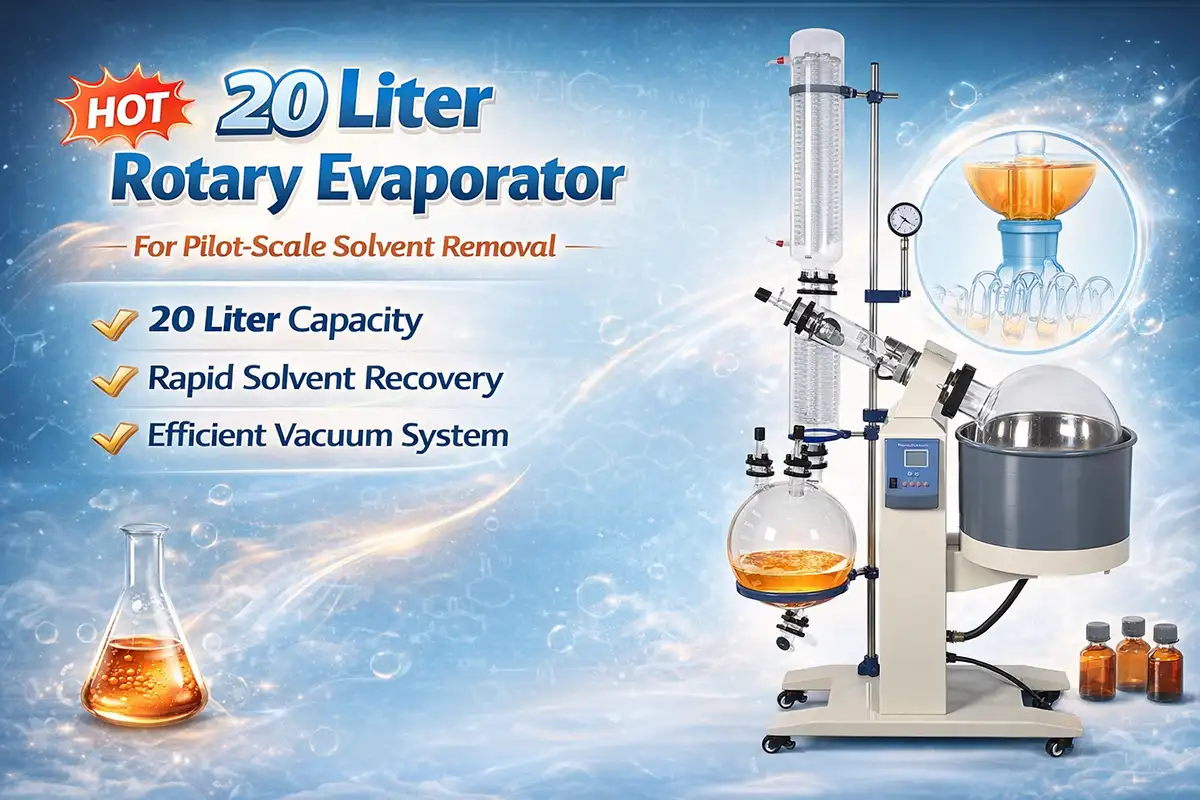
For a broader introduction to the equipment concept and what a “rotovap” does, see: What is a rotovap? This is useful when aligning team expectations between R&D, process engineers, and production.
2) Throughput basics: why vacuum and cooling decide real productivity
Many buyers focus on flask volume (20 L) and then ask, “How many liters per hour can it evaporate?” The important detail is that evaporation rate is not a single-number promise—it is a system result that depends on heat input (bath), pressure (vacuum), and condensing capacity (cooling).
A helpful, widely used reference point is the effect of vacuum on boiling point. According to NIST Chemistry WebBook data for water, the boiling point drops from 100 °C at 101.3 kPa to roughly ~33 °C at ~5 kPa (≈50 mbar). Lower boiling temperatures can protect heat-sensitive materials—but only if the condenser can actually capture the vapor.
Source reference: NIST Chemistry WebBook (thermophysical data; boiling point vs pressure behavior).
What “rated evaporation rate” usually assumes
Manufacturer specs often report evaporation rate in L/h of water under optimized conditions. In the provided parameters for a 20 L class unit (RE-2002), the evaporation rate is listed as >5 L/h (H2O). This is useful for comparison, but pilot users should mentally translate it into:
- Your solvent (ethanol, acetone, ethyl acetate, heptane…) has different latent heat and vapor behavior than water.
- Your vapor load might be limited by condenser temperature and coolant flow, not the bath heater.
- Your vacuum stability depends on pump type, vapor handling, and leaks.
If the spec says “>5 L/h,” should throughput planning use 5 L/h?
For conservative pilot scheduling, I recommend treating the headline number as a best-case ceiling. A more reliable approach is to plan at 50–70% of the water-rated figure until the exact solvent, target pressure, condenser temperature, and foam behavior are validated in the real process.
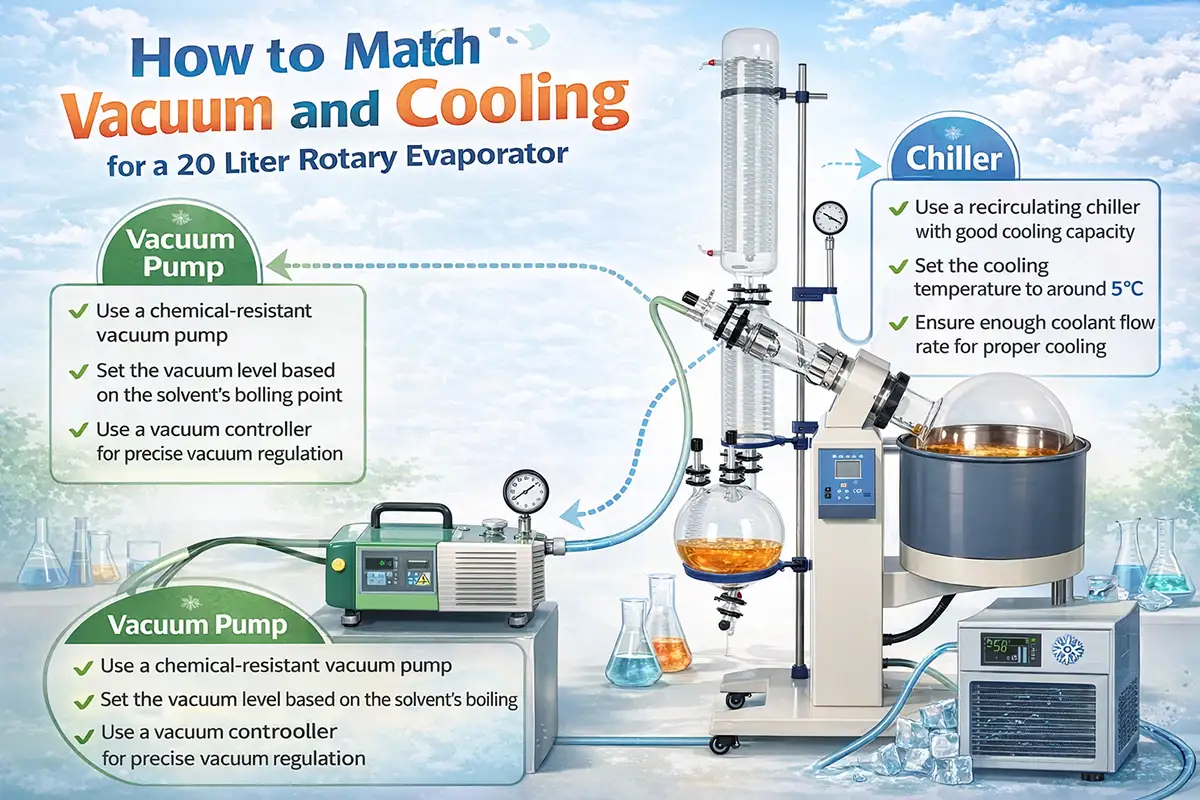
3) How to match vacuum and cooling to a 20 L pilot workload
A 20 liter rotary evaporator can only be as productive as the “utilities package” attached to it. Below is a plain-language way to size the support equipment so the system runs smoothly rather than “surging” (rapid boiling, condenser overload, unstable vacuum).
Step A: Decide the operating pressure range (not just “maximum vacuum”)
The spec for the 20 L class unit shows a maximum vacuum degree around <133 Pa (≈1.33 mbar). That is an ultimate vacuum number, but pilot work usually targets a stable operating range, for example:
- High-vacuum (low temperature) operation for heat-sensitive compounds: requires a pump that maintains low pressure under vapor load.
- Moderate vacuum operation for robust solvents/products: easier stability, often higher vapor throughput when condenser is strong.
If vacuum pump selection is a current decision point, this internal guide can help clarify pump behavior and selection tradeoffs: Rotovap vacuum pump: everything you need to know.
Step B: Size cooling for vapor capture (condenser temperature + chiller power)
The provided 20 L model uses a vertical double condenser. That design increases surface area, but surface area alone is not enough—coolant temperature and flow rate decide how much vapor becomes liquid instead of passing into the pump.
Step C: Match bath power to the intended evaporation rate
For the 20 L class parameters, the water/oil bath power is listed as 5000 W. That is enough to drive a strong evaporation rate—but only if vacuum and cooling keep up. If the bath is powerful but the condenser is weak, the system often “boils hard” and then stalls as vapor backs up.
Should the coldest possible coolant always be used to maximize throughput?
Not always. Extremely cold coolant can be useful for very volatile solvents, but it may also increase icing risk (when moisture is present), raise energy use, and sometimes reduce process control (too aggressive condensation while foaming). In my view, the best practice is to set coolant temperature just low enough to fully condense vapor at the chosen vacuum level, then optimize rotation speed and bath temperature for smooth boiling.
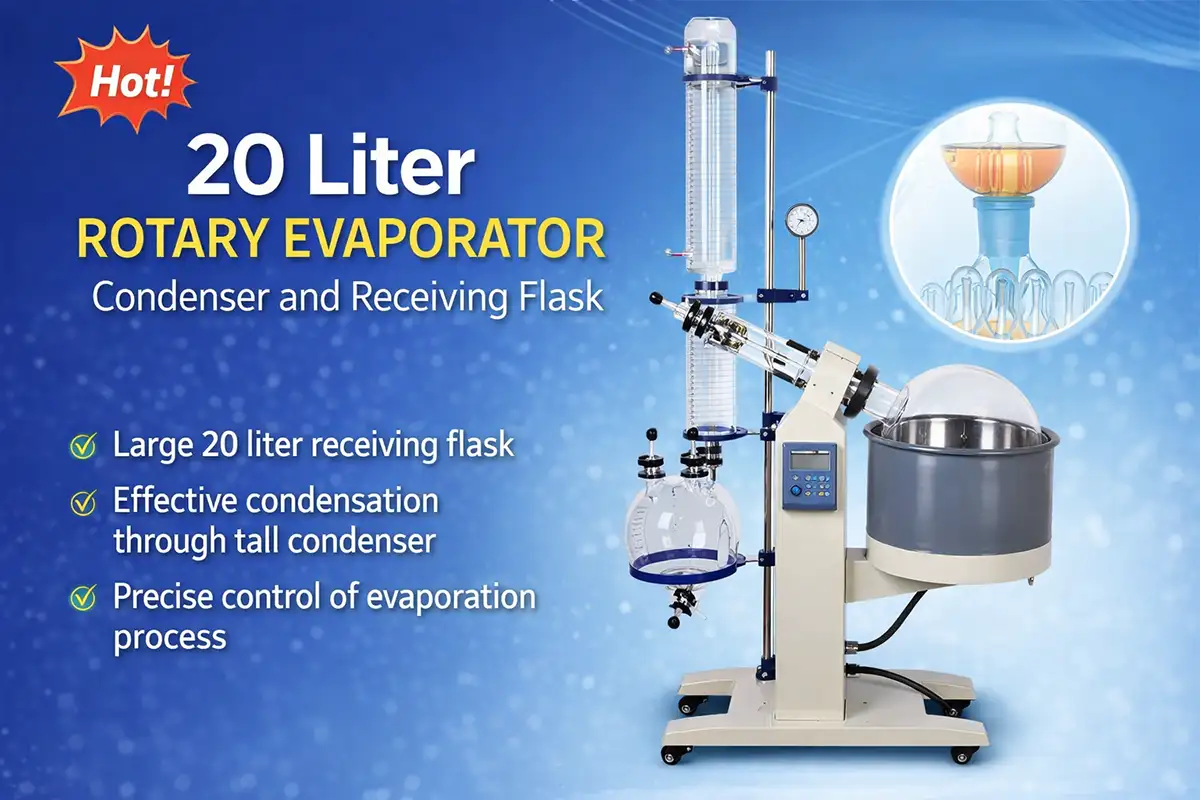
4) 20 L configuration reference (from the provided parameters)
The table below summarizes the key parameters users usually ask about when evaluating a 20 liter rotary evaporator for pilot use, including the parts that impact throughput matching (bath power, rotation, condenser type, and water-rated evaporation rate).
| Item | 20 L Class Value (RE-2002) | Why it matters in pilot scale |
|---|---|---|
| Evaporating flask | 20 L | Batch size ceiling; practical fill is often below max for anti-bump margin. |
| Receiving flask | 10 L | Impacts how often solvent must be drained during long runs. |
| Rotation speed | 0–90 rpm | Controls film formation; better film = better heat transfer, less bumping. |
| Rotating motor | 250 W | Torque reserve helps with higher-viscosity loads and stable rotation. |
| Bath power | 5000 W | Heat input that drives vapor generation; must be balanced with condenser capacity. |
| Temperature range | RT to 99 °C (250 °C option noted) | Defines usable solvent set; oil bath extends range for higher boiling solvents. |
| Temperature stability | ±1 °C | Helps repeatability between pilot batches and method transfer. |
| Evaporation rate (water) | >5 L/h (H2O) | Benchmark only; real rate depends on solvent, vacuum, and cooling. |
| Condenser | Vertical double condenser | Higher surface area supports higher vapor loads—if coolant is strong enough. |
| Lifting mode / height | Manual bath lift / 0–220 mm | Safety and handling convenience, especially when foaming starts. |
| Sealing mode | PTFE + fluoro rubber sealing | Vacuum integrity and chemical compatibility; leaks directly reduce throughput. |
If a product page is needed for fast comparison or to request a quotation, the internal listing is here: 20L rotary evaporator.
5) Common mismatches that quietly kill capacity (and how to avoid them)
-
Ultimate vacuum overvalued, operating vacuum ignored.
A pump may reach a low ultimate pressure on an empty system, but under real vapor load the pressure rises and becomes unstable. Throughput planning should use the working pressure range the pump can hold while condensing properly. -
Chiller chosen by temperature only, not by heat removal.
A chiller that can reach very low temperatures may still be too small in cooling power (and/or flow). If the condenser is warm and vapor reaches the pump, productivity drops and solvent loss increases. -
Overfilling the 20 L flask to “go faster.”
Higher fill often increases bumping and foam, forcing the operator to lower bath temperature or raise pressure—both reduce net throughput. In pilot work, steadiness usually beats aggressive settings.
Conclusion: choosing a 20 liter rotary evaporator is really choosing a complete evaporation system
A 20 liter rotary evaporator is a strong pilot-scale tool when the goal is flexible, repeatable solvent removal: extract concentration, solvent swaps, reaction workups, and solvent recovery. But capacity is not dictated by flask size alone. The real limiter is whether vacuum stability and condenser cooling can keep up with the bath-driven vapor load.