




Price can be tempting, but freeze-drying is physics: water must sublimate, and that only happens reliably when temperature control, deep vacuum, and a strong cold trap work together. This guide explains what matters (and what doesn’t), in plain English—so buying decisions are based on performance, not marketing.
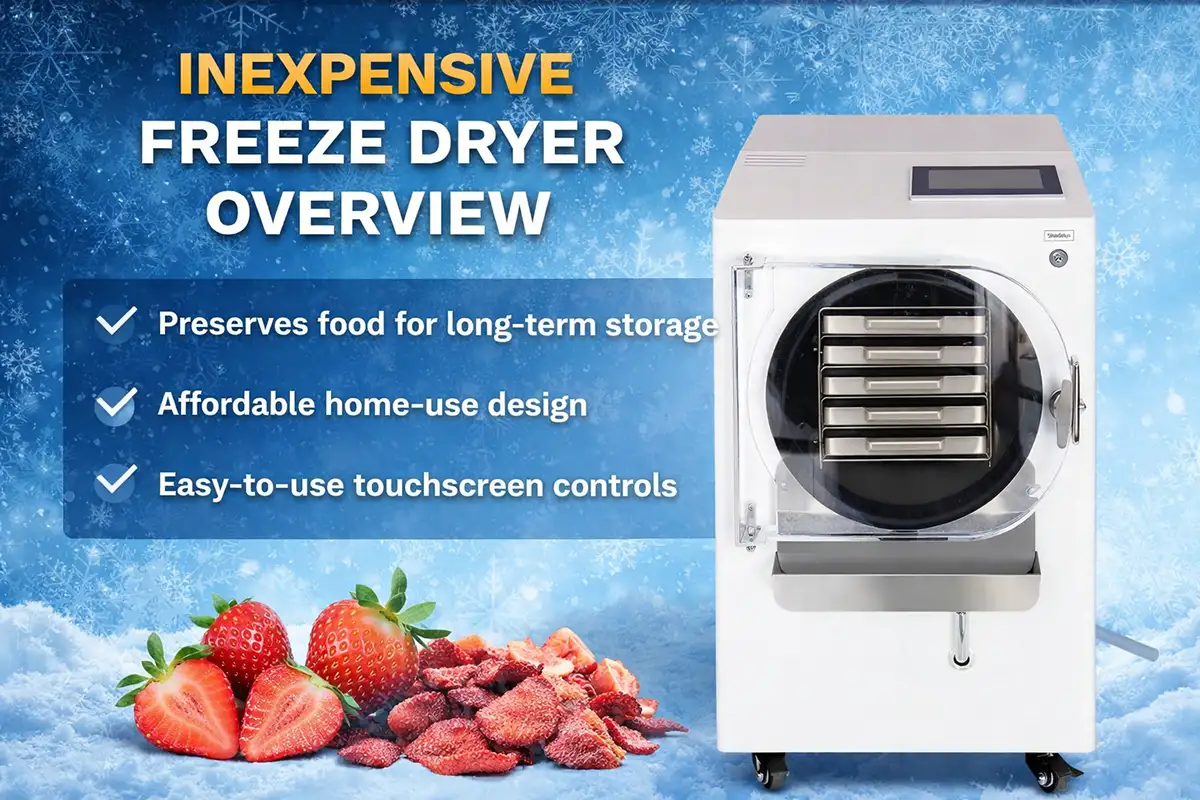
So, is a cheaper unit automatically a bad choice?
Not automatically. An inexpensive freeze dryer can still deliver excellent freeze-dried food, candy, or lab samples if it hits the right performance targets: cold enough condenser (cold trap), stable shelf temperature control, and deep, stable vacuum. What usually goes wrong in ultra-low-cost machines is not “freeze drying” itself—it’s inconsistent control that causes uneven drying, long cycles, or partial thawing.
The 3 specs that actually determine freeze-drying performance
Many listings highlight capacity or tray count, but real freeze-drying quality is mainly determined by these three: temperature (shelf), vacuum (Pa), and cold trap temperature. The goal is simple: keep water frozen while encouraging it to sublimate and then capture the vapor as ice in the condenser.
1) Shelf temperature range & control (freezing + drying + final dry)
Shelf temperature is how the machine “pushes” energy into the product. Too warm too fast can cause collapse (soft, shrunken structure) or melt-back (thawing during drying). Too cold for too long makes cycles slow and inefficient. A practical range like -35°C to +80°C supports both careful primary drying and effective final drying.
2) Vacuum level (how easily ice can sublimate)
Vacuum reduces pressure so ice can transition directly to vapor. In spec sheets, vacuum is often shown in Pa (Pascal). Lower is better (deeper vacuum), but stability matters too. A machine capable of ≤5 Pa is already in “serious freeze-drying” territory for many applications, especially when paired with a sufficiently cold condenser.
3) Cold trap (condenser) temperature (protects vacuum + captures vapor)
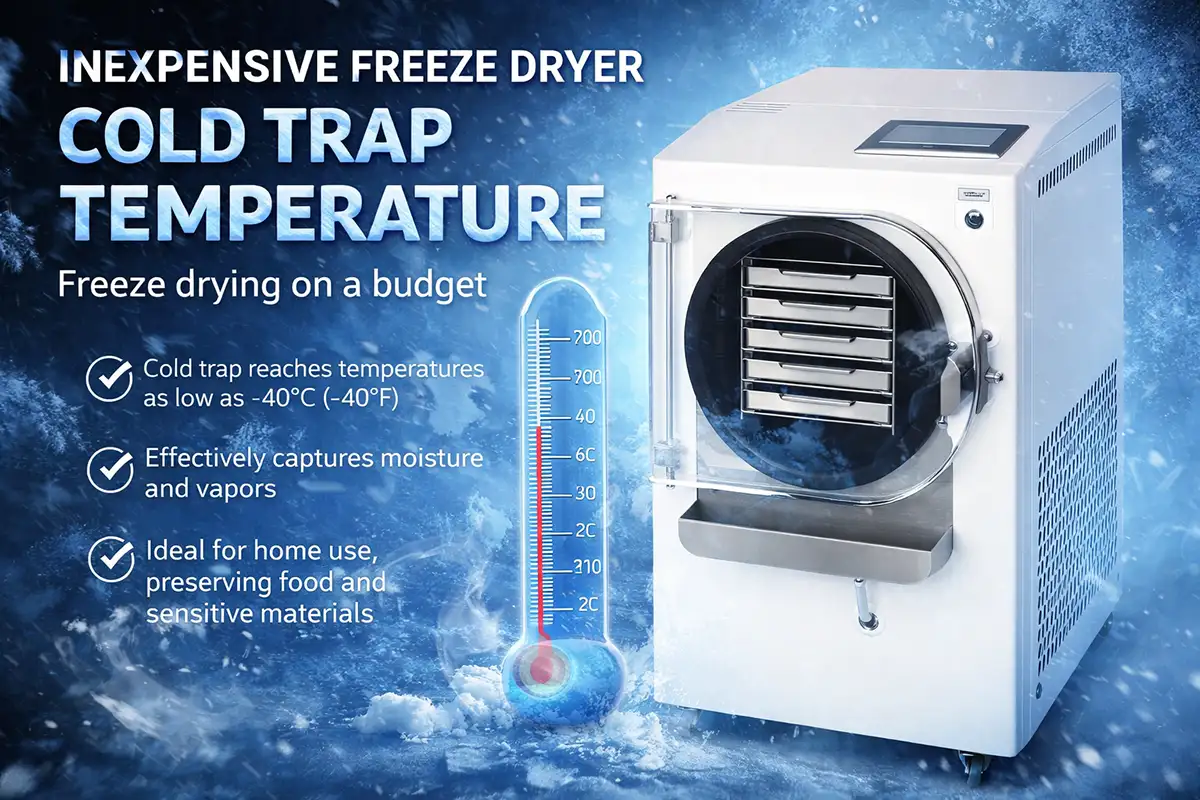
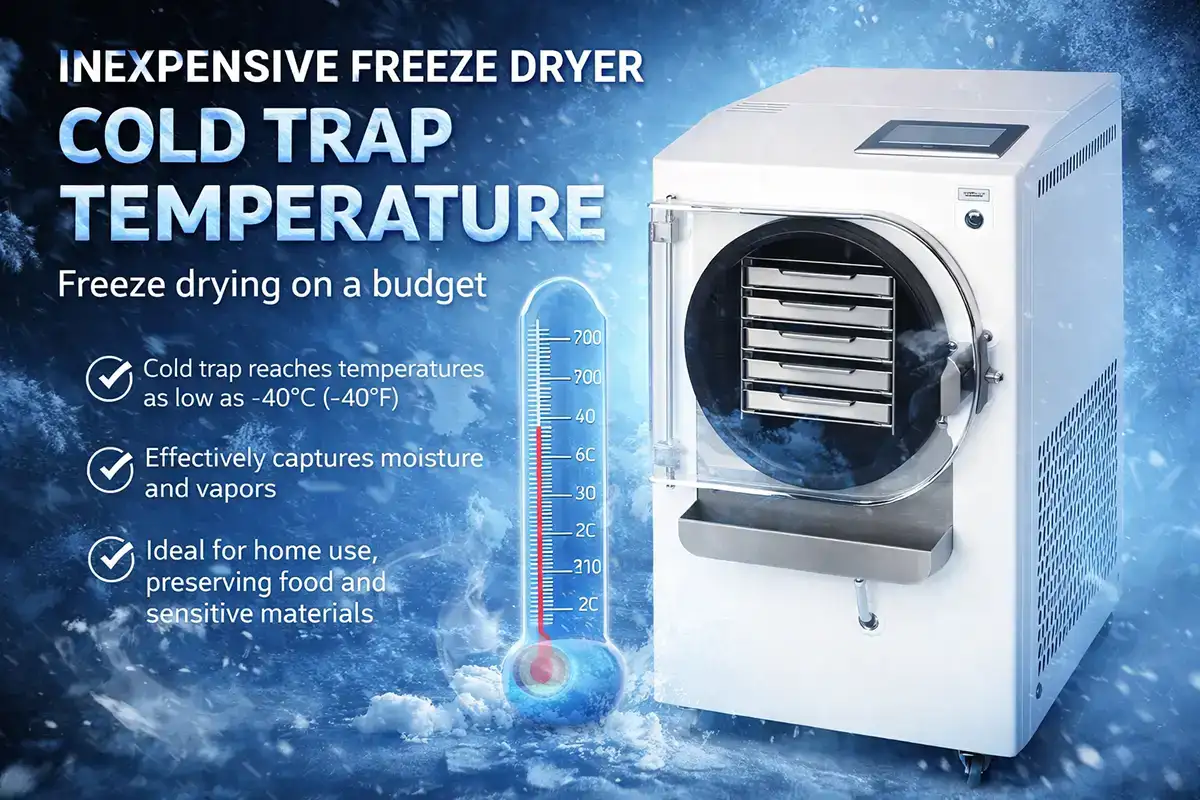
The cold trap is the “water vapor catcher.” If it isn’t cold enough, vapor won’t condense efficiently, vacuum becomes unstable, and drying slows or fails. A cold trap around -60°C is a strong indicator that the condenser can keep up with typical moisture loads.
Want real-world context? Read the practical walkthrough on candy freeze drying: how to freeze dry candy using a machine. It highlights why vacuum stability and condenser strength often matter more than “tray count.”
Which spec fails first in “too cheap” units?
If a freeze dryer seems inexpensive, which specification is most likely to be the hidden weak point: vacuum, shelf temperature, or cold trap?
Most often, it’s the system balance—but the cold trap and vacuum are common bottlenecks. A machine may claim deep vacuum, yet struggle to maintain it if the condenser can’t capture vapor fast enough, or if leakage/pump performance is marginal. In practice, a strong cold trap temperature spec (for example, -60°C) paired with a real vacuum spec (like ≤5 Pa) is a reassuring combination.
Example parameters (5 kg class) and what they mean
Below is a clear set of parameters from a 5 kg freeze dryer configuration. The point isn’t the model name— it’s how the three key specs appear together and support consistent freeze-drying performance.
| Parameter | Value | Why it matters |
|---|---|---|
| Process capacity | 5 kg | How much wet product can be processed per batch (varies by food type). |
| Cold trap temperature | -60°C | Colder condenser captures more vapor, stabilizes vacuum, speeds drying. |
| Tray (shelf) temperature | -35°C to 80°C | Supports freezing, controlled primary drying, and final drying to low moisture. |
| Vacuum | ≤5 Pa | Deep vacuum helps ice sublimate efficiently; stability prevents melt-back. |
| Freeze-dried area | 0.51 m² | Affects how thinly product can be spread (thinner = faster, more uniform). |
| Tray count / size | 5 trays / 499×205×25 mm | More trays can help throughput, but only if vacuum + condenser can keep up. |
| Ice condensation capacity | 5 kg | Indicates how much water the condenser can capture as ice during a run. |
| Power / heating | 1200 W / Electric heating | Heating power supports controlled energy input; too little can prolong cycles. |
| Overall dimensions | 588×470×760 mm | Important for installation and ventilation clearance. |
| Net weight | 90 kg | Heavier units often imply stronger refrigeration/vacuum structure (not a rule, but common). |
For broader buying context and typical price logic, see: why freeze dryers can be expensive.
Is “lower temperature” always better?
If a cold trap is advertised as extremely low temperature, does that automatically guarantee better freeze-drying?
Not automatically. A colder condenser helps, but only if the system also has enough condensing capacity and a vacuum system that can maintain deep pressure during high vapor flow. Freeze drying is a chain: if vacuum leaks or shelf control is unstable, a very cold trap alone cannot prevent product collapse or uneven dryness.
A simple buying checklist for an inexpensive freeze dryer
- Cold trap temperature: aim for a clearly stated condenser spec (e.g., around -60°C for many food/candy uses).
- Vacuum spec in Pa: look for deep vacuum (e.g., ≤5 Pa) and ask whether it’s stable under load.
- Shelf temperature range: a wide, controllable range (e.g., -35°C to 80°C) supports both primary and final drying.
- Condensing capacity: check ice capture capacity vs. expected water removal per batch.
- Usable area vs. capacity claims: area (m²) often predicts uniformity better than “kg” alone.
Planning to freeze-dry fruit at home as well? This guide is a helpful next read: freeze drying fruits at home.
What should be prioritized first?
When choosing between two similarly sized machines, what should be prioritized first for better results: more trays, lower vacuum number, or colder trap?
Prioritize the core drying engine—vacuum and cold trap—before adding trays. More trays only help if the condenser can capture vapor and the pump can hold deep vacuum during peak sublimation. When vacuum (Pa) and trap temperature are both strong, shelf temperature control becomes the tool to optimize texture and cycle time.
Summary: An inexpensive freeze dryer is worth buying when it clearly delivers deep stable vacuum, a cold/strong condenser, and controlled shelf temperatures. Those three specs decide freeze-drying success far more than marketing claims.