




Stainless Steel Jacketed Reactor for Cosmetics Manufacturing Lines
A stainless steel jacketed reactor helps cosmetics manufacturers heat, cool, mix, dissolve, disperse, and react ingredients in one controlled vessel. For creams, lotions, gels, serums, essential oil blends, botanical extracts, wax phases, and pilot batches, the right reactor can make production more stable, cleaner, and easier to scale.
Why cosmetics lines use a jacketed stainless steel reactor
Cosmetic formulas often depend on temperature control. A lotion may need the oil phase warmed so waxes melt smoothly. A gel may need steady mixing while polymers hydrate. A serum may need low-temperature blending to protect heat-sensitive actives. A stainless steel jacketed reactor is built for exactly this type of controlled processing. The inner vessel holds the product, while the outer jacket connects to a heating or cooling circulator. This lets operators raise or lower product temperature without direct flame, hot spots, or uneven heating.
For many cosmetic factories, stainless steel is preferred because it is strong, easy to clean, and suitable for repeated production. ZZKD stainless steel reactors are available with SUS304 or SUS316 material options, depending on the formula. SUS304 is widely used for general mixing and heating. SUS316 is a stronger choice when formulas contain salts, acids, alcohols, plant extracts, or more demanding ingredients. If your cosmetic line handles premium active ingredients or formulas that are difficult to clean, choosing the better contact material can reduce long-term risk.
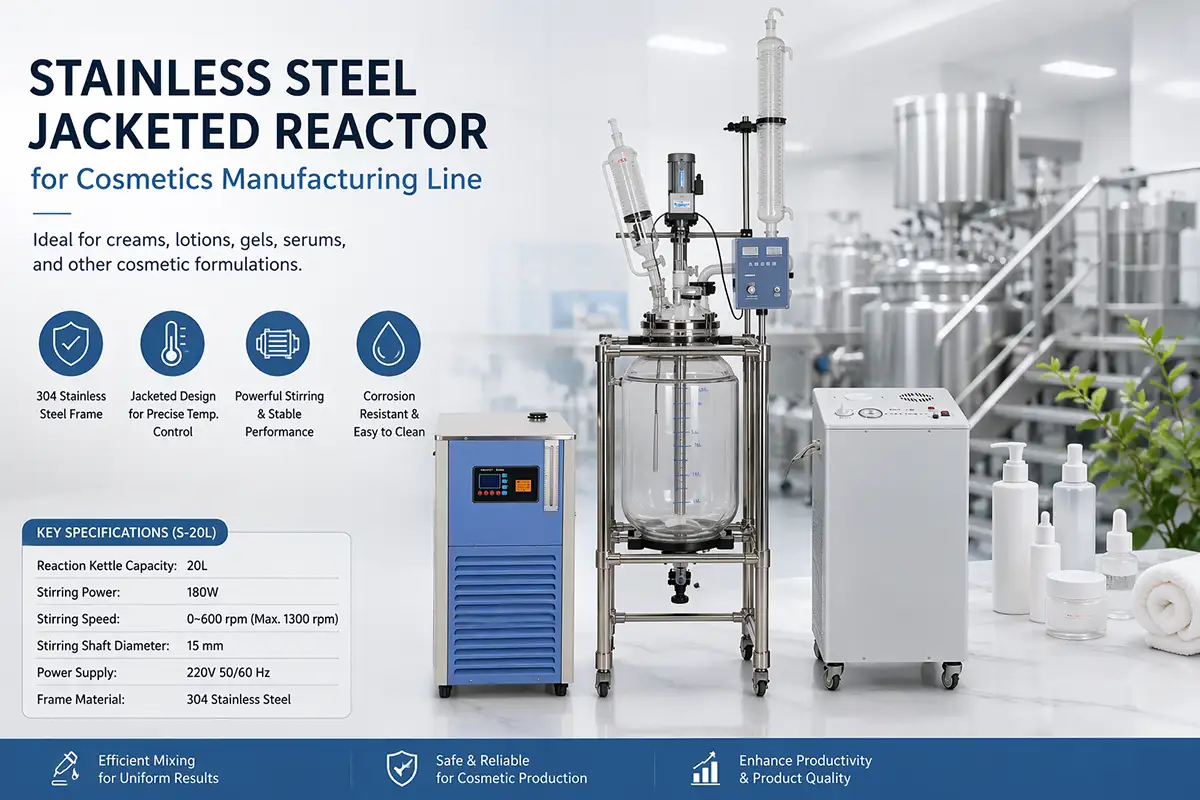
ZZKD stainless steel jacketed reactor used for cosmetic cream, lotion, and serum production.
Another reason cosmetics teams like jacketed reactors is flexibility. The same vessel can support heating, cooling, vacuum operation, condensation reflux, ingredient feeding, pressure observation, and bottom discharge, depending on the model and configuration. For buyers comparing stainless steel jacketed reactor options, the most important question is not only the tank size. It is whether the reactor can match the process temperature, mixing speed, material compatibility, cleaning method, and batch size of the product line.
What should buyers check before choosing a cosmetics reactor?
A cosmetics reactor should be selected around the real formula, not only around the advertised capacity. A light toner, a thick body butter, and a wax-rich balm do not behave the same way inside the vessel. Before ordering, prepare the batch volume, viscosity, target heating temperature, cooling requirement, ingredient sensitivity, and discharge method. This helps the supplier recommend the correct motor power, stirring structure, seal type, port layout, and stainless steel grade.
- Capacity and working volumeChoose a model that gives enough headspace for mixing. For example, a 20L reactor is not always ideal for a full 20L cosmetic batch if the product foams or becomes thick during heating.
- Jacket heating and coolingThe jacket should connect to a suitable circulator, heater, or chiller. ZZKD models include jacket volumes such as about 1.5L for 5L, about 5L for 20L, about 15L for 50L, and about 20L for 100L units.
- Stirring speedMany ZZKD stainless steel models support 0-600 rpm frequency conversion speed control. This is useful when a formula starts thin, then becomes thicker as emulsifiers, waxes, gums, or powders are added.
- Sealing and vacuumMechanical sealing helps reduce leakage and supports vacuum-assisted processing. The ZZKD 5L stainless steel reactor lists a vacuum range of -0.098 MPa to 0.5 MPa, while larger series models list working pressure from -0.1 MPa to 0.5 MPa.
- Ports and observationCosmetics production often needs material addition, temperature measurement, pressure display, reflux or condensation, and visual checking. Multi-port lids are useful for these routine operations.
ZZKD stainless steel reactor specifications for cosmetic production
ZZKD offers lab, pilot, and small production stainless steel jacketed reactors that can support cosmetic R&D and scale-up. The following table summarizes useful specification points from available ZZKD parameter sheets. Exact configuration should be confirmed based on the selected model and customization needs.
| Model | Typical Use | Material | Temperature / Pressure | Mixing | Notable Details |
|---|---|---|---|---|---|
| SS-5L | Lab samples, premium formula tests, small batches | 316 stainless steel reactor body, 304 frame and pipe | -100 to 250°C, vacuum -0.098 MPa to 0.5 MPa | 0-600 rpm, 120 W, frequency converter | 1.5L jacket, PT100 digital display, mechanical seal, ball quick discharge valve |
| SS-20L | Pilot batches, formula validation, boutique cosmetics | 304 stainless steel | Heating power 6 kW | 0-100 rpm, 550 W | 220V/50Hz single phase, 3 mm material thickness |
| SS-50L | Small production, pilot scale, repeated batch work | SUS304 or SUS316 | -100 to 299°C, -0.1 MPa to 0.5 MPa | 0-600 rpm, digital frequency conversion | About 15L jacket, double wall stainless steel, paddle stirring, optional 8 ports |
| SS-100L | Production line scale for creams, gels, lotions, and emulsions | SUS304 or SUS316 | -100 to 299°C, -0.1 MPa to 0.5 MPa | 0-600 rpm, digital frequency conversion | About 20L jacket, double wall structure, PTFE mechanical seal, sight glass and pressure gauge ports |
Simple rule: use 5L for testing, 20L for pilot batches, 50L for small production, and 100L when the cosmetic line needs more continuous output. If the formula is thick or sensitive, confirm stirring structure and temperature control before choosing only by volume.
How it supports creams, lotions, gels, and serums
In a cream or lotion process, the reactor can heat the oil phase, help dissolve waxes and emulsifiers, and maintain a stable temperature while the water phase is introduced. For a gel, the operator can add thickener slowly through a feeding port while the stirrer keeps the liquid moving. For plant extract or essential oil products, low-temperature circulation can help protect aroma and active compounds. For formulas that require air removal, vacuum operation helps reduce bubbles and improve the final texture.
A jacketed reactor is different from a simple mixing tank because it is designed for controlled thermal transfer. It can be paired with circulating oil, water, or glycol systems, depending on the temperature range. It is also different from a high-shear homogenizer. A reactor is excellent for batch heating, cooling, dissolving, reaction, and controlled stirring. A homogenizer is often used when the target is very fine emulsification or particle size reduction. In many cosmetics lines, both are useful: the reactor controls the batch environment, while a homogenizer improves texture. Buyers researching a vacuum homogenizer can compare it with a reactor to decide whether the line needs mixing only, homogenizing only, or a combined process.
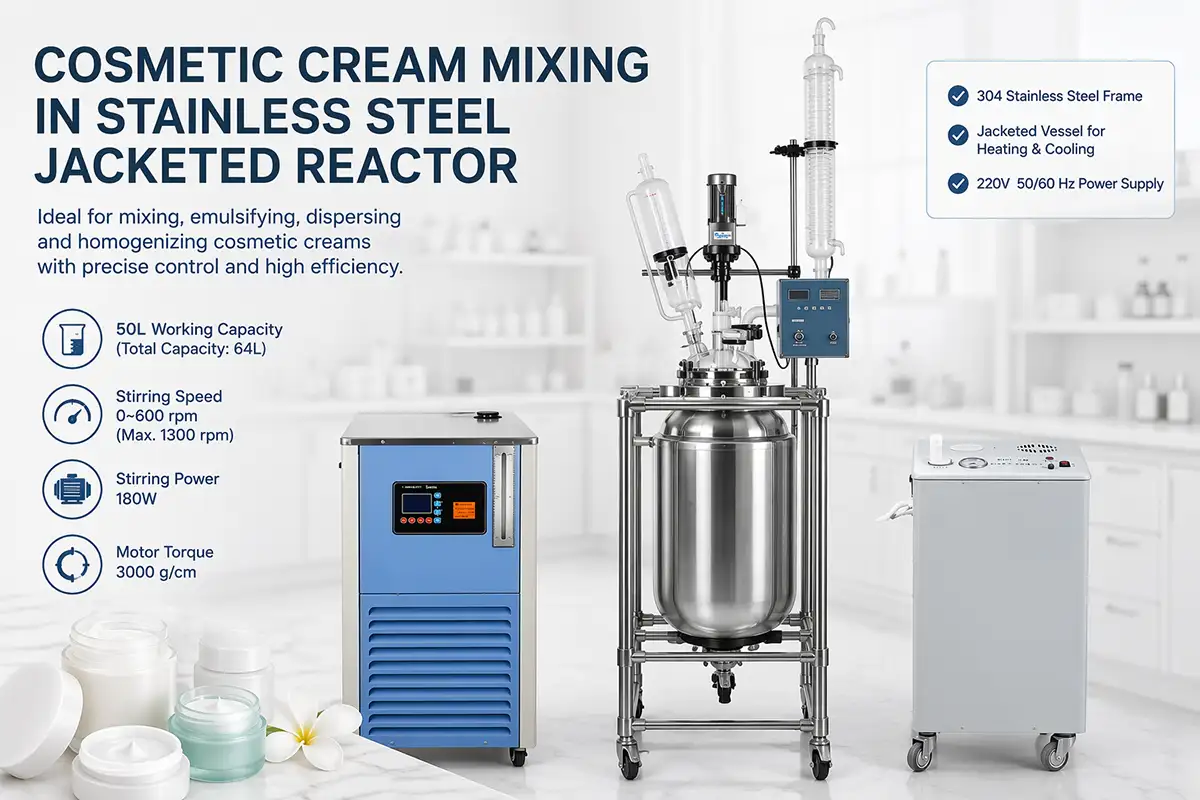
Cosmetic cream or lotion batch being heated, mixed, and processed in a stainless steel vessel.
Reference price range for ZZKD stainless steel jacketed reactors
Reactor price depends on volume, stainless steel grade, pressure design, condenser, port layout, control system, polishing, and customization. Based on the provided ZZKD product price sheet, the following prices can be used as practical references. Where one product line has multiple prices, the table uses a middle but relatively lower reference price rather than the highest value.
Suitable for lab formula development, ingredient tests, and small cosmetic samples.
Reference price: $1,485Suitable for pilot production, small-batch lotions, gels, and boutique product lines.
Reference price: $1,634Suitable for repeated pilot work or small production lines that need more output per batch.
Reference price: $2,042Listed range: $1,485-$3,500. A middle, lower-side reference is used for planning.
Reference price: $2,135Listed range: $3,300-$5,100. A lower-middle reference is used for budget discussion.
Reference price: $3,800Common buyer questions answered
Is a stainless steel jacketed reactor suitable for cosmetics manufacturing?
Yes. It is especially suitable when the cosmetic process needs controlled heating, cooling, stirring, vacuum operation, or a clean stainless steel vessel. It can be used for creams, lotions, gels, serums, wax blends, extraction-related processing, and pilot production.
Should I choose SUS304 or SUS316?
SUS304 is a good general choice for many cosmetic batches. SUS316 is better when the formula contains more aggressive ingredients, salts, acids, alcohol-based extracts, or expensive actives where contamination resistance matters more. For premium cosmetics or frequent formula changes, SUS316 contact parts are often worth considering.
What capacity should a cosmetics line start with?
For laboratory formula work, 5L is practical. For pilot work, 20L is often easier to manage. For small production, 50L gives more output while staying flexible. For a growing line that already has stable formulas and steady demand, 100L can reduce the number of batches per day.
Can the reactor make a finished emulsion by itself?
It depends on the formula. A stirred reactor can heat, mix, dissolve, and hold vacuum, but high-shear emulsification may require a homogenizer. For smooth creams and lotions, many manufacturers combine a jacketed reactor with a homogenizing step.
Why choose ZZKD for this type of reactor?
ZZKD provides stainless steel reactor models from small lab scale to larger production volumes, with useful options such as digital frequency speed control, double wall stainless steel structure, PTFE mechanical sealing, multiple lid ports, pressure indication, and SUS304/SUS316 material choices. You can also read more about the role of stainless steel chemical reactor equipment in modern production environments.
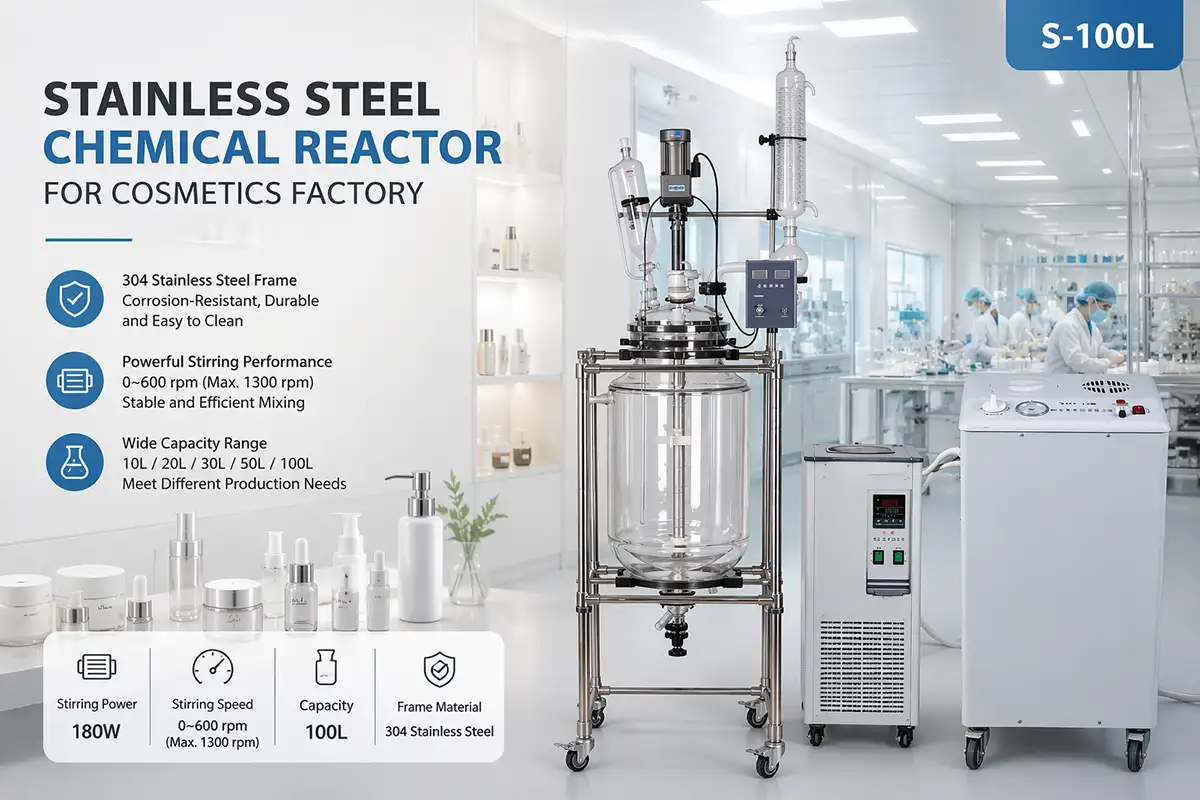
Finished ZZKD stainless steel reactor prepared for installation in a cosmetic production area.
Final recommendation
If your cosmetics manufacturing line needs stable heating, cooling, mixing, and cleaner batch control, a ZZKD stainless steel jacketed reactor is a strong choice. Start by matching the vessel size to your real working volume, then confirm material grade, stirring power, temperature range, vacuum needs, discharge method, and port configuration. For many buyers, the best path is to test the formula at 5L or 20L, then scale to 50L or 100L after the process is stable.
Practical buyer tip Share your formula viscosity, batch size, target temperature, and cleaning method before quotation. These details help avoid underpowered mixing, slow heat transfer, or a vessel that is difficult to clean during daily production.