




Short Path Distillation Systems for Solvent Purification and Recovery
Short path distillation is a practical way to clean, concentrate, and recover valuable solvents when a simple open-boiling process is too slow, too hot, or too wasteful. For laboratories, extraction rooms, universities, and pilot plants, ZZKD short path distillation systems offer a clear path from small tests to repeatable solvent recovery.
What Is a Short Path Distillation System?
A short path distillation system separates liquids by boiling point under vacuum. The vapor travels only a short distance from the boiling flask to the condenser and receiver, which reduces hold-up, lowers thermal stress, and helps the operator collect cleaner fractions. In solvent purification, this matters because many solvents are flammable, volatile, expensive, or sensitive to contamination.
For example, if a solvent has been used in extraction, washing, or reaction work, it may contain pigments, oils, water traces, polymers, residues, or heavier compounds. Instead of discarding the solvent after one use, a properly configured system can distill the usable fraction into a receiving flask. The result is cleaner recovered solvent, lower disposal volume, and better control over batch quality.
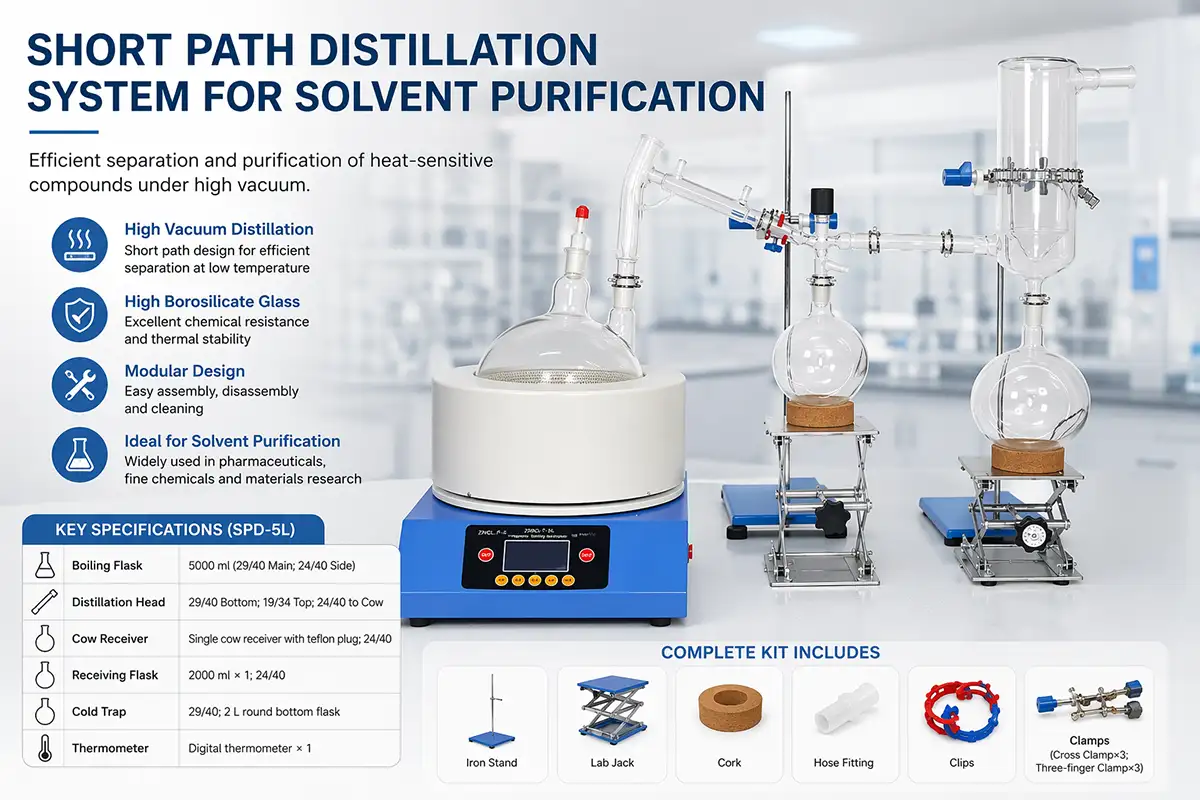
ZZKD offers common short path distillation kits such as SPD-2L, SPD-5L, SPD-10L, and SPD-20L. These systems usually include a digital heating mantle, two-neck boiling flask, short path distillation head, cow receiver, multiple round-bottom receiving flasks, Keck clips, stands, clamps, and, on larger configurations, accessories such as a cold trap, PTFE magnetic stirring bar, lifting platform, backing ring, and thermometer sensor.
Why Use Short Path Distillation for Solvent Recovery?
Many buyers ask whether short path distillation is only for essential oils, cannabinoids, or fine chemicals. The answer is no. It is also useful for solvent recovery when the recovered solvent needs better purity than basic evaporation can provide. A rotary evaporator is excellent for fast bulk removal, while short path distillation gives more control over fraction separation. If your process includes both bulk evaporation and final purification, these technologies can work together.
For a broader look at recovery workflow, ZZKD also explains how a solvent recovery system helps reduce solvent waste and improve reuse. Short path distillation fits naturally into that discussion because it helps separate usable solvent from higher-boiling residues in a compact glass system.
Cleaner recovered solvent
Fraction collection lets operators separate early, main, and late fractions instead of mixing everything into one container.
Gentler boiling under vacuum
Vacuum operation reduces boiling temperature, which is useful for heat-sensitive compounds and safer process control.
Less waste, more reuse
Recovering usable solvent can lower purchasing cost, reduce hazardous waste, and make daily lab work more predictable.
Which ZZKD Model Should You Choose?
The best system depends on your batch size, solvent type, residue load, and how often you run the process. A small laboratory testing new methods should not start with the same setup as a pilot plant recovering solvent every day.
| Model | Best For | Typical Included Parts | Practical Buying Note |
|---|---|---|---|
| SPD-2L | Small trials, teaching labs, early solvent purification tests | 2000 ml heating mantle, 2000 ml two-neck boiling flask, short path head, cow receiver, three 500 ml receiving flasks, clips, stand, clamp | Good when sample volume is limited and process learning matters more than throughput. |
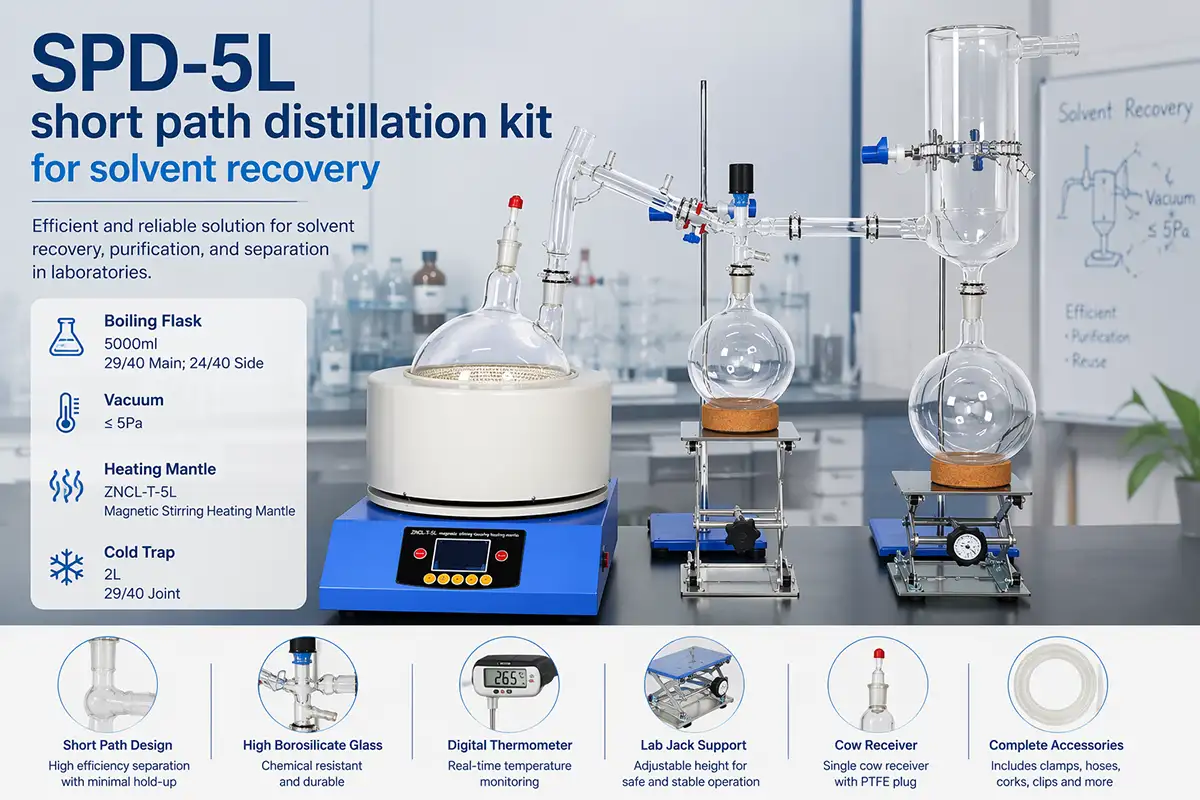
| SPD-5L | Routine lab batches and small production validation | 5000 ml heating mantle, 5000 ml two-neck boiling flask, short path head, cow receiver, three 1000 ml receiving flasks, cold trap, stirring bar, lifting platform, thermometer sensor | A balanced size for many labs; see the ZZKD 5L short path distillation kit for a relevant product page. |
| SPD-10L | Larger solvent batches, more frequent recovery work | 10000 ml heating mantle, 10000 ml two-neck boiling flask, short path head, cow receiver, three 2000 ml receiving flasks, clips, clamps, stand, cold trap | Useful when the 5L system is too slow but a 20L setup is not yet necessary. |
| SPD-20L | Pilot solvent recovery and higher-volume purification | 20000 ml heating mantle, 20000 ml two-neck boiling flask, short path head, cow receiver, three 3000 ml receiving flasks, clips, clamps, stand, cold trap | A stronger choice when daily recovery volume and operating time matter. |
How Much Does a Short Path Distillation System Cost?
Short path distillation price depends on capacity, glassware specification, vacuum pump, chiller, cold trap, heating and stirring package, receiving design, and whether the equipment is a standard glass short path kit or a molecular/wiped film distillation system. When one product style has several prices, a middle-lower reference price is usually more realistic than the very lowest listing, because the lowest price may exclude key accessories.
| System Type | Reference Capacity | Middle-Lower Price Reference | What It Usually Means |
|---|---|---|---|
| Entry glass short path kit | 2L | $475 | Suitable for basic lab purification, method testing, and small solvent batches. |
| Routine lab short path kit | 5L | $595 | A practical size for repeated lab use when accessories such as cold trap and stirring are needed. |
| Larger glass short path setup | 10L-20L | $1,300 | Better for higher volume solvent recovery or pilot process development. |
| Double or jacketed package | 10L-20L | $1,500 | Often selected when users need stronger temperature control or a more complete package. |
| Molecular or wiped film short path system | Lab or pilot | $25,000+ | Used for higher-value materials, continuous-style operation, or more demanding separation work. |
These prices are useful planning references, not a final quotation. The safest way to quote a ZZKD system is to confirm solvent type, batch volume, expected purity, vacuum level, condenser temperature, collection method, and whether the user already owns a vacuum pump or chiller.
How the Recovery Process Works
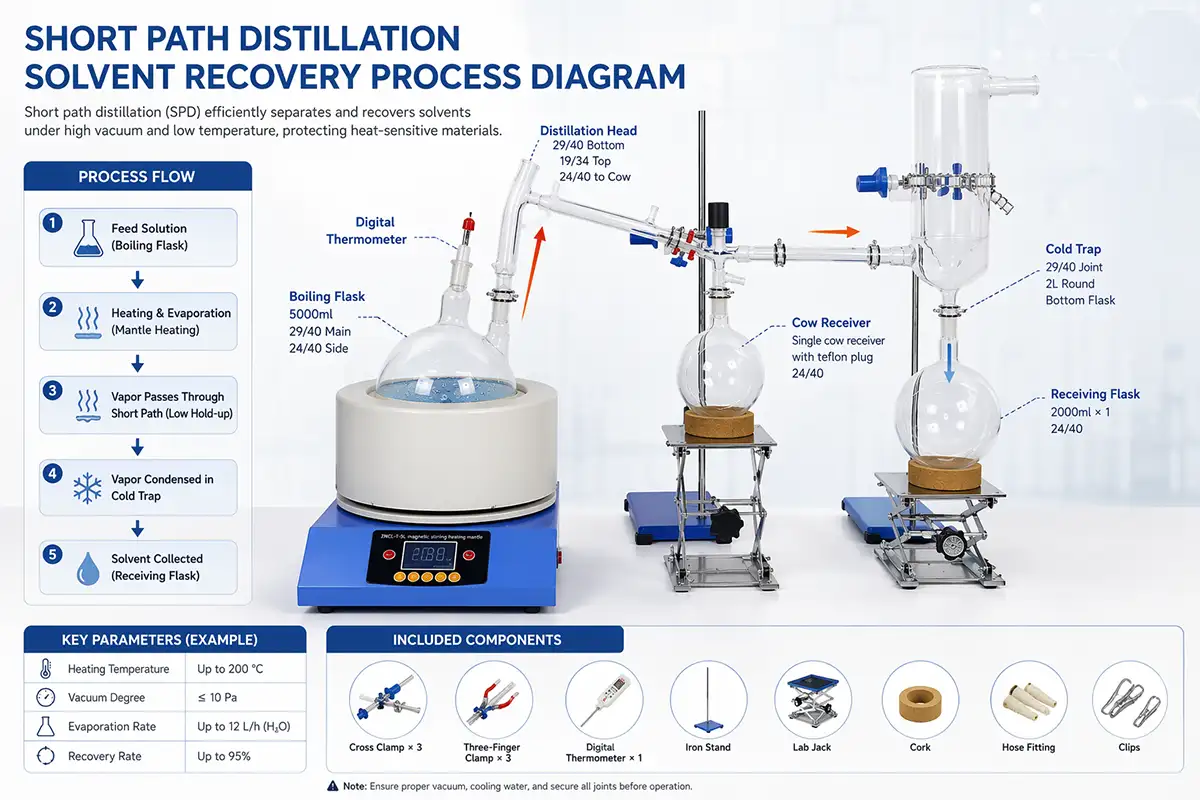
Short path solvent recovery is easy to understand if you think of it as controlled boiling and clean collection. The contaminated solvent is placed in the boiling flask. The vacuum pump reduces system pressure, so the solvent boils at a lower temperature. Vapor moves through the short path head, condenses, and flows into the receiver. Heavier residue remains in the boiling flask, while the operator collects usable fractions in separate flasks.
Prepare the feed
Filter visible solids if needed and avoid overfilling the boiling flask. A moderate fill level improves boiling behavior and reduces bumping.
Build stable vacuum
Check seals, glass joints, cold trap temperature, pump oil condition, and vacuum tubing before heating. Vacuum stability is one of the biggest factors in clean distillation.
Heat gradually
Raise temperature step by step. Sudden overheating can cause bumping, poor separation, and contamination of the receiving flask.
Collect fractions
Use the cow receiver to separate early heads, the main solvent fraction, and late residue-rich fractions. Label every flask for reuse decisions.
Check recovered quality
For critical reuse, test water content, odor, color, boiling behavior, or process-specific purity before returning recovered solvent to production.
Common Questions Buyers Ask
Does short path distillation remove solvents?
Yes, it can remove and recover many solvents by boiling point difference, especially under vacuum. It is often used when operators need better separation than basic evaporation. ZZKD has a related explanation of short-path distillation and solvent removal for readers who want a deeper answer.
Is it better than a rotary evaporator?
It depends on the goal. A rotary evaporator is great for fast bulk solvent removal from relatively clean material. A short path system is better when you need fraction collection, higher purity, or separation from heavier residues. Many labs use both.
Can recovered solvent be reused directly?
Sometimes yes, but it depends on your quality requirement. Technical cleaning solvent may be reused after simple checks, while pharmaceutical, food, electronic, or analytical applications may require stricter testing before reuse.
What solvents are common?
Users often recover ethanol, acetone, hexane, heptane, ethyl acetate, isopropanol, and similar process solvents. The correct setup depends on boiling point, flammability, residue type, and desired purity.
How to Specify a ZZKD System
Before choosing a system, prepare five pieces of information: solvent name, batch volume, contamination type, desired recovery rate, and whether the recovered solvent must meet a formal purity standard. This information helps match the boiling flask size, condenser capacity, vacuum pump, cold trap, and receiving flask volume.
For a first-time buyer, the SPD-2L is a low-risk way to prove the process. For routine lab work, the SPD-5L is often the more useful choice because it gives more working volume without becoming difficult to handle. For daily solvent recovery or pilot trials, SPD-10L and SPD-20L systems save time by processing larger batches. If your feed is viscous, valuable, heat-sensitive, or requires more advanced separation, a molecular or wiped film short path system may be the better direction.
Practical Safety and Maintenance Tips
Use a suitable cold trap
A cold trap protects the vacuum pump from solvent vapor. This is especially important for aggressive, volatile, or high-volume solvent recovery work.
Do not chase speed at the cost of purity
Higher heat can make distillation faster, but it may also pull impurities into the receiver. Stable vacuum and controlled temperature usually give better results.
Inspect glassware and joints
Small leaks can reduce vacuum, slow recovery, and make boiling unstable. Clean joints, proper clips, and careful assembly are simple but important.
Record each run
Track temperature, vacuum, feed amount, recovered amount, and fraction appearance. Good records make it easier to scale from 2L to 5L, 10L, or 20L.
Final Takeaway
A ZZKD short path distillation system is a strong choice when you need practical solvent purification and recovery in a compact laboratory or pilot-scale format. Choose SPD-2L for testing, SPD-5L for routine lab work, SPD-10L for heavier use, and SPD-20L for larger solvent batches. With the right vacuum pump, cold trap, condenser temperature, and collection method, short path distillation can turn contaminated solvent into a reusable resource while giving operators clearer control over purity, safety, and cost.