




What lab-scale spray dryer is suitable for universities?
A university spray dryer should support meaningful experiments without demanding industrial-scale sample volumes or excessive installation space. For departments working with compatible aqueous feeds, the SD-2L is a practical candidate: its specified water evaporation capacity is 1.5–2.0 L/h, its minimum feed quantity is 50 mL, and its temperature ranges allow a variety of experimental drying conditions.
Short answer: The SD-2L is worth considering for university teaching and small-batch research when sample compatibility, available utilities, powder collection needs, and laboratory safety requirements match the equipment configuration.
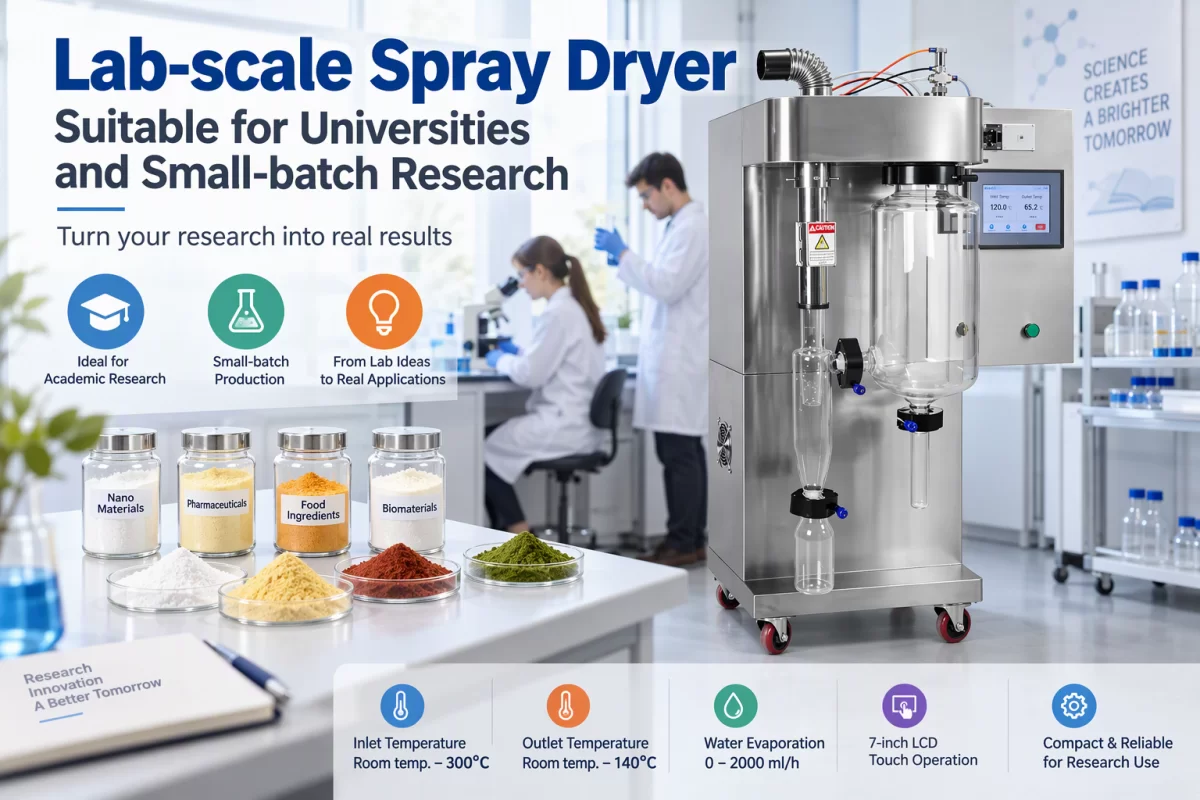
Why a small laboratory spray dryer makes sense
University laboratories usually prioritize experimental flexibility over continuous production. A food science project may compare carrier concentrations, while a materials laboratory may investigate how a suspension behaves during drying. Chemical engineering classes can use the same process to explore heat transfer, mass transfer, atomization, and powder recovery.
A smaller system helps keep sample preparation manageable. The SD-2L’s specified 50 mL minimum feed quantity is particularly relevant when a formulation is expensive or available only in limited amounts. However, this figure describes feed quantity, not guaranteed powder recovery. Tubing hold-up, chamber deposits, and collection losses can become significant during very small trials.
Is the largest drying capacity always the best choice for a university?
Alice’s answer: I would prioritize the typical experiment rather than the largest available machine. A 1.5–2.0 L/h water evaporation class can be a sensible starting point for teaching and formulation screening. Larger equipment becomes more appropriate when repeated pilot batches or higher powder output are central to the research program.
The laboratory scale spray dryer product page provides a relevant starting point for equipment inquiries. The requested quotation should identify the exact model and supplied accessories rather than relying only on a general product-family description.
SD-2L specifications for university planning
The following specifications provide a useful basis for evaluating laboratory fit. Rated capacities and control ranges should be interpreted as equipment specifications, not promises that every feed will dry successfully at every setting.
| Parameter | Specified value |
|---|---|
| Inlet air temperature control | 30–300 °C |
| Outlet temperature control | 30–150 °C |
| Water evaporation capacity | 1,500–2,000 mL/h |
| Maximum feed volume rate | 2,000 mL/h |
| Minimum feed quantity | 50 mL |
| Feeding method | Adjustable peristaltic pump |
| Average drying time | 1.0–1.5 seconds |
| Electric heater | 3.5 kW; AC 220 V, single-phase, grounded |
| Fan power | 0.55 kW |
| Maximum air volume | 5.6 m³/min |
| Maximum wind pressure | 1,020 Pa |
| Air compressor power | 1.2 kW |
| Maximum compressor gas production | 4.2 m³/h |
| Compressed air working pressure | 2–3 bar |
| Nozzle diameter | 1.00 mm |
| Dimensions: L × W × H | 600 × 700 × 1,200 mm |
| Equipment weight | 130 kg |
Capacity distinction: Water evaporation capacity is not dry powder output. Actual throughput depends on feed solids, viscosity, ambient conditions, operating temperatures, and collection efficiency. The specified drying time is also not the total duration of a batch.
Temperature and feeding flexibility support better experiments
Adjustable peristaltic feeding gives researchers a useful way to vary the liquid delivery rate. Together with drying-air conditions and atomization settings, feed rate influences droplet drying, residual moisture, and chamber deposition. A well-designed study changes one variable at a time or uses a documented experimental design.
The SD-2L lists inlet and outlet temperature control ranges of 30–300 °C and 30–150 °C, respectively. In practice, outlet temperature is linked to inlet conditions, airflow, and evaporative load. Procurement discussions should clarify how outlet temperature is regulated and whether the system can maintain the intended conditions for the specific feed.
Does a 30 °C temperature setting guarantee safe drying of heat-sensitive materials?
Alice’s answer: I would not treat the lower end of a control range as proof of effective low-temperature drying. Drying still requires sufficient heat and mass transfer. Sensitive formulations need trial results for moisture, activity retention, and recovery, and may require a different drying configuration.
For projects involving delicate extracts or sensitive ingredients, the guide to low temperature spray drying technology offers relevant background. A conventional laboratory spray dryer should not be assumed to include vacuum operation or specialized low-temperature capability unless those features are explicitly confirmed.
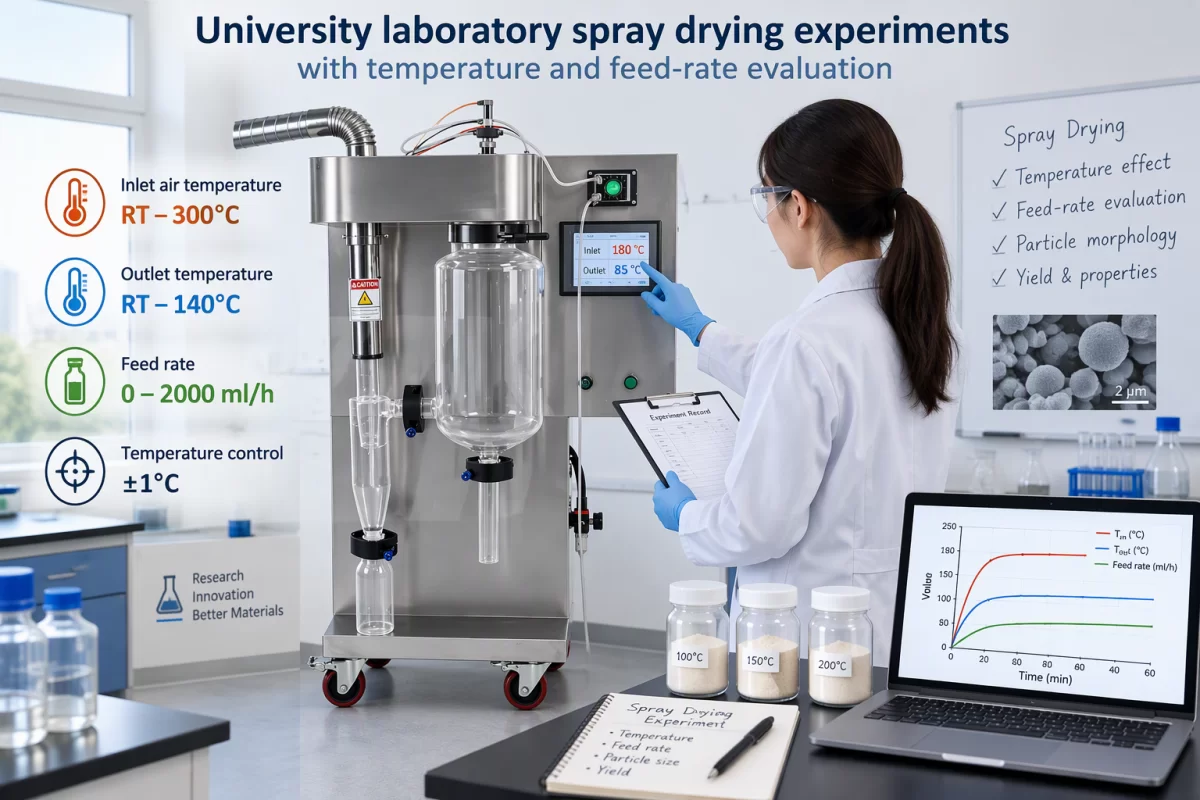
Academic applications worth evaluating
A suitable university lab-scale spray dryer can support several disciplines, provided that each feed is assessed before use. The most productive purchase is usually one linked to an established set of experiments rather than a broad list of possible applications.
- Food science: Evaluate compatible milk-based feeds, beverage formulations, and encapsulation carriers through moisture and reconstitution measurements.
- Chemical engineering: Demonstrate evaporative drying, operating-variable interactions, and material balances.
- Materials research: Screen suitable aqueous suspensions for powder formation, with attention to sedimentation, abrasion, and nozzle blockage.
- Formulation research: Investigate compatible aqueous model systems and compare recovery, morphology, and stability.
Meaningful comparisons require consistent sampling and analysis. Recording recovered powder mass, chamber deposits, residual moisture, and feed solids provides more insight than simply noting whether a powder was produced. The 1.00 mm nozzle specification should also be reviewed against particle size and viscosity; it does not establish the resulting powder particle size.
Check utilities, installation space, and safety before ordering
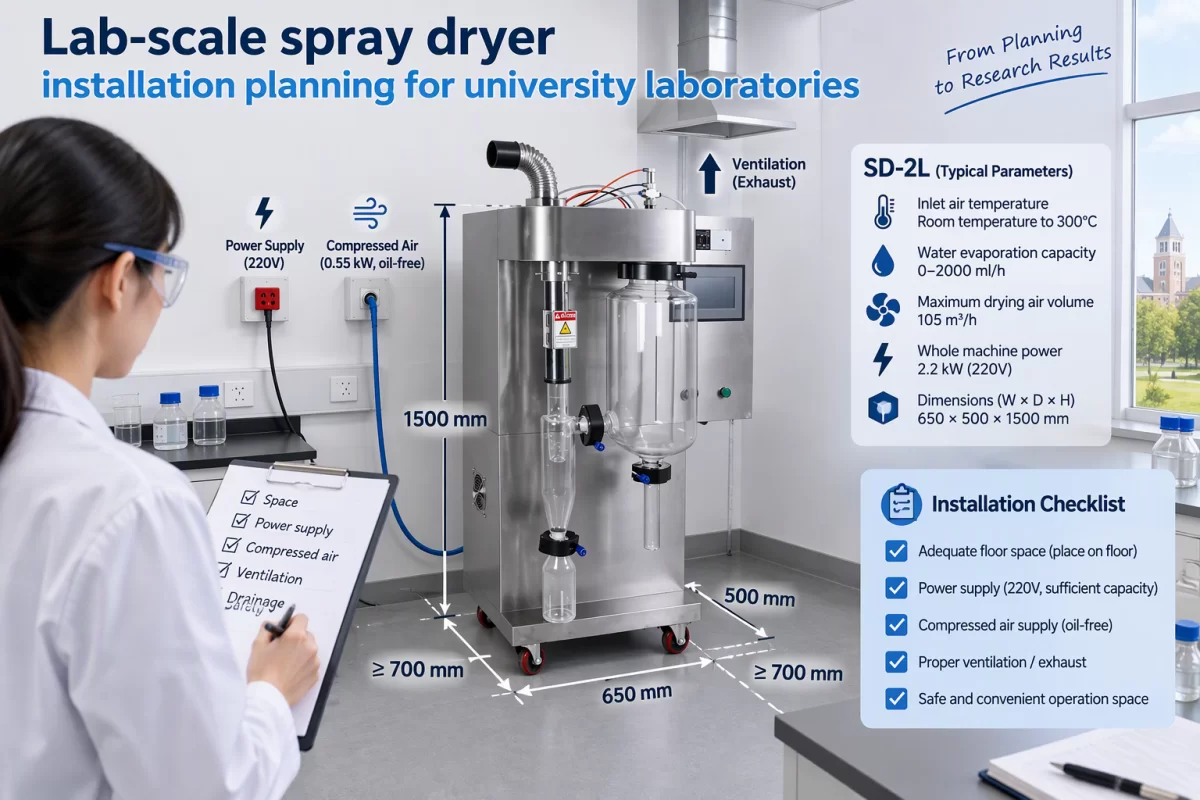
The SD-2L measures 600 × 700 × 1,200 mm and weighs 130 kg. Its relatively compact footprint does not make it suitable for an ordinary laboratory bench without a load assessment. Installation planning must include service clearance, access for cleaning, ventilation connections, and a safe delivery route.
The specification lists a 3.5 kW heater, a 0.55 kW fan, and a 1.2 kW compressor. These values total 5.25 kW of listed component power, but they are not a complete electrical installation rating. A facilities electrician should confirm the manufacturer’s total connected load, circuit protection, grounding, and local supply compatibility.
Safety boundary: The supplied SD-2L specifications do not establish explosion-proof certification, inert-gas operation, closed-loop solvent handling, or containment for hazardous powders. Flammable solvents must not be processed without an appropriately designed and verified system. All feeds require a laboratory risk assessment.
Which checks most strongly influence a successful university purchase?
Alice’s answer: I would confirm sample compatibility, verified installation requirements, and repeatable cleaning first. I would also request details about powder collection, operating safeguards, training, spare parts, and any data-recording features needed for the intended studies.
Company price reference and purchasing priorities
The supplied company price list includes a 2L Mini Spray Dryer Machine for Milk Powder Lab Scale Production at a single listed price of US$2,748. This offers a concrete reference for the company’s 2L product category, but it should not be treated as a confirmed quotation for the SD-2L configuration described above.
Reference equipment price only. Confirm the exact model, accessories, delivery charges, taxes, installation, and quotation validity before issuing a purchase order.
Universities should compare the complete project cost, including replacement tubing, nozzles, collection components, maintenance, and operator training. The pilot spray dryer price guide is relevant when considering whether future workloads justify moving beyond laboratory-scale equipment.
- Define typical feed composition, batch size, and required analytical sample quantity.
- Request a configuration-specific quotation and a written accessory list.
- Seek a representative feed trial with documented recovery and moisture results.
- Confirm electrical, ventilation, cleaning, and safety requirements with laboratory staff.
- Review warranty terms, spare-parts availability, and operator support.
A practical starting point for university spray drying
For universities evaluating compatible aqueous feeds, the SD-2L offers a useful combination of small-sample capability, adjustable feeding, broad specified temperature ranges, and a manageable equipment footprint. These characteristics make it a credible candidate for teaching demonstrations and early-stage formulation research.
My recommendation is to shortlist the SD-2L when the expected workload fits its 1.5–2.0 L/h water evaporation class, then validate the decision through a representative trial and a configuration-specific quotation. The right university spray dryer is not simply the smallest or most powerful option: it is the system that supports safe, repeatable experiments and fits the laboratory’s real research goals.