




Chemistry laboratory · Equipment buying guide
Where to buy rotary evaporator for chemistry laboratory?
Buying a rotary evaporator starts with matching the instrument to the laboratory’s solvent-removal work—not simply choosing the largest flask or the lowest advertised price. ZZKD Instrument’s website is a starting point for reviewing equipment options and preparing a configuration-specific inquiry.
Where to buy a laboratory rotary evaporator: start with the configuration
For a chemistry laboratory evaluating this product range, begin with the documented RE-201D, RE-301, and RE-501 models for smaller-scale work, or consider the R1005, R1010, R1020, and R1050 range when larger nominal flask capacities are needed. These families cover different capacity requirements; their specifications should not be treated as interchangeable.
A useful purchase inquiry identifies the solvent, expected batch volume, required concentration endpoint, available electrical supply, and cooling and vacuum arrangements. Ask for a written quotation naming the exact model and included components. This makes it easier to distinguish a rotary evaporator alone from a package that also includes a chiller, vacuum pump, or other accessories.
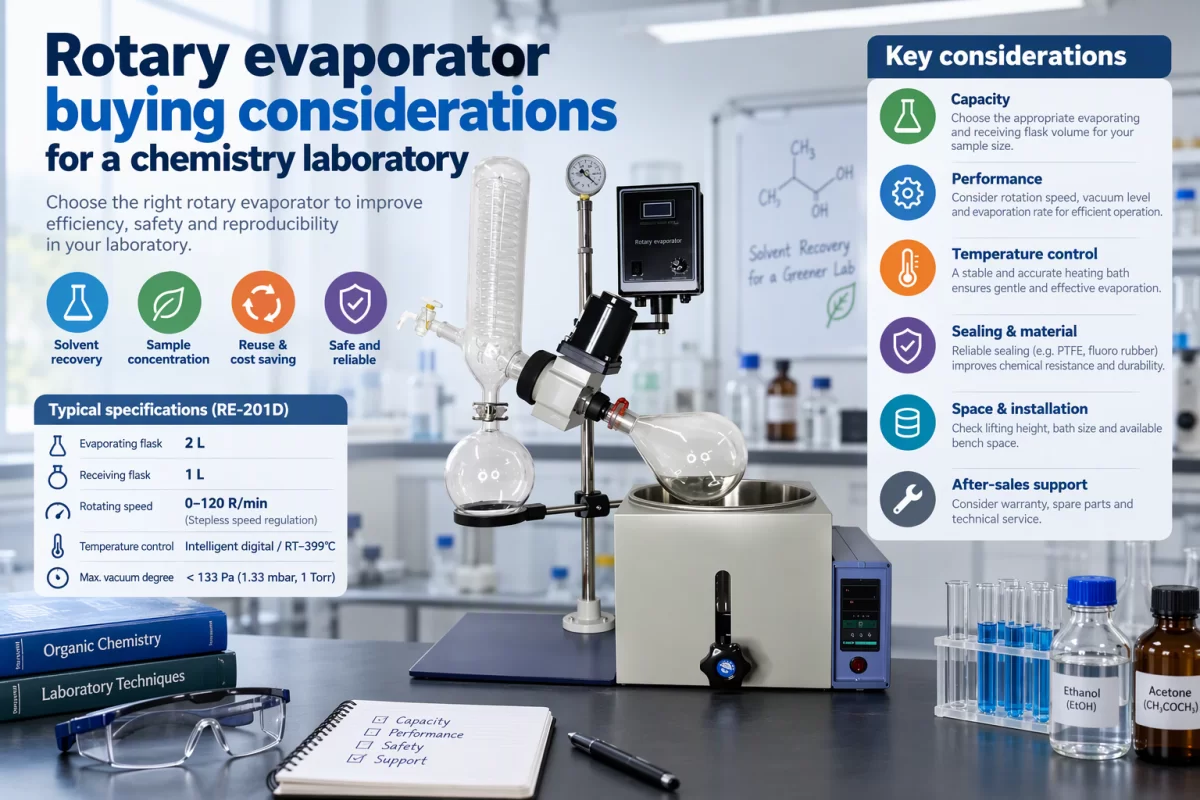
How rotary evaporation supports chemistry workflows
A rotary evaporator removes volatile solvent from a solution through controlled heating, flask rotation, and reduced pressure. Rotation spreads liquid over the flask’s inner surface, while the bath supplies heat. Lower pressure reduces the solvent’s boiling temperature. Vapor then passes into a cooled condenser, and condensed liquid collects in the receiving flask.
This process is useful for concentrating solutions after synthesis, reducing solvent volume during sample preparation, and concentrating solvent-based extracts. It can also collect condensed solvent for assessment before possible reuse. Recovered solvent is not automatically suitable for another experiment: purity, contamination, and the intended application still matter. For further background, see our explanation of how a rotovap works under vacuum.
Does a larger rotating flask always provide faster solvent removal?
Alice: I would not select equipment on flask capacity alone. Evaporation also depends on solvent properties, bath conditions, operating pressure, condenser cooling, and the amount of liquid loaded. A larger flask provides more nominal capacity, but it does not establish a guaranteed processing rate for every solvent.
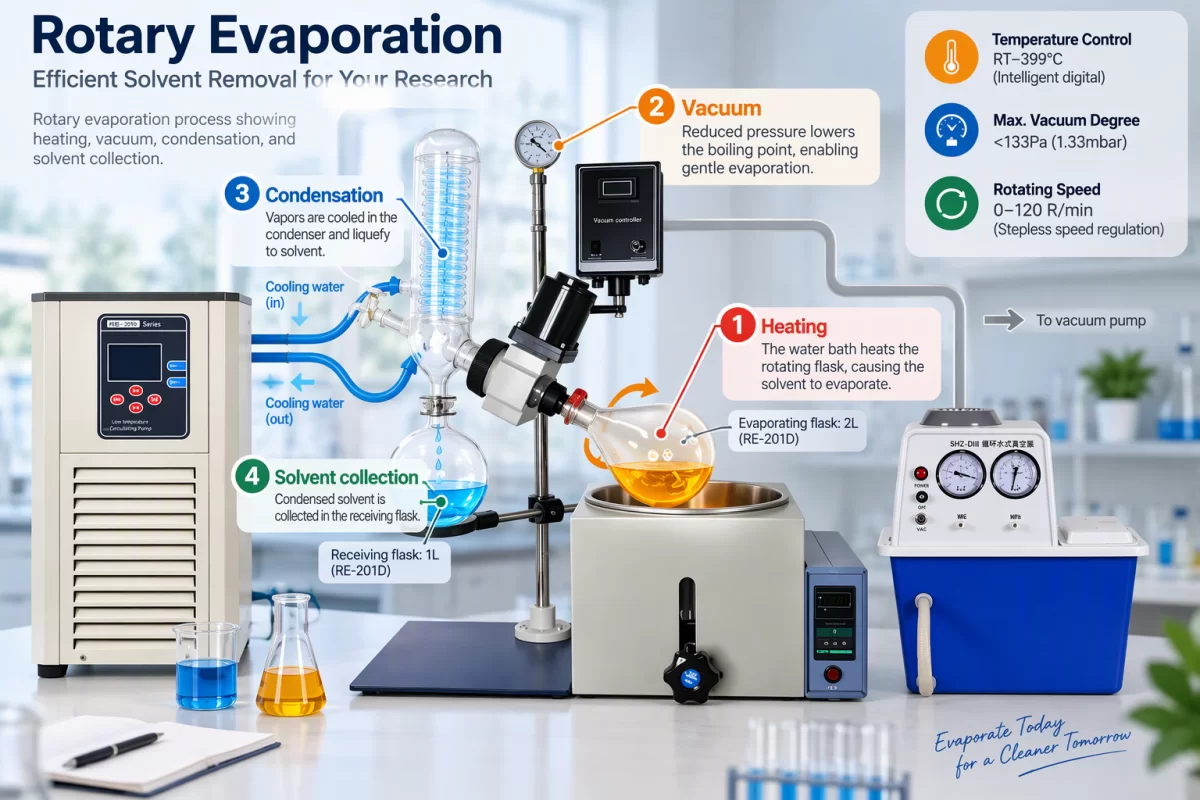
RE-series rotary evaporator specifications for smaller batches
The supplied RE-series technical sheet identifies three flask-capacity combinations. The comparison below uses clearly stated model data, keeping units visible for laboratory purchasing decisions.
| Parameter | RE-201D | RE-301 | RE-501 |
|---|---|---|---|
| Evaporating flask (L) | 2 | 3 | 5 |
| Receiving flask (L) | 1 | 2 | 3 |
| Rotating motor (W) | 40 | 40 | 40 |
| Rotating speed (r/min) | 0–120 | 0–120 | 0–120 |
| Listed water evaporation rate (L/h) | >1 | >1.5 | >1.5 |
| Lifting height (mm) | 0–150 | 0–120 | 0–120 |
The sheet describes stepless speed regulation and intelligent digital temperature control, with a listed range of room temperature to 399°C. It labels the temperature resolution as ±2°C; that wording should not be reinterpreted as a verified temperature-accuracy specification. The listed maximum vacuum figure is below 133 Pa, but actual operating pressure depends on the assembled system and process conditions.
The source lists sealing materials as “FTFE, fluoro rubber.” Confirm the exact polymer designation and solvent compatibility before ordering. Also confirm the bath medium and approved operating limits: the stated controller range is not a recommendation to operate a water bath at its upper limit. Listed water evaporation rates are not solvent-specific performance guarantees.
Larger rotary evaporators for development and pilot-scale evaluation
The R-series sheet provides rotating-bottle capacities from 5 L to 50 L, with corresponding recovery bottles from 3 L to 20 L. These nominal capacities help distinguish models for batch planning, but they do not specify a safe working fill volume.
| Model | Rotating bottle (L) | Recovery bottle (L) | Outline dimensions (mm) |
|---|---|---|---|
| R1005 | 5 | 3 | 660 × 400 × 1020 |
| R1010 | 10 | 5 | 920 × 550 × 1700 |
| R1020 | 20 | 10 | 1250 × 600 × 2100 |
| R1050 | 50 | 20 | 1320 × 770 × 2340 |
The R-series documentation specifies stainless-steel bath pots. When planning installation, allow space beyond the outline dimensions for glassware handling, cooling connections, maintenance, and safe access. Confirm model-specific electrical supply, condenser arrangement, and lifting configuration in the final specification.
For a purchasing route relevant to larger batches, review the 20 L rotary evaporator product page, then request confirmation of the offered model rather than assuming every 20 L listing has identical specifications.
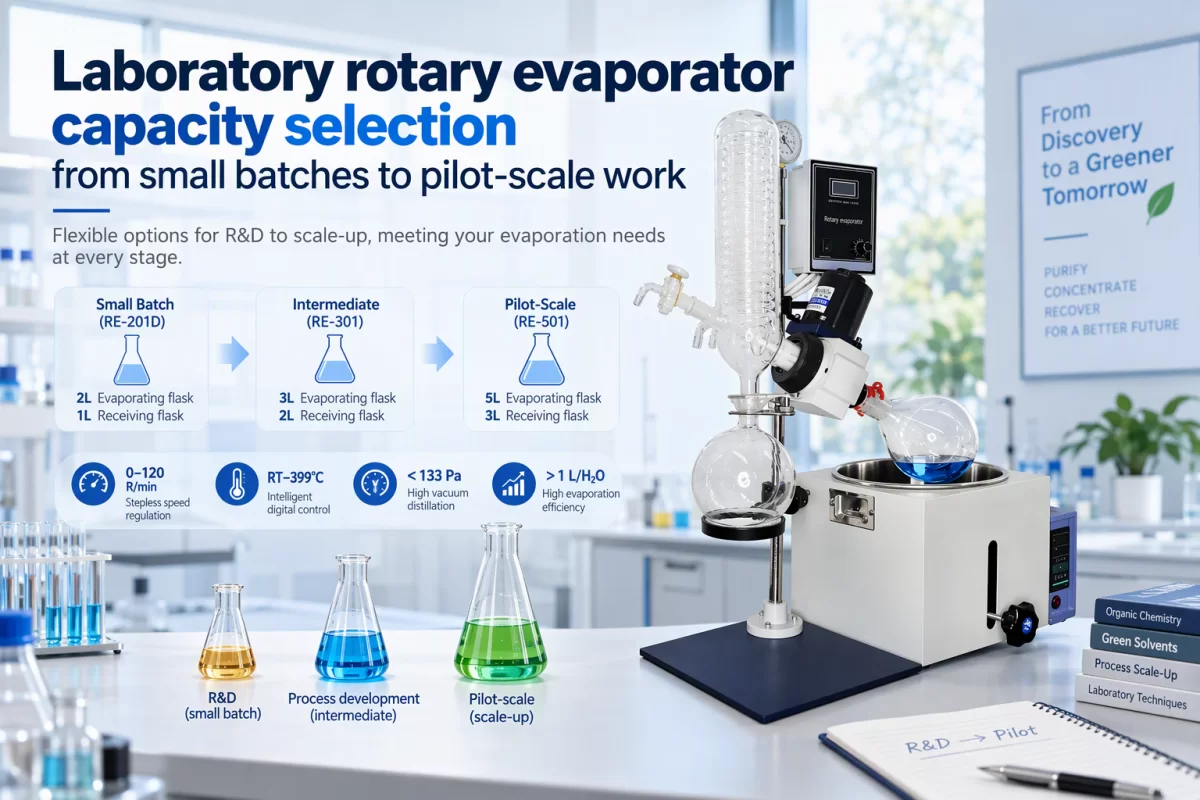
Selection points that protect purchasing value
- Match the process, not just the flask size. Consider solvent volatility, foaming, viscosity, and heat sensitivity. Ask for guidance on working fill volume and suitable operating conditions.
- Specify vacuum and cooling together. A pump must suit the solvent vapor and required operating pressure; the condenser needs adequate cooling for the expected vapor load. Our guide to choosing a vacuum pump for a rotary evaporator provides relevant background.
- Check compatibility and safety documentation. Confirm seals, glassware, bath medium, and electrical requirements. Do not infer certification or explosion-proof suitability from a marketplace product title.
- Compare complete quotation scope. Request an itemized list of glassware, controls, tubing, pump, chiller, and accessories, together with delivery terms, spare-part availability, and warranty conditions.
What information belongs in a rotary evaporator quotation request?
Alice: I recommend listing the solvent or solvent mixture, batch volume, concentration target, preferred model, electrical supply, and existing pump and cooling equipment. I would also request the current technical sheet and a clear list of inclusions so the purchase can be assessed as an operational system.
Company reference price and quotation expectations
The supplied company price sheet contains multiple equipment and accessory listings, including price ranges. Ordering those entries from low to high and selecting the lower middle entry produces the company reference price shown below. Each range is treated as one listing and ordered by its lower bound.
Our company’s reference price
US$1,480
Actual pricing is subject to the selected configuration and the inquiry quotation. This reference is not a quotation for every model, a complete-system price, or a comparison with other suppliers.
Purchasing value comes from obtaining a configuration that fits the laboratory’s workload and utilities. A clearly specified package can help avoid unexpected accessory requirements, while confirmed model data makes technical comparisons more meaningful than comparing listing titles alone.
Does the reference price include a vacuum pump and chiller?
Alice: I would not assume that it does. The reference is calculated from the supplied price entries, which describe different products and packages. Only the configuration-specific quotation can establish whether a pump, chiller, or other accessory is included.
A practical next step for buying a chemistry laboratory rotary evaporator
For laboratories asking where to buy a rotary evaporator, ZZKD Instrument provides a website-based starting point for reviewing the supplied product range. Compare the documented RE-series capacities for smaller batches and R-series capacities for larger workflows, then prepare a detailed inquiry.
The strongest purchasing decision combines confirmed specifications, compatible vacuum and cooling equipment, appropriate safety documentation, and a written quotation. Use the company reference price for initial orientation—not as a substitute for a model-specific offer—and select the rotary evaporator around the chemistry it needs to support.