




Pilot-scale processing · Equipment selection
What rotary evaporator capacity is ideal for pilot plants?
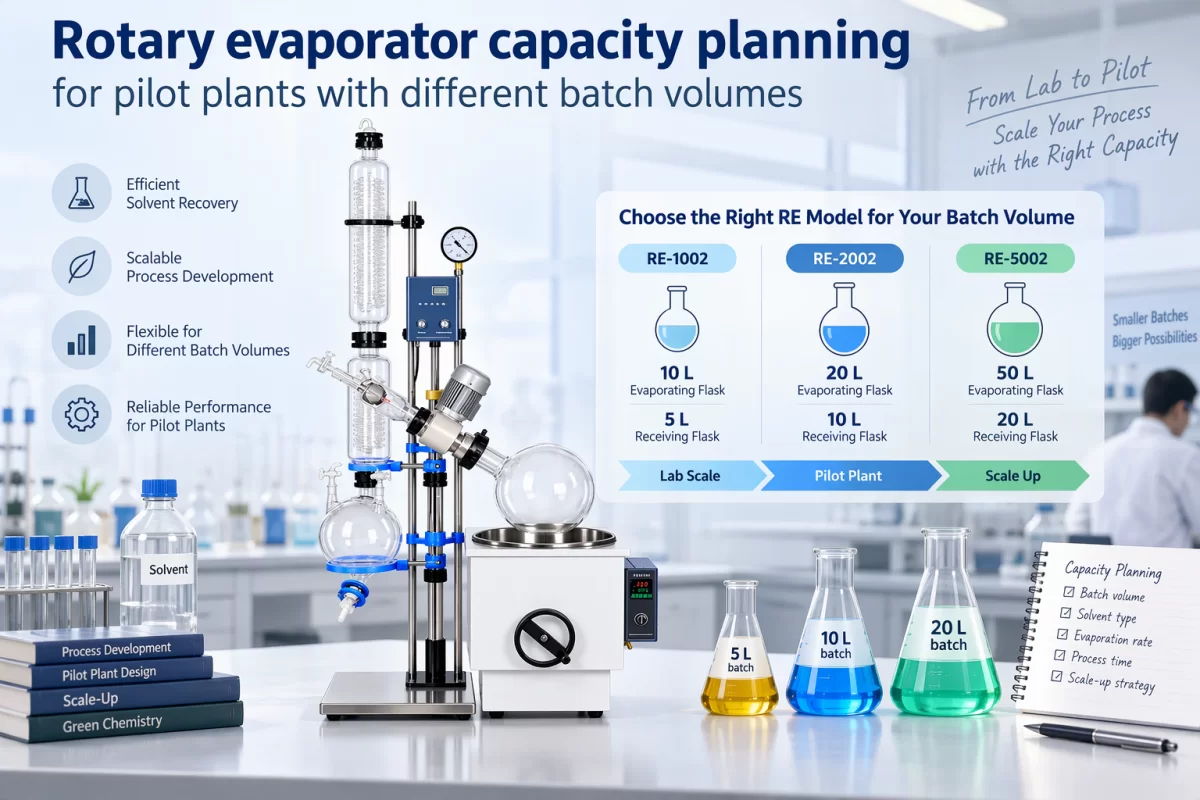
Choosing a rotary evaporator for a pilot plant starts with the process, not simply the largest flask available. A 20 L model is a useful candidate to evaluate when moving beyond small laboratory batches, while 10 L or 50 L options may fit a different workload. The right capacity depends on the actual charge, solvent removal requirement, material behavior and available operating time.
Practical starting point: Compare 10 L and 20 L models for intermediate pilot work, consider 50 L when larger batches justify the installation requirements, and retain 5 L equipment for smaller development runs. Nominal flask capacity is not the same as usable batch volume or hourly output.
Matching rotary evaporator capacity to pilot-plant batches
Pilot plants bridge laboratory development and larger-scale processing. Their evaporation duties may include concentrating a solution after synthesis, removing solvent from an extract, or collecting condensed solvent for evaluation and possible reuse. These duties can involve very different liquid volumes, even within the same facility.
Start by recording the initial liquid charge and the amount of solvent that must be removed. Then consider whether one batch must finish within a particular operating window. A larger rotating flask provides more nominal volume, but it does not independently establish the evaporation rate. Heating, vacuum performance, condensation and the changing properties of the liquid all influence the outcome.
Leave suitable headspace for rotation, vapor formation and any foaming tendency. Do not treat a 20 L rotating flask as permission to load 20 L of process liquid. A suitable working charge should follow the operating instructions and the behavior established during trials.
Is a 20 L rotary evaporator always the ideal pilot-plant choice?
I would treat 20 L as a candidate rather than a universal answer. It deserves consideration when smaller equipment requires too many separate runs, but a 10 L unit may better suit modest batches. A 50 L unit becomes worth evaluating when larger charges and the supporting utilities make practical sense.
How rotary evaporation supports solvent removal
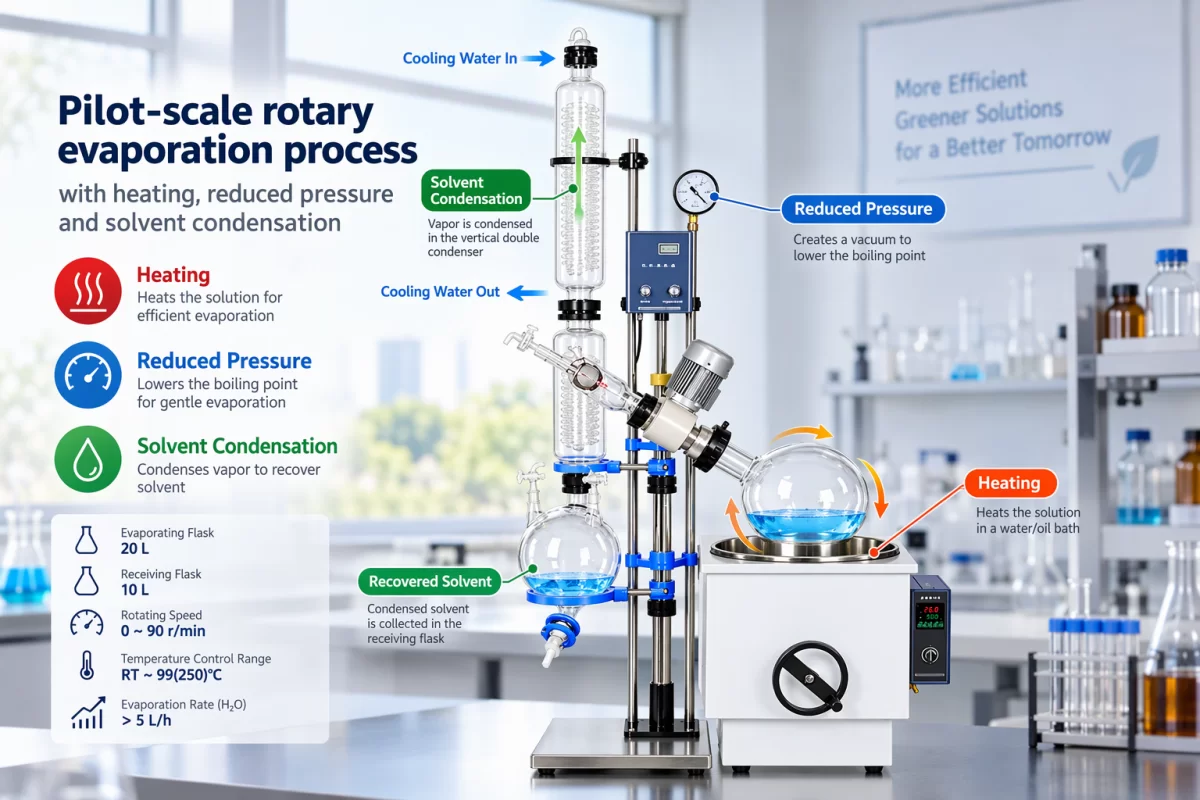
A rotary evaporator combines a rotating flask, a heating bath, a vacuum connection, a condenser and a receiving vessel. Rotation spreads liquid over the flask surface. The bath supplies heat, while reduced pressure allows a solvent to boil at a lower temperature than it would at atmospheric pressure. Vapor passes into the cooled condenser and collects as liquid in the receiver.
This arrangement can be useful for temperature-sensitive solutions when suitable operating conditions are selected. However, reduced-pressure operation does not eliminate the need to understand thermal stability, solvent compatibility or vapor hazards. The bath setting should reflect the process rather than the equipment's maximum possible setting.
For additional process background, read our explanation of how a rotovap works. In pilot work, that operating principle also explains why flask volume alone cannot predict batch completion time.
Model capacities and installation parameters
The R-series offers four rotating-flask sizes for comparing development and pilot-scale requirements. The receiving vessel must also be considered: it collects the condensed solvent and can affect the handling schedule during a run. The following model-specific dimensions help assess equipment placement before purchase.
| Model | Rotating flask (L) | Receiving vessel (L) | Lift travel (mm) | Overall dimensions (mm) |
|---|---|---|---|---|
| R1005 | 5 | 3 | 0–150 | 660 × 400 × 1020 |
| R1010 | 10 | 5 | 0–160 | 920 × 550 × 1700 |
| R1020 | 20 | 10 | 0–190 | 1250 × 600 × 2100 |
| R1050 | 50 | 20 | 0–180 | 1320 × 770 × 2340 |
These are nominal vessel capacities and overall equipment dimensions, not recommended liquid charges or guaranteed throughput figures.
Smaller development duties can also be considered alongside the RE series: the RE-201D has a 2 L evaporating flask and 1 L receiver, the RE-301 has a 3 L evaporating flask and 2 L receiver, and the RE-501 has a 5 L evaporating flask and 3 L receiver. Keeping laboratory and pilot duties separate can help avoid tying up larger equipment for small exploratory runs.
For a closer look at the intermediate capacity category, our 20 liter rotary evaporator guide provides relevant reading.
Does a larger rotating flask guarantee faster solvent removal?
I would not use flask size as a speed guarantee. A larger unit should be evaluated together with its heating, vacuum and cooling arrangement. Process trials are more useful than nominal volume for judging whether a batch can meet the required completion time.
Selection priorities beyond flask volume
- Material and solvent behavior: Identify the solvent, dissolved components, solids content, viscosity and tendency to foam. These influence loading, operating conditions and cleaning.
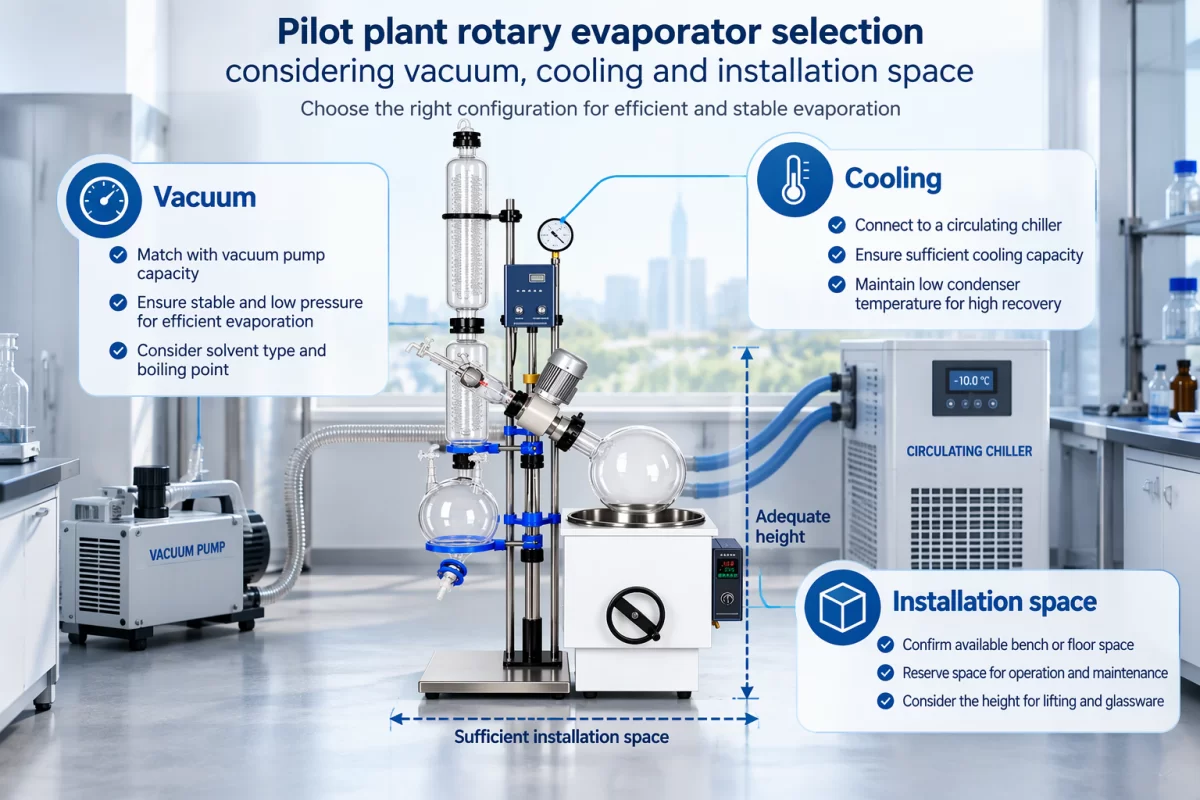
- Vacuum requirements: Match the vacuum arrangement to the solvent and desired boiling conditions. Consider vapor compatibility and control, not only the pump's ultimate vacuum. Our guide to rotary evaporator vacuum pumps explains this supporting equipment.
- Cooling and collection: Evaluate condenser cooling against the expected vapor load. Plan how condensed solvent will be collected, transferred and assessed before reuse.
- Space and access: Allow room beyond the listed overall dimensions for glassware handling, utility connections, cleaning and service access.
- Safety and utilities: Assess ventilation, electrical supply, chemical compatibility and the site's requirements for flammable-solvent processing. Select a configuration appropriate to that assessment.
Purchase value and reference pricing
The purchase value of a Rotary Evaporator comes from its fit with the intended workload. Equipment that is too small may create repeated loading and unloading tasks, while unnecessary capacity can add installation and handling demands. Compare the total system scope, including the bath, glassware, vacuum equipment, cooling equipment and required accessories.
Our company's reference price
US$1,480
This is a company reference price, not a quotation for every model or a complete pilot-plant package. The actual quotation depends on the selected configuration and the inquiry result.
A useful inquiry should describe the material, solvent, intended working batch, target concentration, operating schedule and available utilities. Include any requirements for vacuum control, cooling, collection and site safety. This gives the supplier a practical basis for proposing a corresponding system and quotation.
What makes a pilot-plant rotary evaporator a worthwhile purchase?
I would prioritize a system that handles the intended batches with manageable operation and appropriate supporting equipment. Useful capacity, suitable condensation and a workable installation matter more than choosing the largest flask or comparing purchase prices alone.
Choosing the ideal capacity for pilot plants
The ideal rotary evaporator capacity is the one that matches the working charge and solvent-removal duty without overlooking cooling, vacuum, collection or handling. Compare 10 L and 20 L options for intermediate workloads, evaluate 50 L for larger pilot batches, and consider 5 L for smaller development tasks. A 20 L unit is a sensible starting point for evaluation—not a universal specification.
To discuss a suitable Rotary Evaporator from ZZKD Instrument, provide the process material, working batch, target conditions and configuration needs. Selecting from that information helps turn a nominal capacity choice into a practical pilot-plant solution.