




What is the best vacuum drying oven for labs?
The best vacuum drying oven for a lab is the model that dries samples gently, keeps temperature stable, reaches a reliable vacuum, and fits daily sample volume without taking unnecessary bench space. For most laboratories, the ZZKD DZF-6020 and DZF-6050 are the most practical choices.
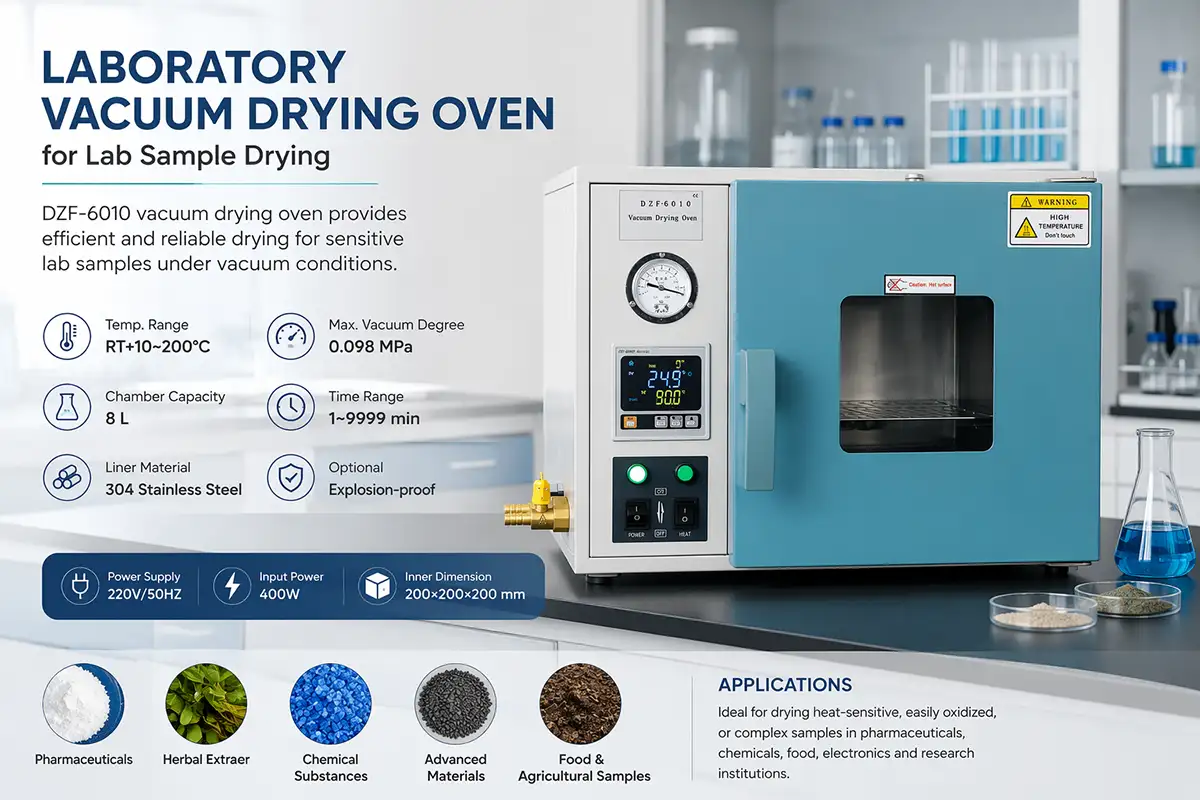
Quick answer for lab buyers
If a lab needs one reliable vacuum drying oven for common sample drying, the ZZKD DZF-6050 is usually the best overall model. It offers a 55 L chamber, 1400 W input power, a 304 stainless steel liner, stable temperature control, and enough internal space for powders, polymers, glassware, plant extracts, small electronic parts, and routine R&D materials.
For smaller labs or tighter budgets, the DZF-6020 is a smart compact choice with 25 L capacity. For tiny sample batches, the DZF-6010 is enough. If the lab supports pilot testing or frequent large batches, the DZF-6090 or larger 430 L models are more efficient.
Why is a vacuum drying oven useful in a laboratory?
A laboratory vacuum drying oven removes air from the chamber and dries samples under reduced pressure. This lowers the boiling point of moisture or residual solvent, so the sample can dry at a lower temperature. That is very important when a material may oxidize, melt, crack, foam, change color, or lose active ingredients during normal hot air drying.
ZZKD explains the basic process in its guide to vacuum oven drying for material processing. In practical lab work, vacuum drying is often used for chemical powders, polymer resin, catalysts, electronic components, ceramic powders, botanical extracts, and moisture-sensitive samples.
Better for heat-sensitive samples
Lower-pressure drying helps remove moisture without forcing the sample through high-temperature stress.
Better for low-oxygen drying
Removing air from the chamber helps protect oxidation-sensitive materials, oils, extracts, and reactive powders.
Better for clean lab workflows
A sealed chamber and stainless steel liner make the process more controlled than open-air drying methods.
How to choose the best ZZKD vacuum drying oven for your lab
Start with the real sample size. A lab should not choose a vacuum oven only by price, because an undersized chamber slows the workflow and an oversized chamber wastes space and energy. The ideal oven gives enough tray area for samples to sit in thin, even layers. This matters especially for powders and granular materials, because thick piles dry much more slowly.
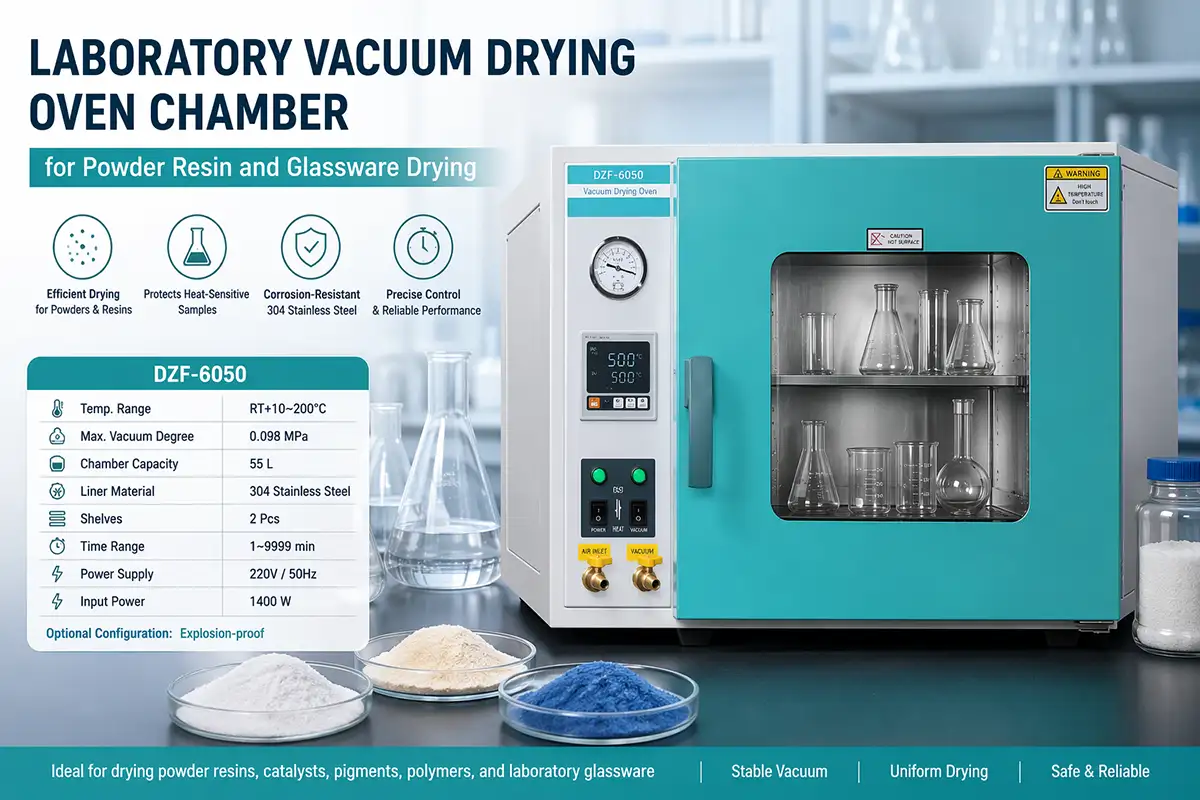
The best lab vacuum drying oven should match your sample volume, tray area, target temperature, and vacuum requirement.
Next, check temperature sensitivity. ZZKD DZF vacuum drying ovens provide a temperature range of RT+10 to 200°C, with a 250°C option for special applications. For many lab samples, stable control is more important than extreme heat. A precise oven helps the user dry the sample without damaging its structure or chemistry.
Finally, consider the drying risk. If your material contains flammable solvent residue, ask ZZKD about explosion-proof configuration and the correct vacuum pump setup. A standard lab oven is not always the right choice for solvent-heavy processes.
ZZKD DZF lab vacuum drying oven comparison
The table below compares common ZZKD DZF models using the provided specifications and practical lab use cases. When several product prices were available, a moderate lower-middle reference price was selected instead of the highest quote.
| Model | Chamber Capacity | Input Power | Inner Dimension | Good Lab Fit | Reference Price |
|---|---|---|---|---|---|
| DZF-6010 | 8 L | 400 W | 200*200*200 mm | Small samples, moisture checks, compact benches | About $360 |
| DZF-6020 | 25 L | 700 W | 300*300*270 mm | Routine sample drying and small-batch R&D | About $472 |
| DZF-6050 | 55 L | 1400 W | 400*400*345 mm | Best all-around choice for most labs | About $679 |
| DZF-6090 | 90 L | 2000 W | 450*450*450 mm | High-throughput labs and pilot testing | About $790 |
| DZF-6210 | 430 L | 2060 W | 560*600*640 mm | Large lab batches and pilot production | About $4,000 |
| DZF-6500 | 430 L | 2800 W | 630*810*845 mm | Large materials needing wider internal space | Quote recommended |
Best model by laboratory application
For universities, testing labs, and research teams that dry many small samples, the DZF-6020 is often enough. It has a compact 25 L chamber but still provides more flexibility than a tiny oven. For labs drying polymers, resin, plant extracts, small batches of powder, or multiple sample dishes at once, the DZF-6050 is the better long-term choice because the 55 L chamber prevents crowding.
For pilot labs, battery material research, ceramic powders, catalysts, and larger experimental batches, the DZF-6090 gives more useful space. The DZF-6210 and DZF-6500 are best when a laboratory also supports production-style drying, scale-up testing, or large trays.
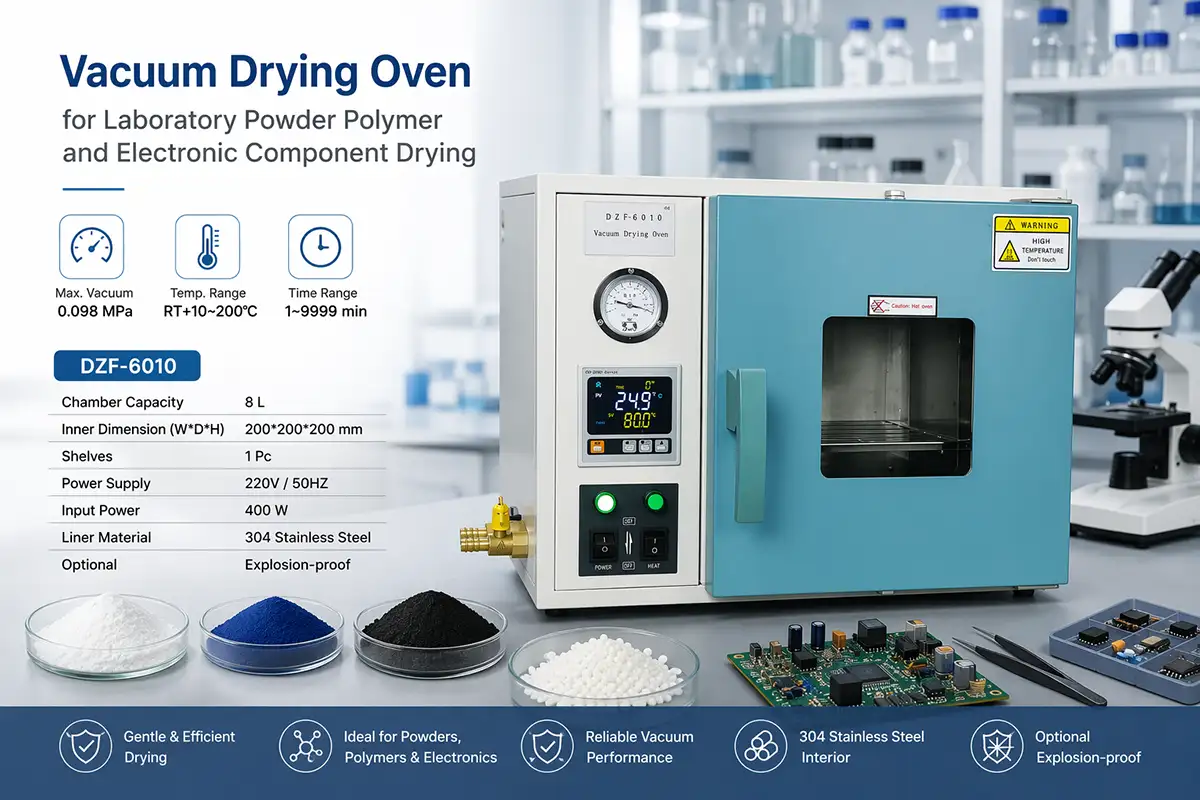
For laboratory users, stable temperature, enough tray space, and a clean stainless steel chamber are usually more important than maximum temperature alone.
If you are comparing vacuum drying and conventional air drying, read ZZKD's explanation of the difference between vacuum drying and air drying. A hot air oven may be fine for rugged materials, but vacuum drying is usually safer for sensitive or high-value samples.
What should a lab confirm before buying?
Before choosing a model, write down the sample name, batch weight, tray loading thickness, drying temperature, expected drying time, moisture or solvent content, and whether the process needs inert gas or explosion-proof protection. These details help ZZKD recommend the right chamber size, pump, and configuration.
Also consider the daily workflow. A lab that dries one small batch per week can choose a smaller oven. A lab that dries samples every day should leave room for growth, because a slightly larger chamber often saves time and improves consistency. When the drying load grows beyond vacuum oven work, some users may also compare other drying equipment, such as a hot air circulation drying oven, for non-sensitive bulk materials.
Practical recommendation
Choose DZF-6020 for compact lab work, DZF-6050 for the best overall balance, DZF-6090 for higher throughput, and DZF-6210 or DZF-6500 for large lab or pilot drying.
So, what is the best vacuum drying oven for labs?
The best vacuum drying oven for most labs is the ZZKD DZF-6050. It is large enough for real laboratory workflows, but still practical for research rooms and small production spaces. Its 55 L chamber, stainless steel liner, stable temperature control, and reasonable reference price make it a strong all-around choice for sample drying, powder drying, polymer drying, and heat-sensitive material drying.
If your lab only dries very small samples, choose the DZF-6010 or DZF-6020. If your lab needs larger batches, choose the DZF-6090 or the larger 430 L DZF series models. The right answer depends on your material, batch size, and drying risk, but for many laboratories, the DZF-6050 gives the most useful balance of performance, capacity, and cost.