




Lab scale spray dryer with PID intelligent control
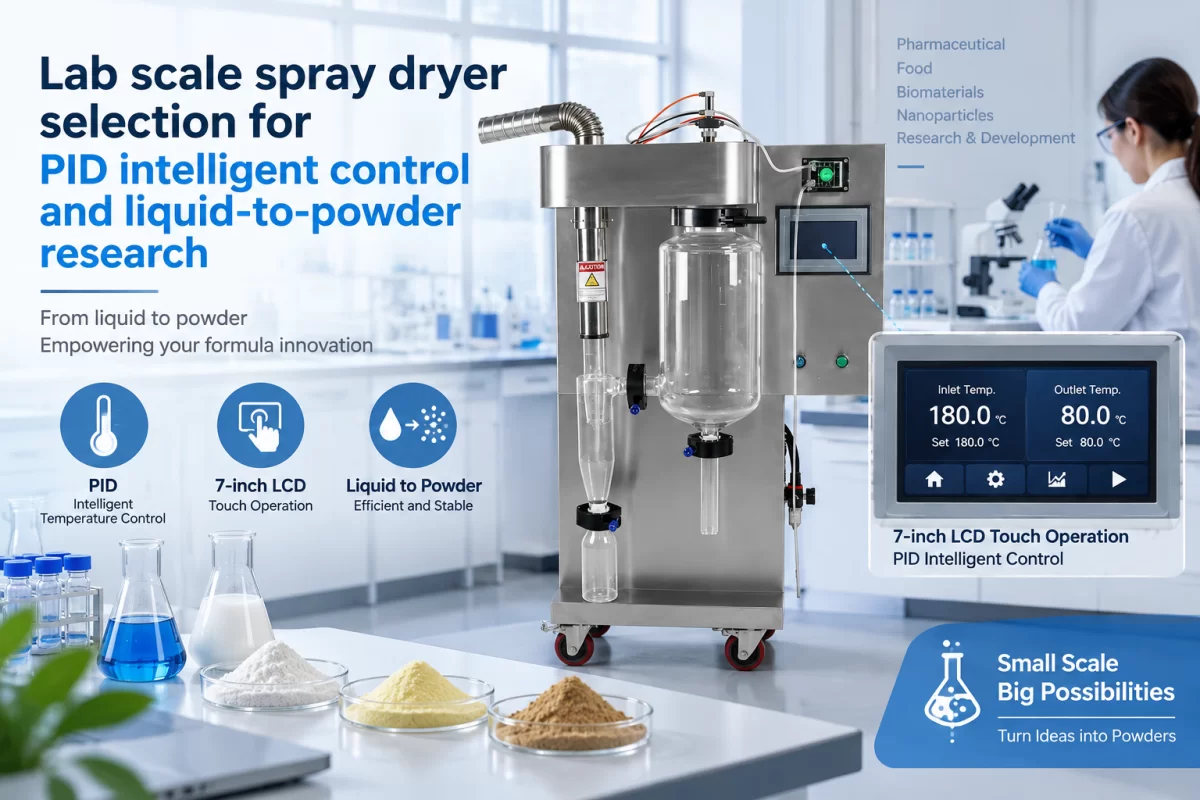
Choosing a lab scale spray dryer with PID intelligent control starts with the material, the required evaporation duty, and the temperature-control strategy. For liquid-to-powder research, a Spray Dryer brings feeding, atomization, and hot-air drying into one process, allowing laboratories to study powder formation before moving to larger-scale trials.
The SD-2L provides a practical starting point for evaluating laboratory capacity, utilities, and installation needs. The LPG-5 and LPG-10 offer additional options when research progresses toward higher evaporation duties.
How a laboratory spray dryer turns liquid into powder
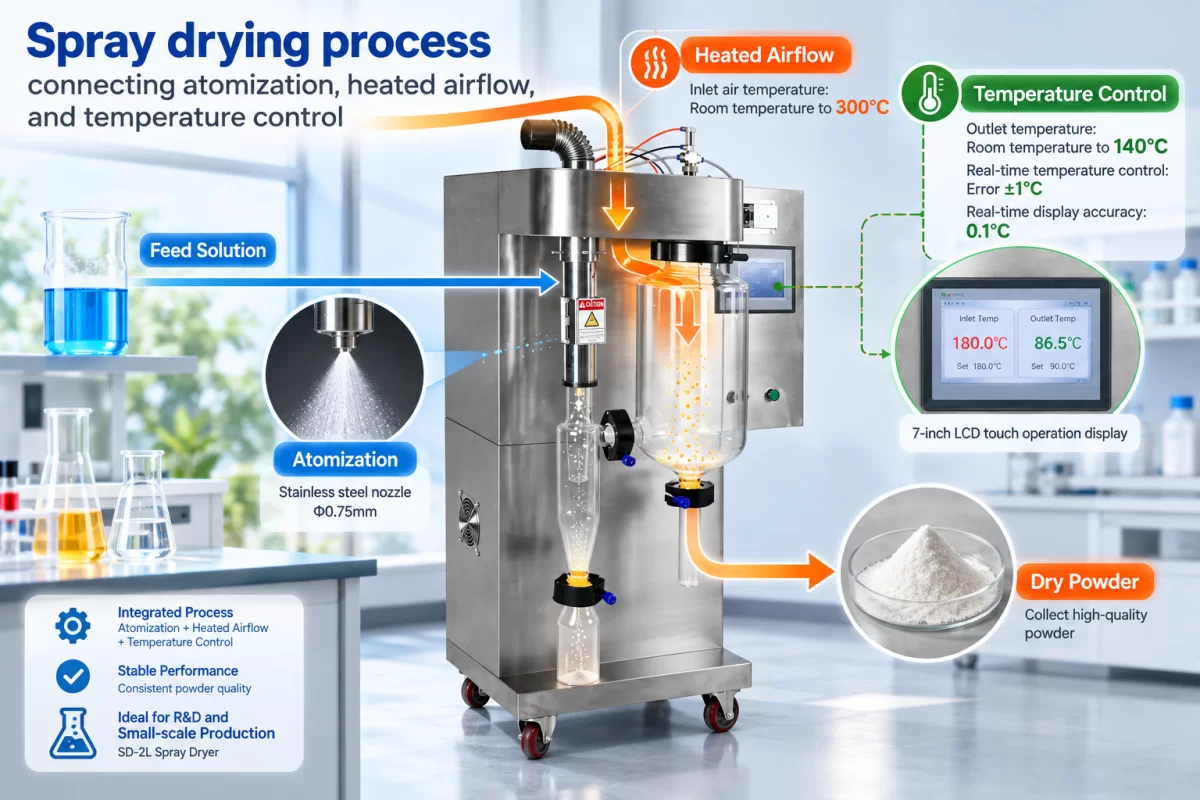
Spray drying begins with a pumpable liquid feed. The feed enters an atomizer, which divides it into droplets. Contact with heated air promotes evaporation, leaving solid particles that are separated from the outgoing air stream and collected. Atomization and drying are connected, but they perform different tasks: the atomizer creates droplets, while heat and airflow remove moisture.
For the SD-2L, feed adjustment uses a peristaltic pump, and the specified nozzle diameter is 1.00 mm. Its compressed-air working pressure is 2–3 bar. These details matter when planning feed delivery and atomization conditions; they should not be interpreted as a guaranteed final particle size. For additional process context, read the guide to spray drying principles and operation.
Does the maximum feed rate equal the powder production rate?
I treat these as separate quantities. The feed rate describes the liquid entering the dryer, whereas powder output depends on the feed’s solids content and the amount of material successfully collected. The water evaporation specification describes moisture removal, not finished powder production.
PID intelligent control: what matters during selection
PID means proportional, integral, and derivative control. In a temperature-control loop, the controller compares a measured temperature with its setpoint and adjusts the heating response. When specifying PID intelligent control for laboratory spray drying, the useful purchasing questions concern which temperature is controlled, where it is measured, and how the controller responds to changing feed conditions.
Inlet and outlet temperatures should be considered together. Inlet temperature describes the incoming drying air, while outlet temperature reflects the air leaving the drying process. Feed rate, airflow, and the moisture load can influence operating conditions. A temperature-control range is therefore not a guarantee that every material can be dried successfully at every setting within that range.
For a PID-focused equipment request, include the required control functions in the configuration brief. Keep the discussion centered on the intended operating window and trial procedure rather than assuming that the word “intelligent” guarantees temperature accuracy, automatic optimization, or a particular powder quality.
SD-2L Spray Dryer specifications
The following parameters apply specifically to the SD-2L. They provide a basis for planning small-sample experiments and evaluating electrical, compressed-air, and space requirements.
| Parameter | SD-2L value | Unit / condition |
|---|---|---|
| Inlet air temperature control range | 30–300 | °C |
| Outlet temperature control range | 30–150 | °C |
| Water evaporation | 1,500–2,000 | mL/h |
| Maximum feed rate | 2,000 | mL/h |
| Minimum feed quantity | 50 | mL |
| Feed adjustment | Peristaltic pump | Adjustable feeding |
| Average drying time | 1.0–1.5 | s |
| Electric heater power | 3.5 | kW; AC 220 V, single-phase, grounded |
| Fan power | 0.55 | kW |
| Maximum air volume | 5.6 | m³/min |
| Maximum wind pressure | 1,020 | Pa |
| Air compressor power | 1.2 | kW |
| Maximum compressor gas production | 4.2 | m³/h |
| Compressed-air working pressure | 2–3 | bar |
| Nozzle diameter | 1.00 | mm |
| Dimensions, L × W × H | 600 × 700 × 1,200 | mm |
| Equipment weight | 130 | kg |
The minimum feed quantity is useful when estimating sample requirements, but it does not indicate how much powder will be recovered from a small trial. Likewise, the average drying time describes the drying stage rather than the total time needed for preparation, startup, collection, and cleaning.
Applications and material-specific trial planning
The spray dryer product range includes applications involving milk, coffee, egg, spirulina, gum arabic, and herbal extracts. These are relevant starting points for food and ingredient development, where researchers want to investigate the conversion of a liquid formulation into a powder. Suitability still depends on the actual feed composition and operating conditions.
Before running trials, assess solids concentration, viscosity, suspended particles, and thermal sensitivity. Record feed delivery settings and inlet and outlet temperatures alongside powder observations. For temperature-sensitive formulations, the guide to low-temperature spray drying technology offers related reading for process selection.
Can a short drying time guarantee protection of heat-sensitive ingredients?
I would not use drying time alone to judge suitability. The formulation’s thermal sensitivity and the actual drying conditions also matter. A useful trial should assess the properties that are important for the intended product, rather than assuming that brief exposure automatically preserves them.
Moving from laboratory trials to pilot-scale drying
When the required moisture-removal duty exceeds the laboratory starting point, compare larger models using their own specifications. The LPG-5 and LPG-10 are centrifugal spray dryer options with electric heating. Their evaporation ratings are expressed in kg/h and should remain distinct from the SD-2L’s volumetric water evaporation specification.
| Parameter | LPG-5 | LPG-10 | Unit |
|---|---|---|---|
| Maximum moisture evaporation | 5 | 10 | kg/h |
| Centrifugal spray-head speed | 25,000 | 25,000 | rpm |
| Spray disc diameter | 50 | 50 | mm |
| Electric heating power | 9 | 20 | kW |
| Heat source | Electricity | Electricity | — |
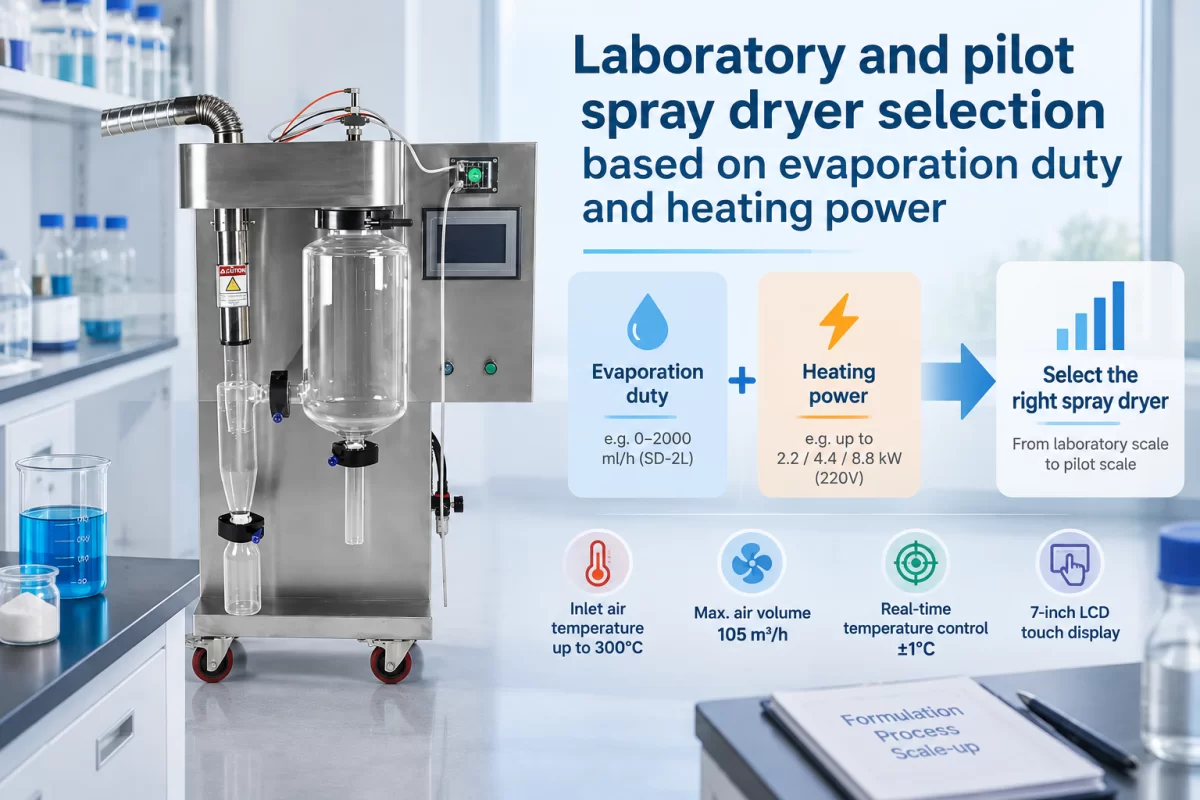
A larger evaporation rating is not automatically the better purchase. Small formulation studies and longer pilot trials have different priorities, including sample availability, utility demand, and the number of experiments planned.
Selection checklist, reference price, and purchasing value
- Define the feed: provide the material name, liquid composition, solids concentration, viscosity, and any solvent content.
- Define the trial workload: state the available batch volume, desired processing duration, and required moisture-removal duty.
- Specify control requirements: describe the temperature operating window and the PID functions needed for the experiment.
- Plan installation: assess electrical supply, grounding, compressed air, equipment access, exhaust arrangements, and cleaning needs.
- Set acceptance criteria: identify the powder characteristics and material properties that the trial must evaluate.
Our company’s reference price for spray dryer budgeting
US$2,800–3,250
This is a company reference price, not a fixed quotation for every model or control package. The actual quotation depends on the selected configuration and the inquiry results.
The purchasing value of a laboratory Spray Dryer lies in obtaining useful process information before committing to a larger drying system. Matching sample quantity, feed delivery, temperature requirements, and utilities can make the equipment more appropriate for the research task than choosing by nominal capacity alone.
What information helps produce a useful equipment quotation?
I recommend sending the material composition, working batch volume, target operating conditions, available utilities, and configuration requirements together. This gives the supplier a practical basis for proposing a dryer and pricing the requested control package.
Choose a laboratory spray dryer around the experiment
A lab scale spray dryer with PID intelligent control should be selected as a process tool, with attention to the material and the control functions required. The SD-2L specifications support laboratory planning, while the LPG-5 and LPG-10 provide separate options for higher evaporation duties.
Explore the laboratory-scale spray dryer product page and submit the material, working batch size, target conditions, and configuration needs to request a suitable equipment proposal and quotation.