




Laboratory equipment • Configuration guide
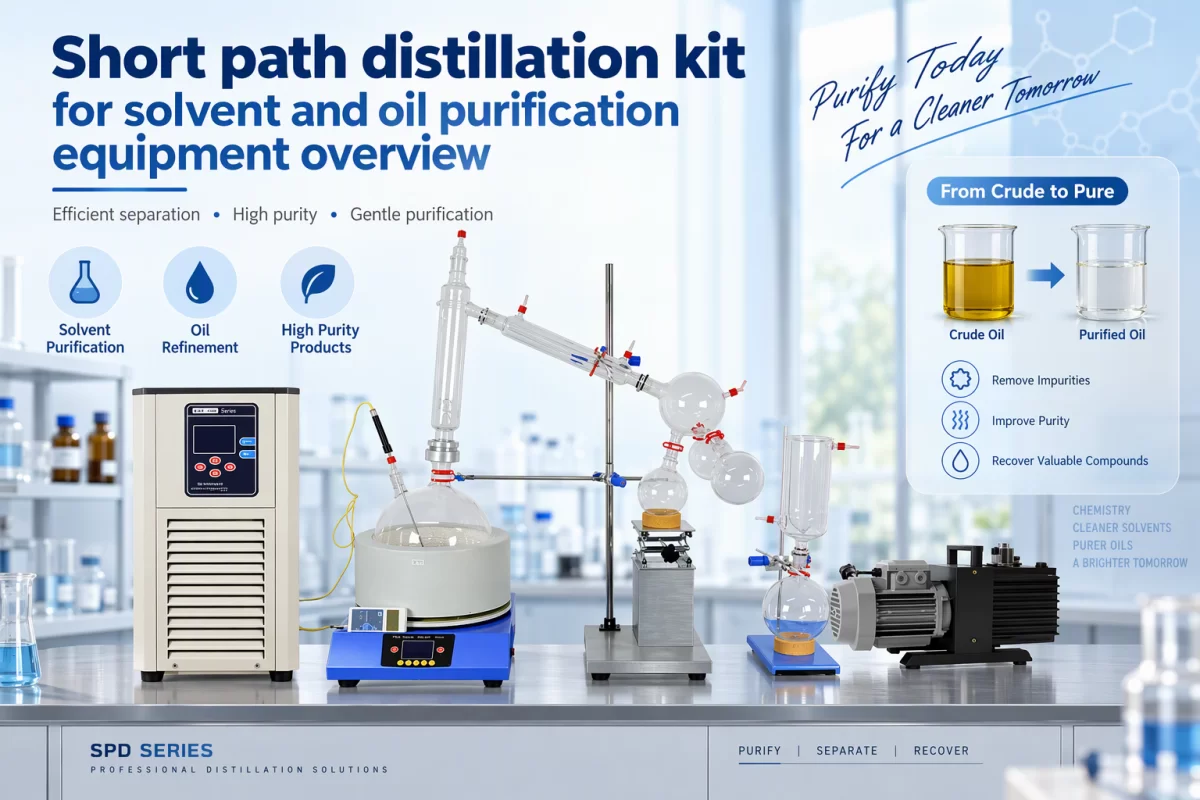
Short path distillation kit for solvent and oil purification
Selecting a Short path distillation kit for solvent and oil purification starts with a clear component list—not a promise of universal purity. The documented Short Path Distillation range includes SPD-2L, SPD-5L, SPD-10L and SPD-20L configurations, giving laboratories several flask sizes to consider for their process development.
Planning solvent and oil purification around the kit
The supplied product listings describe laboratory vacuum and fractional short path distillation equipment, including listings associated with essential oils, plant oils and alcohol or ethanol distillation. These application descriptions provide a starting point for an equipment discussion. They do not establish a validated method for every solvent, oil or mixed feed.
For a practical purchase, separate the hardware decision from the purification target. The hardware decision concerns the heating mantle, boiling flask, distillation head, receiving flasks and supporting accessories. The purification target concerns the actual feed composition and the quality required after processing. The supplied parameter sheets document the former, but do not provide measured final purity, solvent-removal efficiency or processing throughput.
For additional application context, read the discussion of solvent removal with short path distillation. Any proposed process should still be reviewed against the intended material and confirmed operating specifications.
Can a listed kit guarantee complete solvent removal from an oil?
Alice: I would not make that guarantee from these documents. They list equipment components and application-oriented product names, but no residual-solvent test results. I recommend defining the required acceptance criteria before selecting a configuration and verifying the processed material with an appropriate analytical method.
Short path distillation kit capacities and documented components
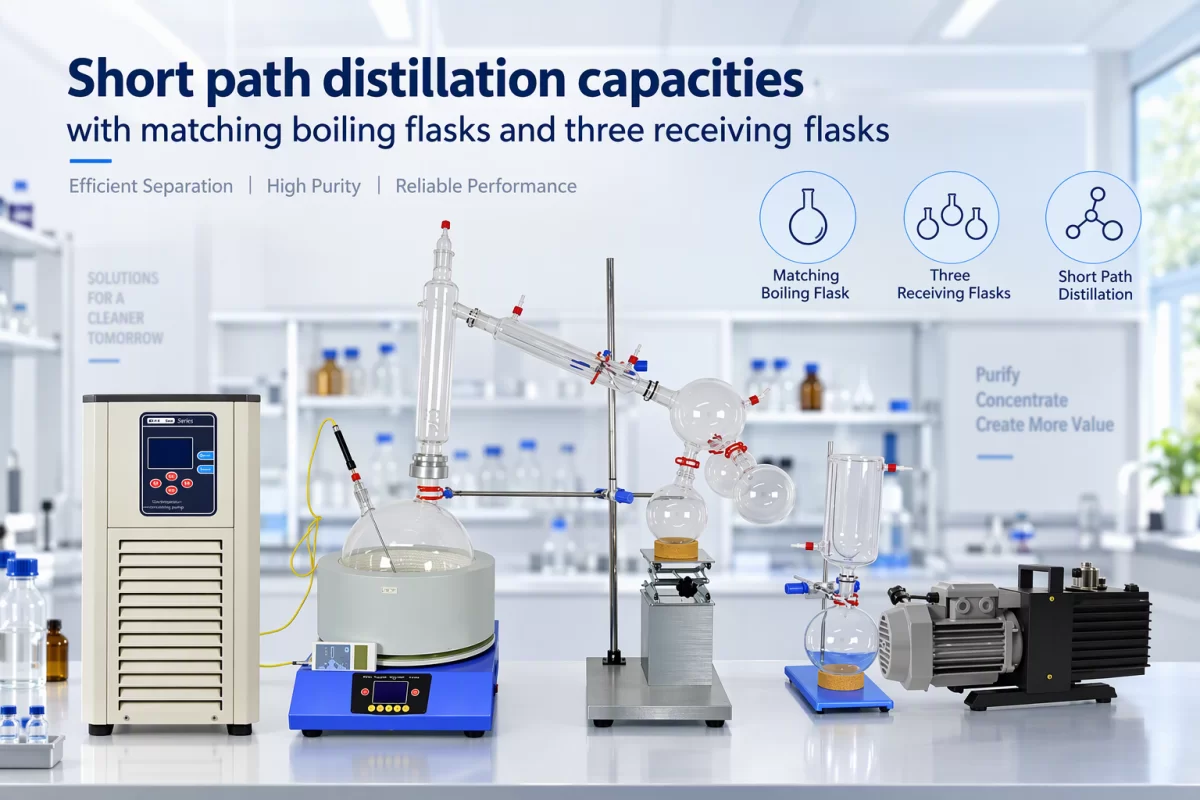
The comparison below follows the main configuration sheet. Each model lists one digital heating mantle and one two-neck boiling flask of matching nominal capacity. These values identify component sizes; they should not be treated as approved working fill volumes or batch-throughput ratings.
| Component / quantity | SPD-2L | SPD-5L | SPD-10L | SPD-20L |
|---|---|---|---|---|
| Digital heating mantle, 1 | 2,000 mL | 5,000 mL | 10,000 mL | 20,000 mL |
| Two-neck boiling flask, 1 | 2,000 mL | 5,000 mL | 10,000 mL | 20,000 mL |
| Round-bottom receiving flasks, 3 | 500 mL each | 1,000 mL each | 2,000 mL each | 3,000 mL each |
| Short path distillation head | 1 | 1 | 1 | 1 |
| Cow receiver | 1 | 1 | 1 | 1 |
| Plastic Keck clips | 7 | 7 | 7 | 7 |
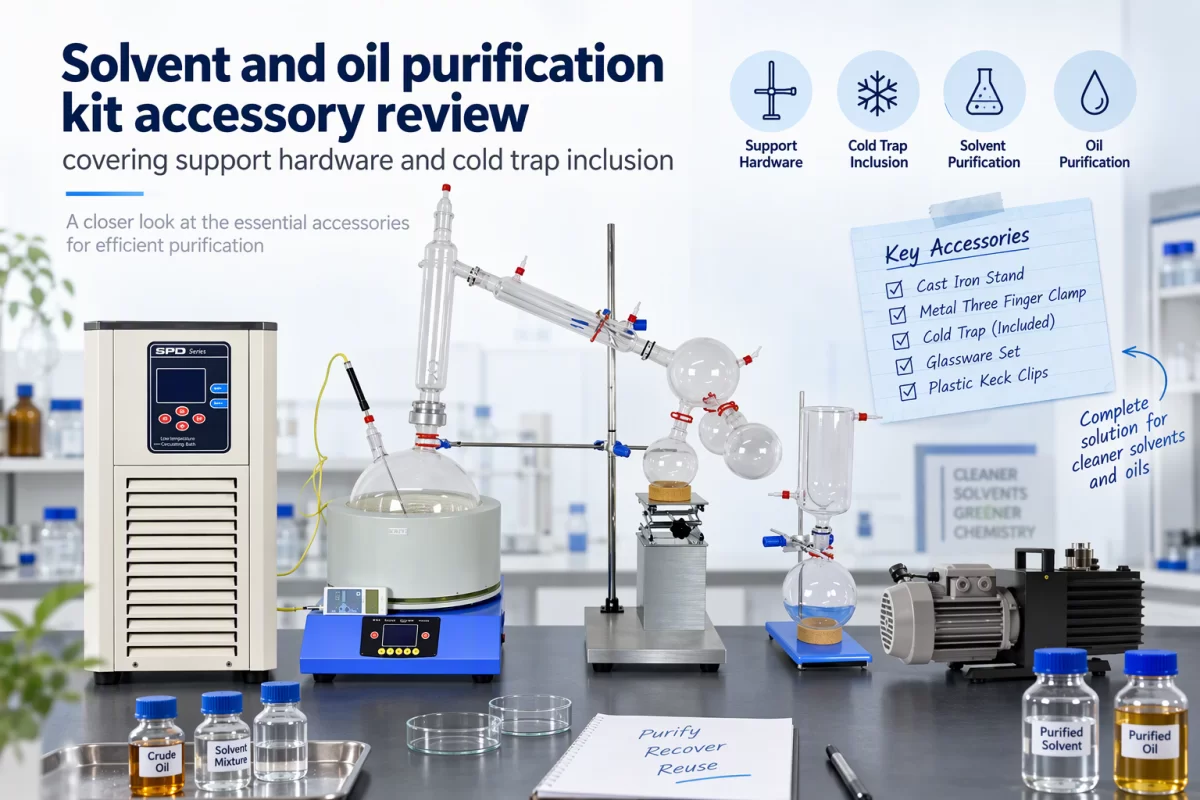
| Cast iron stand | 1 | 1* | 1 | 1 |
| Metal three-finger clamp | 1 | 1 | 1 | 1 |
| Cold trap | Not listed | See detailed list* | 1 | 1 |
The separate 2L parts list agrees with the main sheet for the components shown. The detailed 5L list offers more accessory information, making it particularly useful when discussing support hardware and instrumentation. The 5L short path distillation kit product page is a relevant starting point for a configuration inquiry.
Choosing a configuration for the laboratory workflow
A useful equipment request should describe more than the preferred model number. Include the material to be processed, its solvent content if known, the intended collection plan and the laboratory utilities available. This information helps distinguish the flask size needed from the accessories and external equipment needed to support the process.
The supplied sheets do not specify heating power, maximum temperature, temperature-control accuracy, electrical supply, glass joint dimensions or a model-specific vacuum rating. They also do not establish certifications. Those details should be requested rather than inferred from a product name or from the word “complete” in an individual listing.
Does the largest boiling flask automatically provide the best configuration?
Alice: I would choose capacity around the intended workflow, not simply select the largest model. The SPD-20L lists a 20,000 mL boiling flask and three 3,000 mL receiving flasks, while the SPD-2L lists a 2,000 mL boiling flask and three 500 mL receiving flasks. Those are documented differences, but they do not establish processing speed or the permissible charge volume.
Vacuum pumps and circulating chillers appear in some supplied listing titles, but are not included in the main model component sheet. Their inclusion therefore needs explicit confirmation in the quotation. The guide to laboratory vacuum pump selection provides relevant background for that discussion without implying that a particular pump is supplied with every kit.
Our reference price and quotation scope
The actual quotation is subject to the selected configuration and the results of the inquiry. This reference is not a fixed price for every SPD model or accessory package.
The supplied company price table contains 106 entries across different equipment listings. Sorting them from low to high, using the lower endpoint to order price ranges, places $600 at the lower of the two middle positions. This is the reference-price selection used here, not a model-specific offer.
Because the listings cover different configurations and equipment descriptions, the reference price should be used only for preliminary budgeting. A final quotation should identify the selected model, the exact component quantities and whether a cold trap, vacuum pump, circulating chiller or other accessories are included.
What information makes a quotation easier to evaluate?
Alice: I recommend requesting a model-specific bill of materials alongside the price. I would also ask for electrical requirements, operating limits, accessory specifications and any required certification documents. For the 5L configuration, I would specifically resolve the stand quantity and confirm the additional accessories listed in the detailed sheet.
Build a clear specification for solvent and oil purification
A short path distillation kit for solvent and oil purification is easier to evaluate when component capacities, accessory scope and process expectations are kept distinct. The documented SPD range provides four nominal boiling flask sizes, matching digital heating mantles, a short path head, a cow receiver and three receiving flasks per model.
For the next step, prepare an inquiry with the preferred SPD model, feed description, intended collection requirements and available utilities. Request confirmation of the final component list and operating specifications, and use our USD $600 reference price only as an initial budgeting guide. A configuration-specific quotation and a validated process—not an unsupported purity claim—provide the soundest basis for purchasing.