




Internal references used in this guide: lab reactor jacketed glass vessel explained, jacketed glass reactor vessel, rotary evaporator.
1) What is a lab glass reactor (in simple terms)?
A lab glass reactor is a glass vessel designed to run reactions with controlled mixing, temperature, and often vacuum or inert gas. Unlike a basic beaker-on-a-hotplate setup, a reactor is built for repeatability: the lid has ports for a stirrer, condenser, thermometer, feed addition, sampling, and more.
The biggest “aha” moment for many users is that a lab glass reactor is not only for chemistry synthesis. It is also used for extraction, crystallization, solvent recovery steps (often paired with a rotary evaporator), and pilot-scale process development.
2) Why choose glass instead of stainless steel?
Glass reactors are popular in R&D because glass is chemically resistant to many solvents and acids, and it gives a direct view of phase changes, foaming, color shifts, crystallization, or emulsions. That visibility is more than convenience: it helps catch problems early (for example, unexpected precipitation that could block a line).
Authority data point: According to the U.S. OSHA’s Process Safety Management (PSM) standard, strong mechanical integrity and controlled operating procedures are foundational for reducing risk in processes involving hazardous chemicals. In real lab work, a properly configured reactor (stable frame, secure clamping, correct seals, and appropriate safety accessories) supports that “mechanical integrity” principle even at small scale.Source: OSHA 29 CFR 1910.119 (Process Safety Management of Highly Hazardous Chemicals).
Stainless steel reactors still win when very high pressure or aggressive conditions are required, but for most lab-scale workflows, glass is preferred for its transparency, fast cleaning, and the ability to visually verify mixing quality.
3) What does “jacketed” mean, and why does it matter?
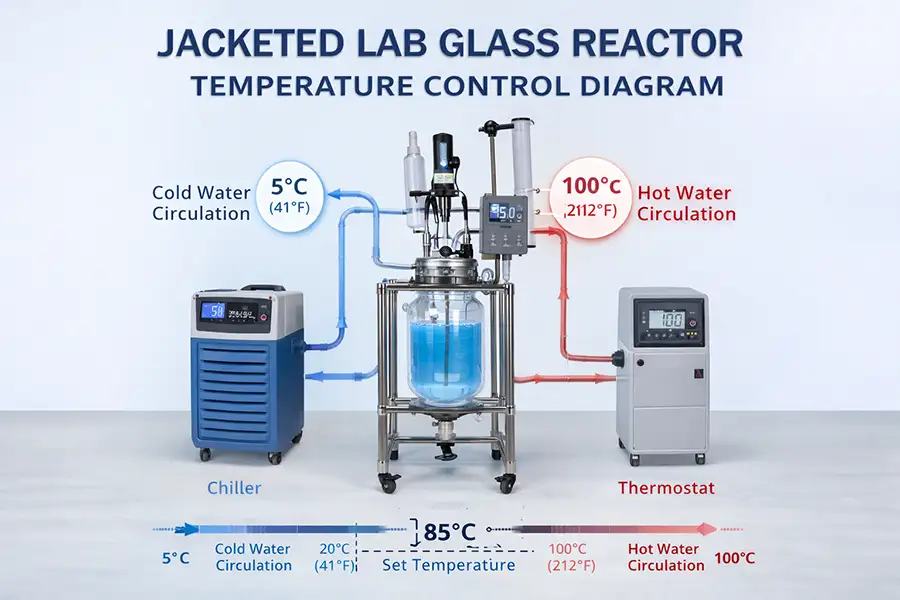
A jacketed glass reactor has a double-wall design: the reaction happens in the inner vessel, while a temperature-control fluid (like glycol or silicone oil) circulates through the outer jacket. This design keeps temperature changes smoother and more uniform than direct heating.
In plain terms: the jacket is what makes a reactor feel “industrial” even on a bench—stable temperature control, repeatable results, and fewer hot spots.
4) The specs that matter (and what they really mean)
When comparing a lab glass reactor, many buyers focus on volume first. Volume matters, but three other specs decide whether the reactor feels smooth and “professional” during everyday use:
- Stirring speed (rpm): These models support 0–600 rpm with a stated maximum of 1300 rpm. This range covers most mixing needs (dissolving, suspension, crystallization, mild emulsification).
- Motor power & torque: Power (W) is not the whole story—torque matters when viscosity rises or when mixing heavy slurries. In the provided specs, torque increases with volume, which is exactly what a scaling lab needs.
- Shaft diameter: Smaller units use 12 mm shafts; larger units may use 15 mm, improving stiffness and stability for larger impellers and heavier loads.
Another selection factor is the power supply. These models use 220V 50/60 Hz as standard, and some configurations can be customized to 110V 60 Hz. This is especially useful when installing a reactor in North American labs or mobile pilot skids.
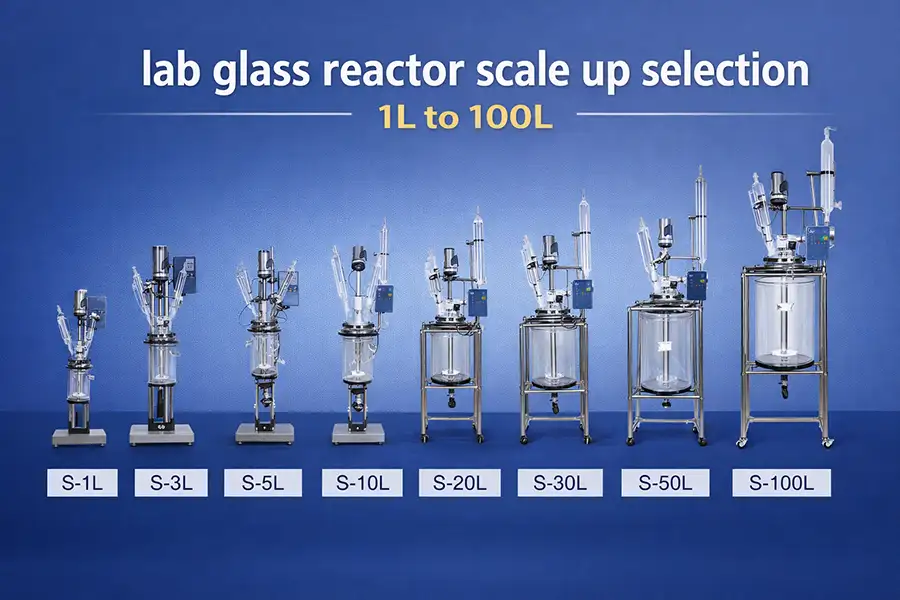
5) Quick overview: 1L to 100L lab glass reactor parameters
The table below summarizes the provided specifications for double-vessel (“dual kettle”) S-series models. Exact configuration options (explosion-proof, floor type, frame material) depend on the model range.
Note: The documents also mention optional stirring power ranges (e.g., 180/250/370W) and 110V/60Hz customization for certain builds. Final configuration should match the process viscosity, solvent class, and safety policy.
6) How to choose the right size (fast decision guide)
Picking a lab glass reactor becomes simple once the real process volume is defined. In my experience, choosing based on “maximum” volume alone often leads to either underfilled mixing problems or unnecessary cost. A practical rule is to run most processes at 50–80% of the vessel’s nominal capacity.
- 1–5L: Best for method development, early R&D, and teaching labs where quick turnaround matters.
- 10–20L: Ideal for pilot validation, repeated batches, and small-scale production where reproducibility is crucial.
- 30–50L: A common “bridge size” for scale-up, especially when viscosity or solids increase.
- 100L: Often chosen for pilot lines and pre-production runs where downstream equipment and logistics are already planned.
7) Safety notes that matter in day-to-day lab work
Glass is strong, but it is still glass. For solvents, flammable vapors, or reactive additions, paying attention to mechanical support and electrical protection is not optional. Many labs choose explosion-proof configurations when dealing with volatile solvents or strict site policies.
For safe operation, I recommend checking these items before every run:
- All clamps and lid seals are correctly seated (no “half-tight” fittings).
- Stirring shaft alignment is straight (reduces wobble and seal wear).
- Temperature fluid hoses are secured and rated for the fluid and temperature range.
- Vacuum/inert lines are routed to avoid kinks and accidental disconnection.
8) Next steps: where to learn more (and what to compare)
If a deeper explanation of jacket design and typical port configurations is needed, the internal guide Lab Reactor Jacketed Glass Vessel Explained is a good next read. For a product-oriented view of larger double-jacket setups, check Jacketed Glass Reactor Vessel.
Summary: A lab glass reactor is the “control center” for scalable lab chemistry—visual, repeatable, and configurable. Use volume wisely, prioritize torque for viscous work, and match safety options to the solvent class and site requirements.