




Which vacuum drying oven is best for material drying?
The best vacuum drying oven is not simply the biggest or the hottest one. For real material drying, the right oven is the model that protects the material, reaches a stable vacuum, controls temperature precisely, and fits the batch size without wasting energy or chamber space.
Quick answer
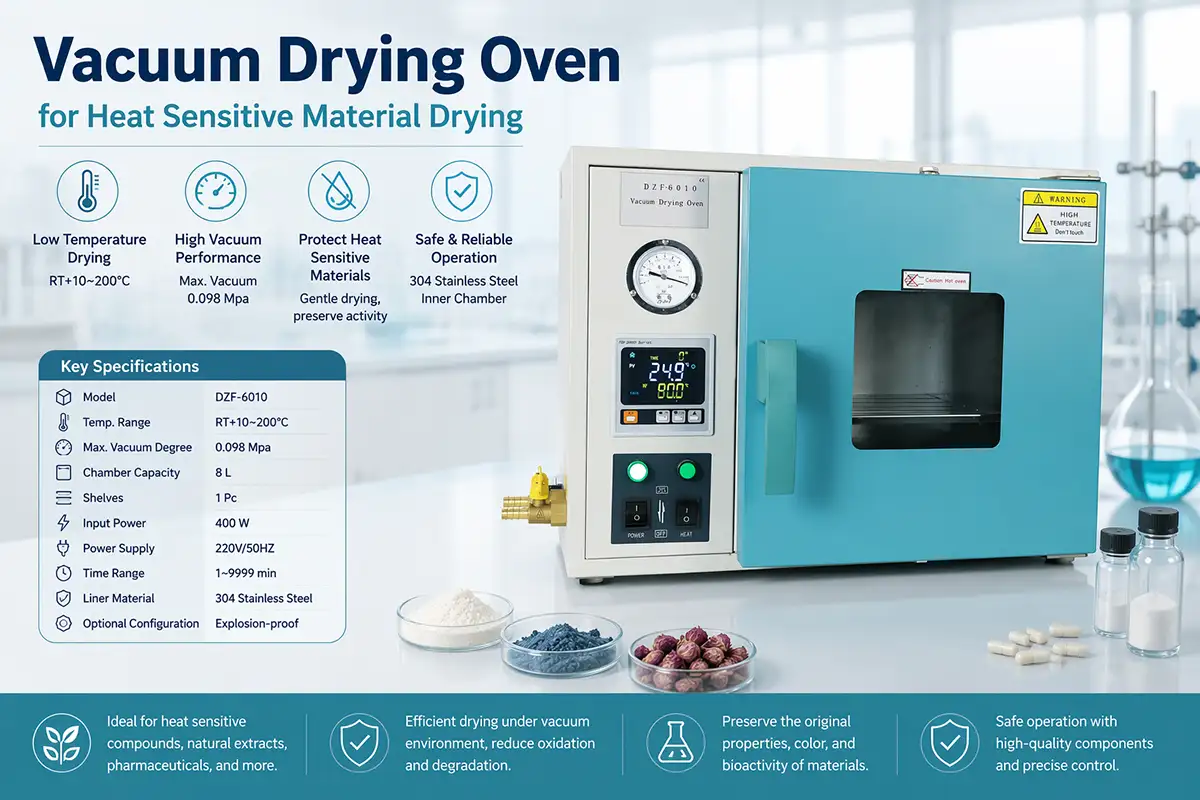
For most laboratory and small production material drying, the ZZKD DZF-6020 or DZF-6050 vacuum drying oven is the best starting choice. The DZF-6020 offers a practical 25 L chamber for routine sample drying, while the DZF-6050 gives 55 L of space for larger trays, powders, polymers, resin, electronic components, and moisture-sensitive materials. For pilot or production drying, the DZF-6090, DZF-6210, and DZF-6500 are better because they provide larger chambers and stronger batch capacity.
A vacuum drying oven is especially useful when the material may oxidize, crack, foam, discolor, or lose active ingredients under normal hot-air drying. If your material is heat-sensitive, porous, oily, hygroscopic, or difficult to dry evenly, vacuum drying is usually the safer and more controlled option.
What makes a vacuum drying oven better for sensitive materials?
Vacuum drying removes air from the chamber, which lowers the boiling point of moisture and solvents. That means water or residual solvent can evaporate at a lower temperature than it would under normal atmospheric pressure. This is the main reason a vacuum oven is often better for material drying than a standard hot air oven.
For a deeper comparison of drying methods, ZZKD has a helpful explanation of the difference between vacuum drying and air drying. In simple terms, hot air drying depends heavily on airflow and heat, while vacuum drying depends on pressure reduction, temperature control, and moisture migration from inside the material.
- Less oxidation: Removing air helps protect oils, plant extracts, electronic parts, battery materials, and active compounds from oxygen exposure.
- Lower drying temperature: Heat-sensitive materials can be dried below the temperature that would damage, melt, or discolor them.
- Cleaner drying environment: A stainless steel liner and sealed chamber help reduce dust and contamination during drying.
- Better internal drying: Vacuum helps pull moisture out of pores, granules, powders, and dense samples instead of only drying the surface.
How to choose the best ZZKD vacuum drying oven
The best choice depends on five practical questions: What are you drying? How much material is in each batch? What temperature can the material tolerate? How fast must the process be? Do you need a standard unit or an explosion-proof option?
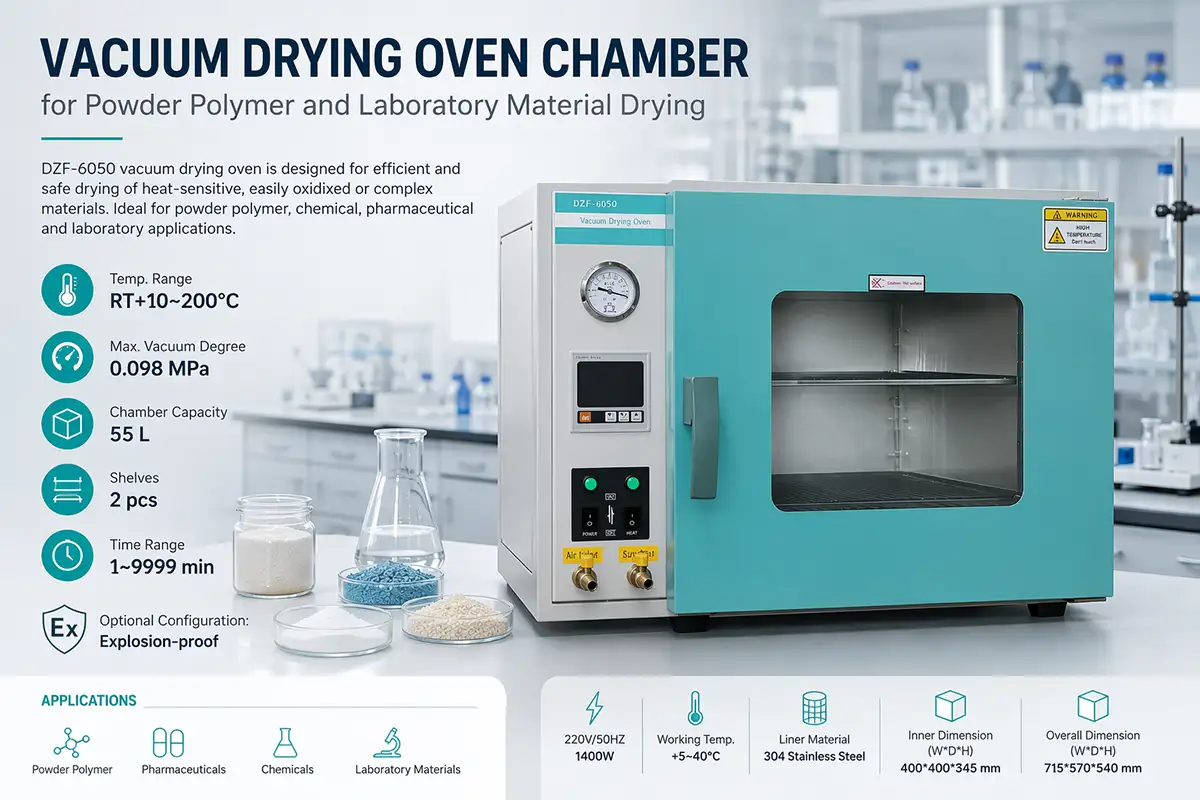
Match chamber volume, shelf layout, temperature range, and vacuum level to the material instead of choosing by price alone.
Choose DZF-6010 for small samples
The DZF-6010 has an 8 L chamber and is suitable for small laboratory batches, test samples, moisture checks, and compact parts. It is a good fit when the material amount is small and you want a lower-cost entry model.
Choose DZF-6020 or DZF-6050 for routine material drying
The DZF-6020 gives 25 L capacity, while the DZF-6050 gives 55 L. These two models are often the most balanced choices because they are large enough for practical drying work but still compact for labs, R&D rooms, universities, and small production lines.
Choose DZF-6090, DZF-6210, or DZF-6500 for larger batches
If you need to dry more material per run, use wider trays, or support pilot production, a larger oven saves labor and improves batch consistency. The DZF-6090 provides 90 L capacity, while the DZF-6210 and DZF-6500 are large 430 L models for heavier workloads.
ZZKD DZF vacuum drying oven specifications
ZZKD DZF vacuum drying ovens use a 304 stainless steel liner, anti-corrosion painted shell, precise temperature control, and a maximum vacuum degree of 0.098 MPa. The working temperature range is RT+10 to 200°C, with a 250°C option available for higher-temperature drying needs.
| Model | Capacity | Input Power | Inner Size (W*D*H) | Best Use | Reference Price |
|---|---|---|---|---|---|
| DZF-6010 | 8 L | 400 W | 200*200*200 mm | Small samples, moisture tests, compact lab drying | About $360 |
| DZF-6020 | 25 L | 700 W | 300*300*270 mm | Routine lab drying, resin, powder, small components | About $472 |
| DZF-6050 | 55 L | 1400 W | 400*400*345 mm | Balanced lab and small production drying | About $679 |
| DZF-6090 | 90 L | 2000 W | 450*450*450 mm | Larger trays, pilot batches, repeated daily drying | About $790 |
| DZF-6210 | 430 L | 2060 W | 560*600*640 mm | Large laboratory and pilot production drying | About $4,000 |
| DZF-6500 | 430 L | 2800 W | 630*810*845 mm | Large-volume material drying with more internal space | Quote recommended |
Which oven is best for different materials?
If you dry powders, choose a chamber that gives enough tray area for a thin and even material layer. Thick powder piles dry slowly, even in vacuum. For polymer resin, plastic pellets, rubber, and chemical intermediates, the DZF-6020 or DZF-6050 is usually a strong choice because the chamber size is practical and the temperature control is stable. For electronics, sensors, glassware, and precision parts, choose a model with enough internal space so parts do not touch the chamber wall or block heat transfer.
For plant extracts, food ingredients, oils, catalysts, ceramic powders, and other oxidation-sensitive materials, vacuum drying is often more suitable than hot air drying because it reduces oxygen contact. ZZKD also explains how vacuum oven drying supports material processing, especially where low-temperature drying and product stability matter.
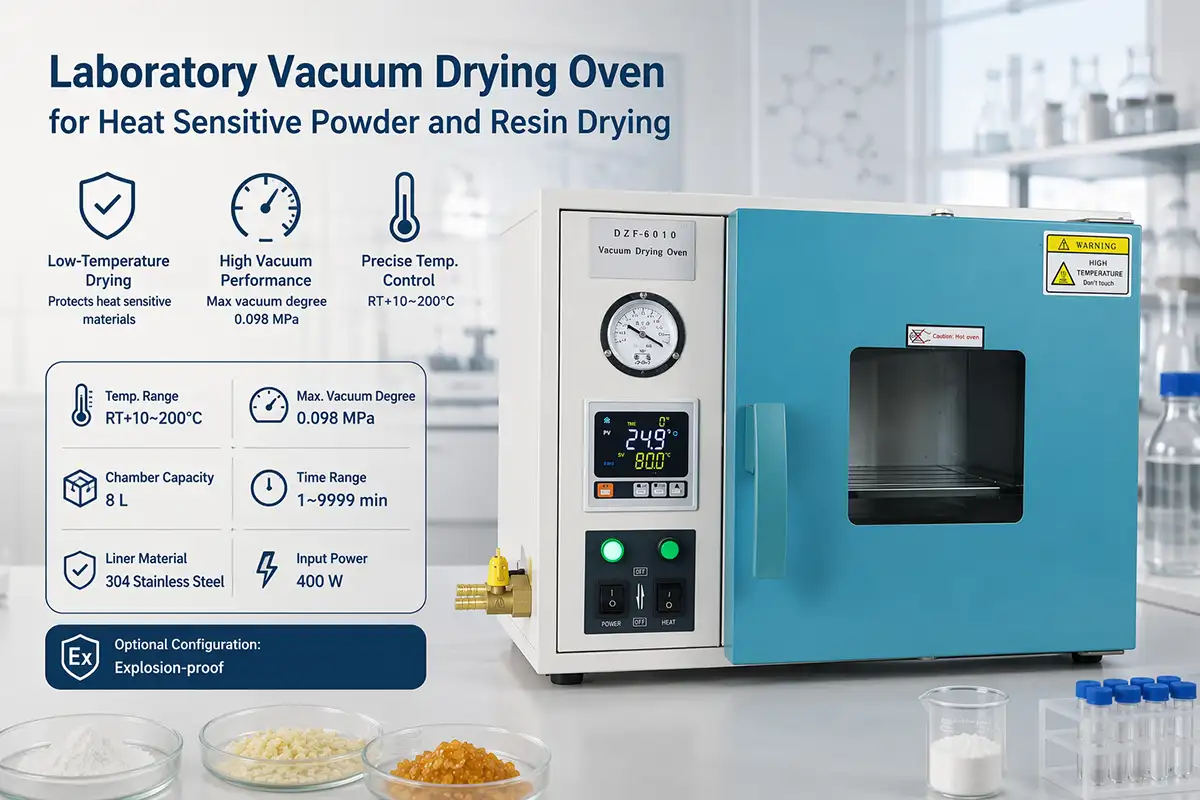
For powders, pellets, resin, and precision parts, the best drying result usually comes from a thin layer, stable vacuum, and controlled temperature ramping.
When the material contains flammable solvent residues, standard equipment may not be enough. In that case, discuss the solvent type, vapor concentration, pump configuration, and explosion-proof requirements with ZZKD before ordering. A safer drying system is always better than forcing a standard oven into a risky process.
When should you choose vacuum drying instead of hot air drying?
Choose a vacuum drying oven when material quality is more important than the lowest equipment cost. Vacuum drying is better when the product must keep its color, active ingredients, chemical structure, shape, or surface quality. It is also useful when moisture is trapped inside pores or when drying at high temperature may cause oxidation or degradation.
Choose a hot air oven when the material is rugged, non-sensitive, and can tolerate strong airflow and higher temperature. Hot air circulation equipment can be a practical option for some large-scale, non-sensitive drying work; ZZKD also provides hot air circulation drying oven solutions for those applications.
Simple rule
If your material is expensive, sensitive, reactive, or difficult to dry internally, choose vacuum drying. If your material is stable, low-cost, and needs bulk surface drying, hot air drying may be enough.
What is the best overall ZZKD model?
For general material drying, the best overall choice is the ZZKD DZF-6050. It has a 55 L chamber, 1400 W input power, a 400*400*345 mm inner size, 304 stainless steel liner, and enough space for routine laboratory and small production batches. It is not as small as the DZF-6010 and not as large as the 430 L models, so it gives a good balance of capacity, price, and daily usability.
If your work is mainly sample testing, choose the DZF-6010. If you need a compact but more useful lab oven, choose the DZF-6020. If you want one model that can cover most research and small production needs, choose the DZF-6050. If your priority is batch volume, move up to the DZF-6090, DZF-6210, or DZF-6500.
Final answer: choose by material risk and batch size
The best vacuum drying oven for material drying is a ZZKD DZF model that matches your material risk and batch size. For most buyers, the DZF-6050 is the strongest all-around recommendation because it provides useful 55 L capacity, stable temperature control, stainless steel construction, and a reasonable reference price. For smaller budgets or small sample work, the DZF-6020 is a smart choice. For larger batches, the DZF-6090 and 430 L models are more efficient.
Before buying, confirm the material name, moisture or solvent content, safe drying temperature, target final moisture, batch weight, tray loading thickness, vacuum pump requirement, and whether explosion-proof configuration is needed. With those details, ZZKD can help match the oven, pump, chamber size, and accessories to your real drying process instead of guessing from capacity alone.