




Short Path Distillation Equipment for Solvent Recovery Purchase
Buying short path distillation equipment for solvent recovery should not feel confusing. The right system helps you separate usable solvent from higher-boiling residues, protect heat-sensitive materials, reduce waste, and make small batch purification more predictable. This guide explains what buyers usually ask before purchasing a ZZKD short path distillation setup, including model choice, core parts, price references, and practical operating points.
What does short path distillation do for solvent recovery?
Short path distillation is a vacuum distillation method. Under vacuum, a solvent can boil at a lower temperature than it would at normal pressure. That matters because lower temperature helps reduce thermal stress, darkening, oxidation, and unwanted decomposition. In a short path setup, vapor travels a short distance from the boiling flask through the distillation head into the receiver. The compact vapor route helps improve transfer efficiency and makes the system suitable for laboratory and pilot scale batches.
For solvent recovery, the goal is simple: heat the used solvent mixture carefully, let the target solvent vaporize, condense it back into liquid, and collect it in clean receiving flasks. The remaining heavy residue stays behind. If your process uses ethanol, acetone, light essential oil solvents, or other recoverable liquids, the short path system can be a practical part of a cleaner workflow. If you are comparing recovery methods, ZZKD also has useful background on solvent recovery equipment and where different recovery systems fit.
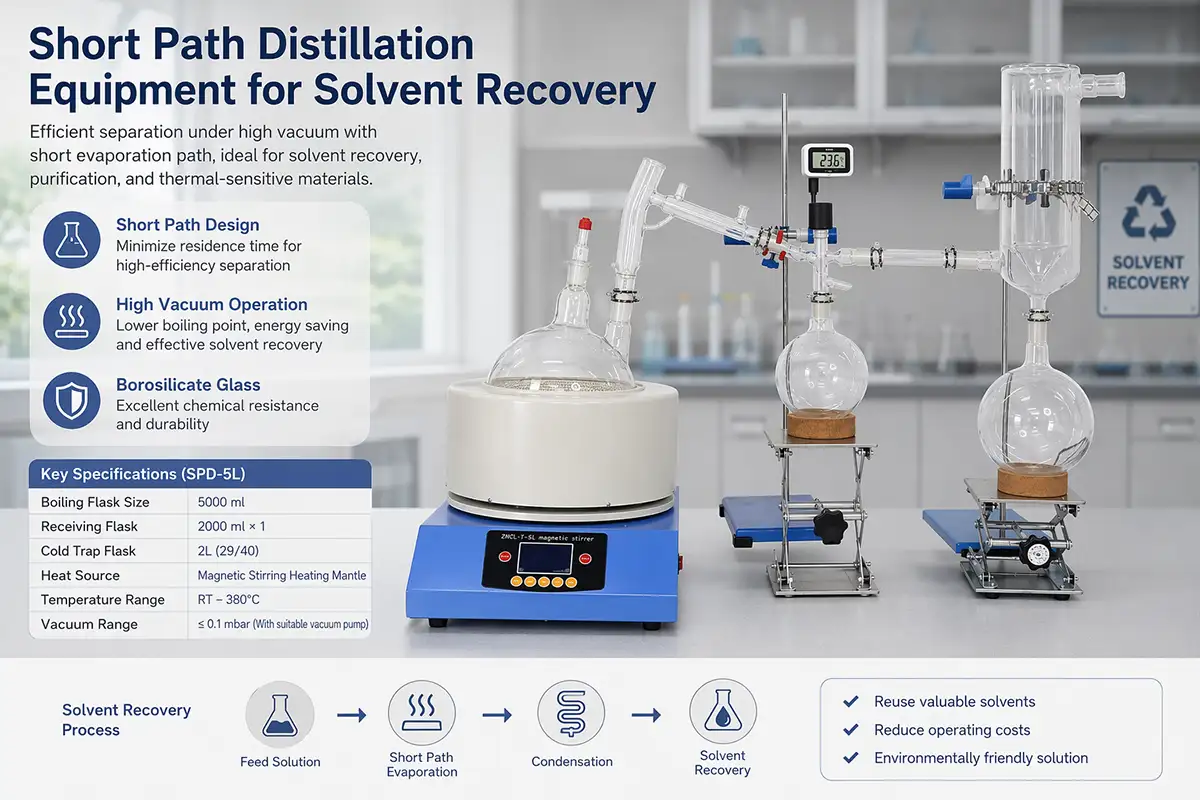
How to choose the right ZZKD short path distillation model
The main sizing question is batch volume. A smaller SPD-2L unit is easier to handle, warms up faster, and is friendly for method development. A 5L unit is a common middle choice for labs that need more throughput without moving into a large footprint. SPD-10L and SPD-20L systems are better when the operator already understands the solvent behavior and wants fewer repeated batches.
Do not choose by flask volume alone. The complete working setup should include a suitable vacuum pump, a cold trap to protect the pump, enough cooling capacity, stable stands and clamps, and receiving flasks sized for the expected recovered solvent volume. The more volatile the solvent, the more attention you should give to condenser temperature and cold trap performance. A good purchase decision is not just "which glass kit is cheapest"; it is "which package can recover my solvent cleanly, safely, and repeatedly."
SPD-2L
Good for testing recipes, small solvent batches, teaching labs, and users who want a compact entry system.
SPD-5L
A balanced choice for many laboratories because it adds capacity while staying manageable for one trained operator.
SPD-10L to SPD-20L
Better for larger batches, repeated recovery runs, and buyers who want to reduce handling time between batches.
ZZKD short path distillation kit configuration
Based on ZZKD product parameters, the core kit includes a digital heating mantle, a two-neck boiling flask, a short path distillation head, a cow receiver, round bottom receiving flasks, Keck clips, a cast iron stand, and a metal three finger clamp. Larger 10L and 20L listings also show a cold trap in the configuration. For real solvent recovery work, a cold trap is strongly recommended because it captures vapors before they reach the vacuum pump.
| Model | Boiling flask and heating mantle | Receiving flasks | Important included parts | Best fit |
|---|---|---|---|---|
| SPD-2L | 2000 ml digital heating mantle and 2000 ml two-neck boiling flask | 3 x 500 ml round bottom flasks | Short path head, cow receiver, 7 Keck clips, stand, clamp | Small batch method testing and light solvent recovery |
| SPD-5L | 5000 ml digital heating mantle and 5000 ml two-neck boiling flask | 3 x 1000 ml round bottom flasks | Short path head, cow receiver, 7 Keck clips, stands, clamp, cold trap, stirring bar, lifting platform | General lab use and repeatable solvent recovery batches |
| SPD-10L | 10000 ml digital heating mantle and 10000 ml two-neck boiling flask | 3 x 2000 ml round bottom flasks | Short path head, cow receiver, 7 Keck clips, stand, clamp, cold trap | Bigger lab batches where vacuum and cooling are already planned |
| SPD-20L | 20000 ml digital heating mantle and 20000 ml two-neck boiling flask | 3 x 3000 ml round bottom flasks | Short path head, cow receiver, 7 Keck clips, stand, clamp, cold trap | Higher recovery volume and fewer batch changeovers |
What price should buyers expect?
Short path distillation prices vary because sellers may quote glassware only, a basic kit, or a more complete package with a vacuum pump and chiller. Based on the provided product price list, small laboratory short path distillation kits often appear from the mid hundreds of US dollars, while larger and more complete systems can move above one thousand dollars. When a product showed a range, a lower-middle reference was used instead of the highest number, because buyers usually want a realistic but cost-conscious planning price.
| Purchase option | Typical use | Reference price | Buyer note |
|---|---|---|---|
| 2L ZZKD glass lab short path kit | Entry solvent recovery and testing | $475 | Good for learning the process before scaling. |
| SPD-5L short path distillation | Routine lab recovery and purification | $628 | A practical middle size for many laboratories. |
| 10L short path distillation machine | Larger lab batches | $900 | Confirm heating mantle power, receiving flask size, and support frame. |
| 20L setup with vacuum pump and chiller | Higher volume solvent recovery | $1,200 | More complete packages cost more but reduce accessory matching work. |
The lowest advertised price is not always the best purchase. If a system does not include a cold trap, pump, chiller, or proper glass joints, the final installed cost can rise quickly. Before paying, ask whether the quote includes all glassware, stands, clamps, seals, pump protection, cooling connections, and spare fragile parts.
What makes solvent recovery more stable?
Stable solvent recovery depends on three conditions: controlled heat, reliable vacuum, and effective cooling. Heat should rise gradually so the boiling flask does not bump or foam. Vacuum should be pulled down step by step, especially when the used solvent contains dissolved gases or low-boiling impurities. Cooling should be ready before strong vapor production begins, otherwise valuable solvent can pass through the condenser and overload the cold trap.
Operators should also avoid overfilling the boiling flask. A common habit is to leave enough headspace for bubbling and vapor movement. If the flask is too full, liquid can splash into the distillation head and contaminate the recovered solvent. For buyers who are new to the process, it is worth reading more about short path fractional distillation so the benefits and limits are clear before choosing a model.
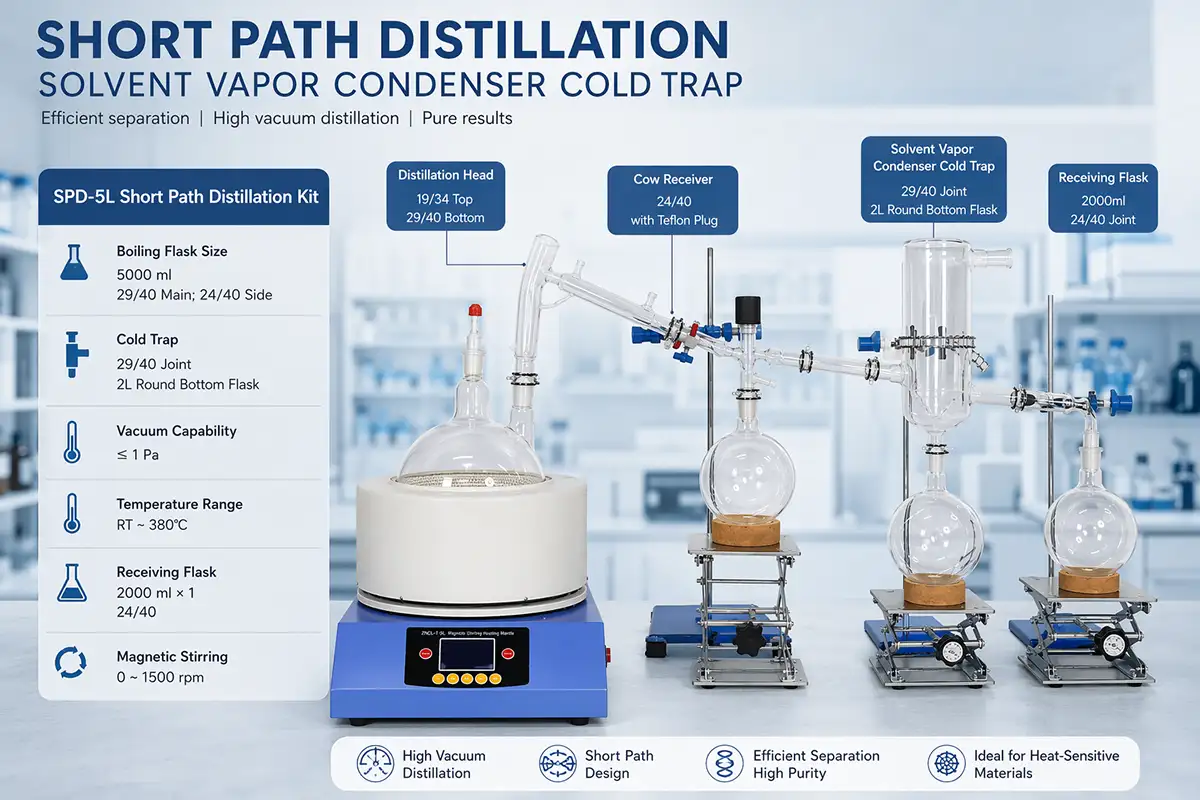
Questions to answer before placing an order
A good purchase request gives the supplier enough detail to recommend the correct configuration. The more information you provide, the easier it is for ZZKD to match glass volume, heating power, cooling capacity, and vacuum level.
- What solvent are you recovering? Ethanol, acetone, and other solvents have different boiling points, vapor loads, and safety requirements.
- How much liquid is processed per batch? Select 2L, 5L, 10L, or 20L capacity based on practical working volume, not only total flask size.
- What purity do you need? Basic recovery is different from high-purity fraction collection.
- Do you already have a pump and chiller? If not, buying a complete package can prevent mismatched accessories.
- Will the solvent foam or carry solids? Foaming liquids may need slower heating, more headspace, and careful pre-filtration.
- Do you need spare glassware? Receiving flasks, clips, seals, and thermometer parts are useful spares for daily operation.
Why choose ZZKD for a short path distillation purchase?
ZZKD short path distillation equipment is aimed at laboratories and small production users who need practical, understandable equipment rather than an oversized industrial system. The model range covers small method development and larger recovery batches. The glass configuration is easy to inspect, the modular structure is convenient for cleaning, and the system can be matched with vacuum pumps, cold traps, and cooling equipment according to the solvent and workload.
For buyers who want to compare product pages directly, ZZKD provides short path distillation kits for common laboratory capacities. When contacting the sales team, share your solvent name, batch volume, expected daily runs, target recovery rate, and whether you need a complete vacuum and cooling package. Those details make the final quotation much more accurate.
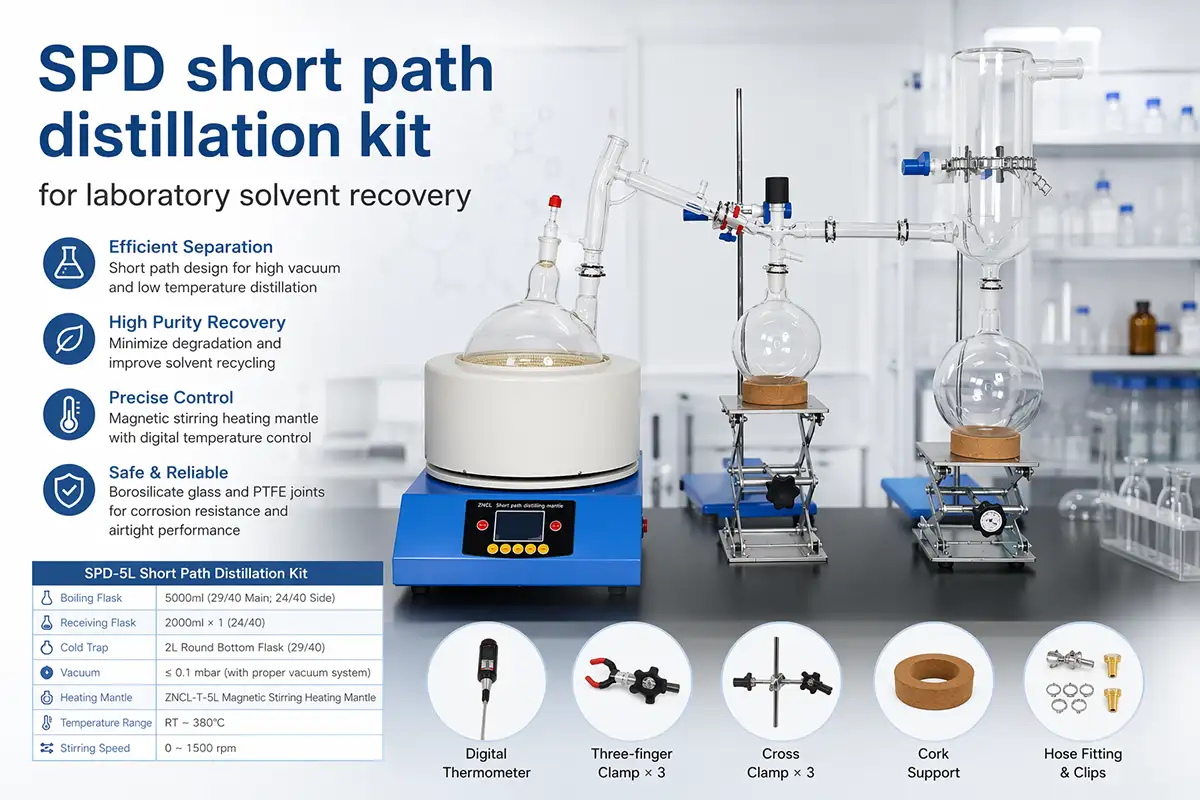
Common buyer questions
Can short path distillation remove solvent completely?
It can remove and recover a large portion of volatile solvent when the boiling point difference, vacuum level, heating temperature, and condenser temperature are suitable. However, "complete" removal depends on the material and purity target. Some residues may need a longer hold time, deeper vacuum, or a second finishing step.
Is a cold trap necessary?
For solvent recovery, a cold trap is highly recommended. It protects the vacuum pump from solvent vapor, helps reduce pump oil contamination, and improves workplace cleanliness. On larger SPD-10L and SPD-20L systems, the cold trap becomes even more important because vapor load is higher.
Should I buy 2L or 5L first?
If you are developing a new recovery process or processing very small batches, SPD-2L is economical and easy to learn. If you already run regular batches, SPD-5L usually gives a better balance of price, capacity, and handling time.
What accessories affect the final price most?
The vacuum pump, chiller, cold trap, glass size, support frame, and spare parts have the biggest effect. A cheap glass-only kit may look attractive, but a complete working recovery setup needs compatible accessories.
What information should I send to ZZKD for a quote?
Send the solvent type, liquid volume per batch, target recovered solvent quality, available power supply, preferred model size, and whether you need the pump and chiller included. Photos or a short description of your current process also help.
Final purchasing advice
For most buyers, the smartest choice is the smallest ZZKD short path distillation system that can comfortably handle the real working batch volume while leaving enough headspace and cooling capacity. SPD-2L is ideal for testing, SPD-5L is the practical lab workhorse, and SPD-10L or SPD-20L is better for higher recovery volume. Match the glassware with a suitable vacuum pump, cold trap, and chiller, and the equipment will be far easier to run, clean, and maintain.