




Why Can Spray Drying Turn Liquid Directly into Powder—and Still Control Particle Size?
Spray drying often looks almost magical: a pump feeds liquid into a machine, and seconds later a dry powder appears. But the science behind it is actually very clear. Once the process is understood, it becomes easier to see why spray drying is one of the most efficient ways to make stable powders from solutions, extracts, emulsions, and some suspensions.
The basic reason is simple. A spray dryer does not try to dry one large pool of liquid. Instead, it breaks the liquid into countless tiny droplets. These droplets have a very large surface area compared with their volume, so moisture can evaporate very quickly when they meet hot drying air. That is why spray drying solutions can convert a liquid feed into powder in a matter of seconds rather than hours.
In practical operation, the sequence is straightforward: the feed solution enters the atomizer or nozzle, the liquid is dispersed into fine droplets, hot air contacts those droplets, the water or solvent evaporates rapidly, and the dry particles are then collected. This is the core of the “liquid to powder” effect.
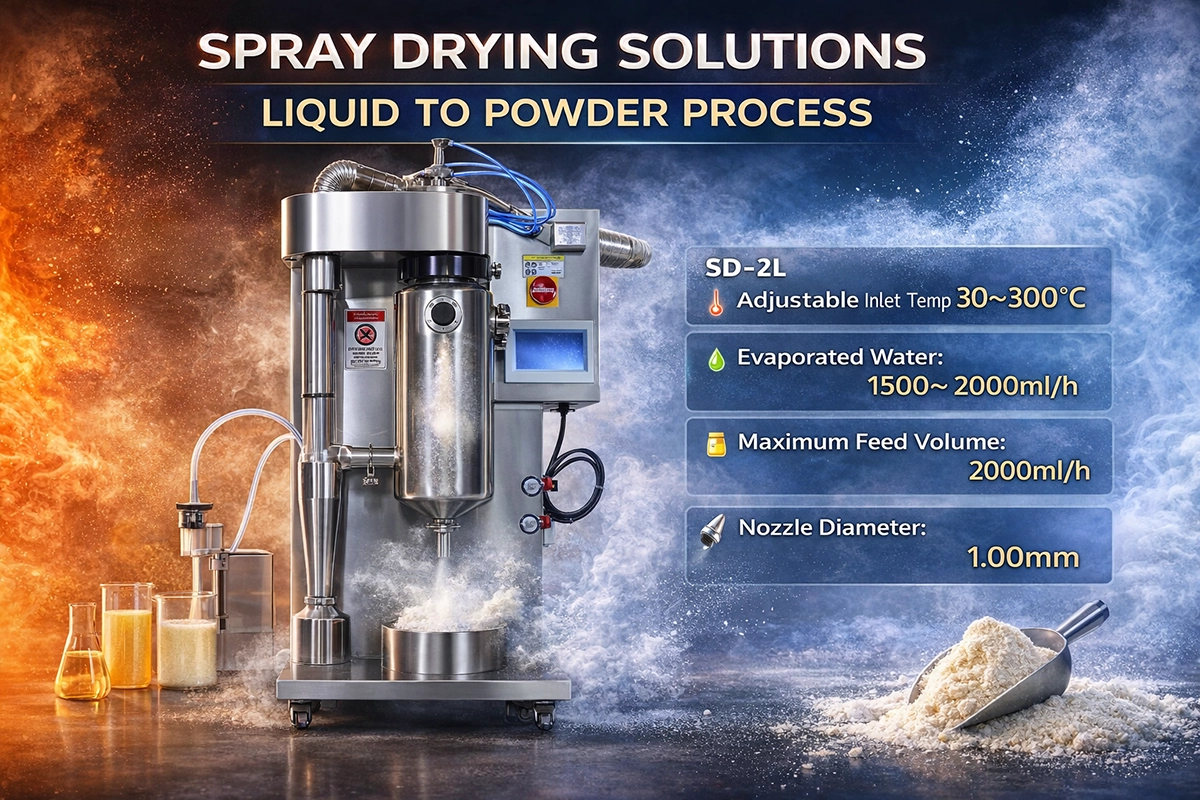
This is one of the most common questions. The answer is that evaporation itself cools the droplets. Even if the inlet air is hot, the droplet surface temperature is often much lower during the main drying stage because heat is being consumed to evaporate moisture. In other words, the hot air provides the energy, but the droplet is busy losing water so quickly that the material can remain within a manageable temperature range.
Interactive question: If the inlet temperature is high, does that automatically mean the product will be overheated?
Not necessarily. From the author’s perspective, this is exactly where spray drying is often misunderstood. The key is not only the inlet temperature, but also the outlet temperature, droplet size, residence time, and feed rate. With proper settings, many heat-sensitive materials can still be dried successfully because the average drying time is extremely short.
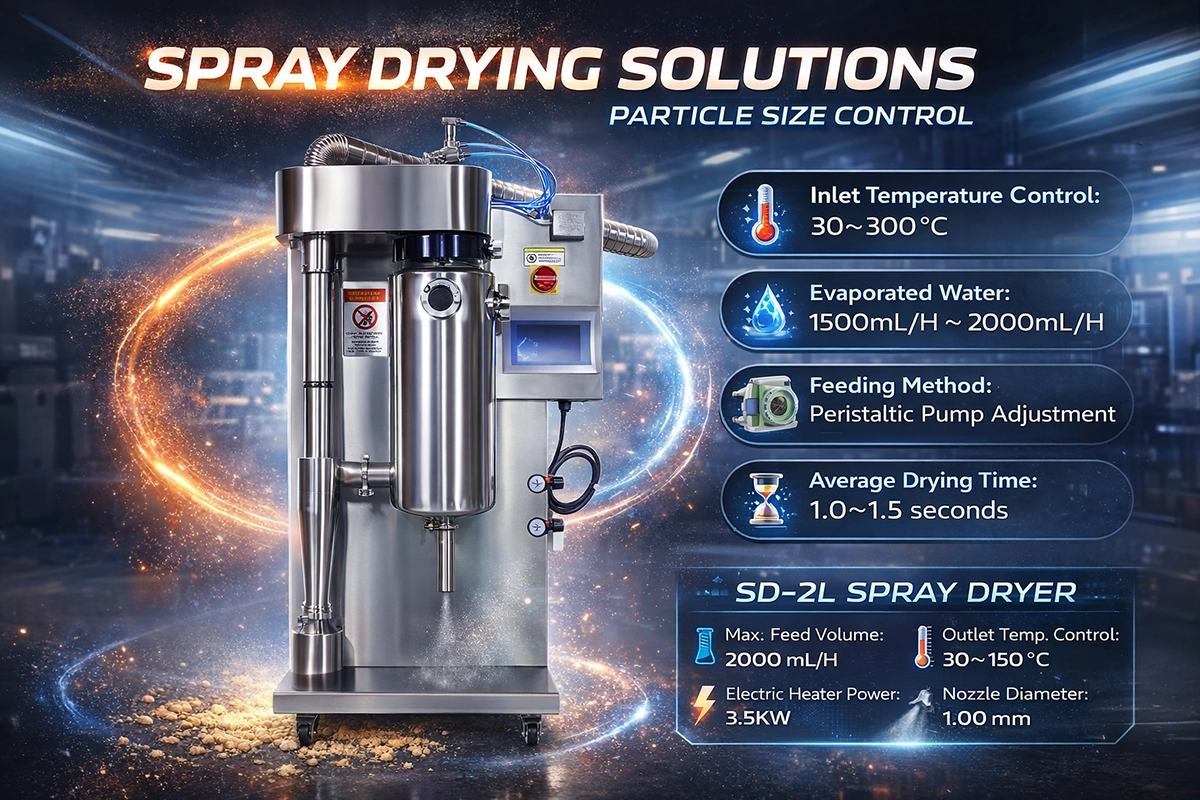
For example, the laboratory spray dryer parameters provided here show an average drying time of about 1.0 to 1.5 seconds on models such as LPG-3L and SD-2L. That very short residence time helps explain why spray drying can work even for sensitive formulations. It is fast, controlled, and repeatable.
If a broader comparison is helpful, this article on spray drying equipment versus other drying methods gives useful context for why spray drying is chosen when speed and powder quality matter.
This is the second big advantage of spray drying. The machine does not just dry liquid; it also shapes powder characteristics. Particle size is influenced by how the droplets are created and how they dry. In simple terms, smaller droplets usually produce smaller particles, while larger droplets usually produce larger particles.
The most important control points include:
- Nozzle or atomizer design: nozzle diameter, spray disc diameter, and atomization method directly affect droplet size.
- Feed rate: changing the peristaltic pump speed changes how much liquid enters the chamber and influences droplet formation and drying behavior.
- Liquid properties: viscosity, solids content, and surface tension all affect atomization.
- Inlet and outlet temperature: these influence drying speed, shell formation, and final particle structure.
- Airflow and pressure: fan air volume and compressed air conditions also shape the drying environment.
For example, the supplied specifications mention a 1.00 mm nozzle diameter for the LPG-3L and SD-2L, with optional sizes such as 0.7 mm, 1.5 mm, and 2.0 mm. That matters because different nozzle sizes help produce different droplet distributions. On the LPG-5L to 10L side, the use of centrifugal atomization shows another route to controlling droplet formation at higher capacities.
Interactive question: Can one spray dryer make both fine powder and slightly larger granules?
In the author’s view, yes—within a realistic operating range. The same equipment can often be adjusted for different particle targets by changing nozzle size, feed concentration, pump speed, inlet temperature, and atomization conditions. It is not unlimited, but it is highly flexible for product development and pilot work.
Most buyers and researchers are not just asking about theory. They usually want practical answers:
-
Can a spray dryer really turn liquid into powder directly?
Yes. As long as the feed is suitable for atomization and drying, the liquid can be fed directly into the machine and collected as powder after rapid evaporation. -
Can particle size be adjusted?
Yes. It can be influenced through nozzle selection, atomization method, feed concentration, airflow, and temperature control. -
Is the process fast enough for lab and pilot work?
Yes. The provided lab-scale units show drying times around 1.0–1.5 seconds, making them highly efficient for formulation screening and process development. -
What kind of materials can be handled?
Solutions are ideal, and some suspension liquids can also be processed, depending on viscosity, solids, and atomization conditions.
For readers exploring smaller-scale systems, this guide to a laboratory spray dryer is also relevant, especially when comparing R&D and pilot needs.
The parameters provided for the LPG and SD series clearly show how modern spray dryers are designed around controllability. Temperature windows are wide, feed is adjustable, and atomization options are available for different process goals.
| Model | Inlet Temperature | Outlet Temperature | Evaporation Capacity | Feed / Atomization | Notable Point |
|---|---|---|---|---|---|
| LPG-3L | 30–300°C | 30–140°C | 1500–3000 mL/h | Peristaltic pump, nozzle atomization | Optional nozzle sizes, ±1°C control |
| SD-2L | 30–300°C | 30–150°C | 1500–2000 mL/h | Peristaltic pump, 1.00 mm nozzle | Compact footprint, 1.0–1.5 s drying |
| LPG-5L | Room temp to 330°C | Room temp to 140°C | About 6 L/h | Centrifugal atomization | Suitable for solution and some suspension liquids |
On mobile devices, tables like this should always be placed inside a responsive wrapper, which is why Bootstrap’s .table-responsive class is included here.
Controlling particle size is not just a technical detail. It changes how the powder behaves. Finer particles may dissolve faster, larger particles may flow better, hollow particles may reduce bulk density, and denser particles may pack differently. This affects storage, transport, mixing, solubility, and downstream processing.
That is why spray drying is used across food, pharmaceuticals, chemicals, and materials science. It is not only a drying step. It is also a powder engineering step.
Interactive question: Why do many manufacturers prefer spray drying over slower drying methods for solutions?
From the author’s perspective, the answer is efficiency plus control. Spray drying can save time, reduce handling steps, improve powder consistency, and give more control over moisture and particle properties. When the goal is a dry powder rather than a sticky concentrate, it is often the most direct route.
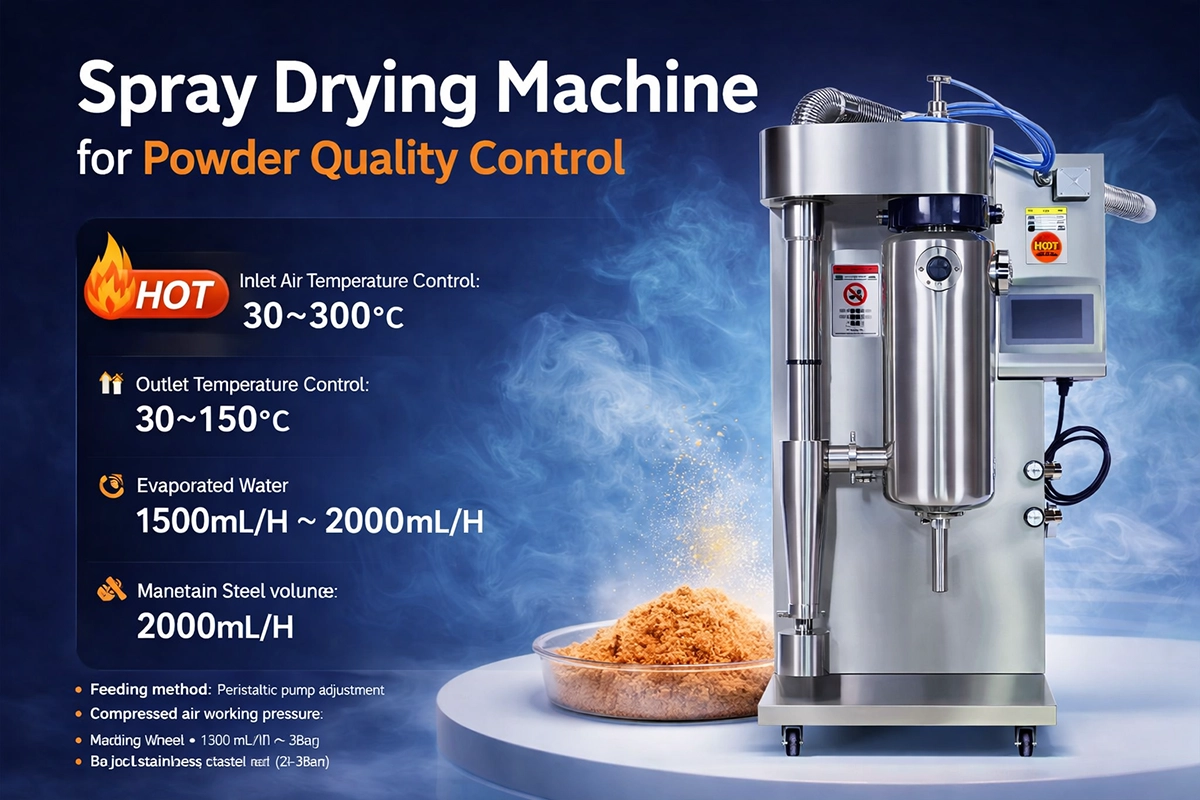
Spray drying works because liquids are first transformed into tiny droplets, and tiny droplets dry very fast. That is the core reason a solution can go directly from liquid to powder in seconds. Particle size control is possible because the machine controls how those droplets are formed and how they move through the drying chamber.
So, if the goal is to make uniform powder from liquid feed while also tuning powder characteristics, spray drying solutions offer a highly practical answer. With adjustable temperature, feed rate, atomization method, and nozzle configuration, a modern spray drying machine can do much more than simple drying—it can help shape the final product itself.
Readers who also want a broader safety and application overview can continue with this explanation of spray drying in food and related applications.