




How to Choose a Short Path Distillation System?
Choosing short path distillation equipment is not simply a matter of buying the largest flask. A suitable system must match the feed material, actual batch volume, thermal sensitivity, vacuum requirements, and fraction-collection plan. When these factors work together, laboratory separation becomes easier to control and more repeatable.
ZZKD’s SPD-2L, SPD-5L, SPD-10L, and SPD-20L configurations provide different nominal flask capacities for laboratory development and larger batch evaluation. This guide explains how to compare those options and identify the supporting equipment needed for a practical installation.
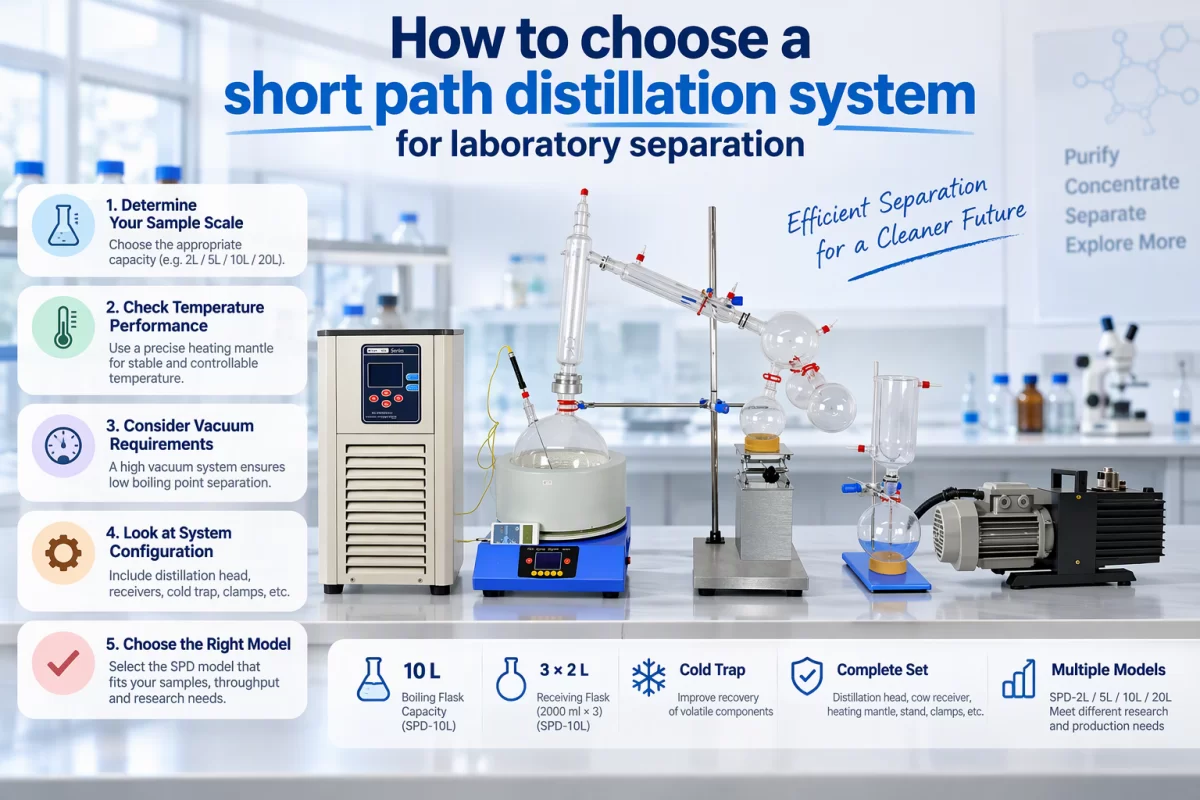
Start with the Material and Separation Objective
Short path distillation uses a compact vapor route between evaporation and condensation. Under reduced pressure, suitable compounds can boil at lower temperatures than at atmospheric pressure. This can be beneficial for high-boiling materials, although thermal exposure still depends on the feed, pressure, temperature, and time spent in the boiling flask.
Before selecting equipment, document the feed composition, viscosity, residual solvent content, expected fractions, and required product quality. Separation becomes more challenging when components have similar volatility or when the material foams, decomposes, or becomes difficult to stir.
Solvent-rich feeds often benefit from a separate bulk-solvent removal stage. The guide to solvent removal with short path distillation provides related context. Final residual-solvent compliance must be verified analytically rather than assumed from equipment choice.
Does a shorter vapor path automatically guarantee higher purity?
Alice’s assessment: No. I consider the short vapor path a useful design feature, not a purity guarantee. Feed composition, stable pressure, controlled heating, and accurate fraction switching remain decisive. A representative trial is the strongest basis for evaluating achievable separation.
Match Flask Size to the Real Batch Requirement
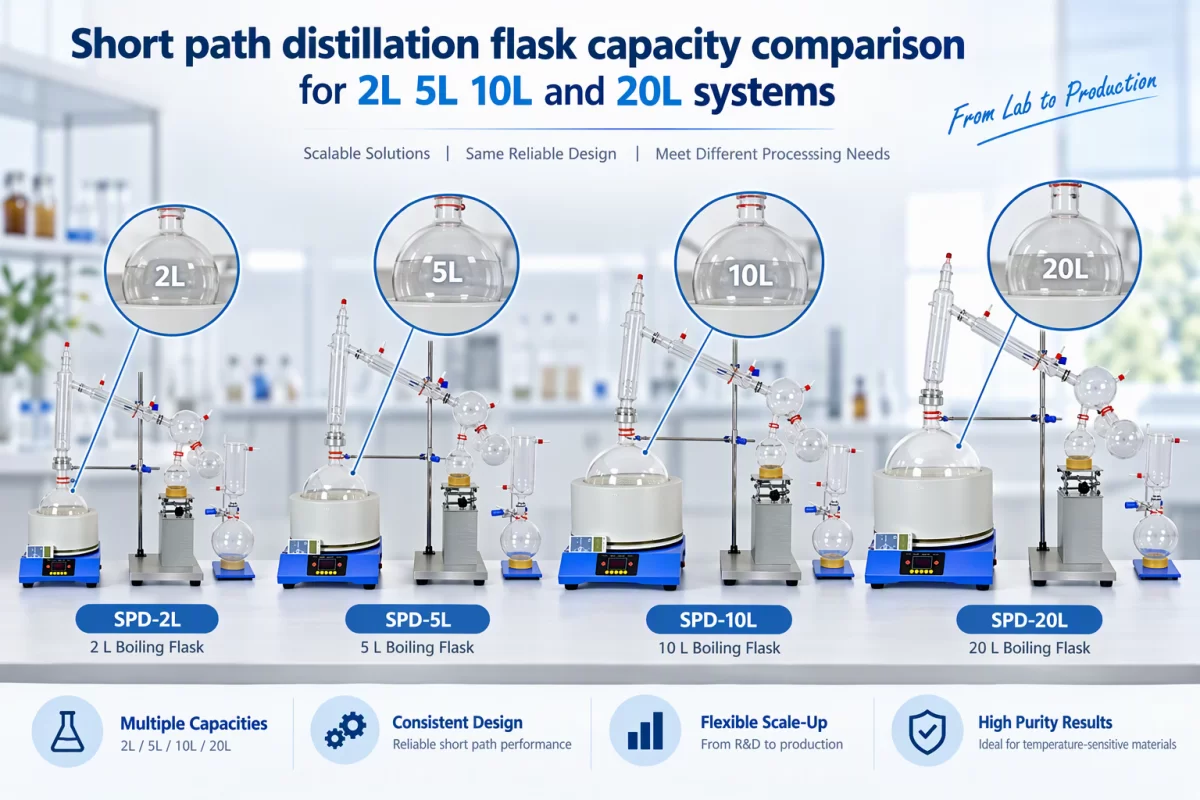
The stated 2L, 5L, 10L, and 20L capacities refer to nominal boiling-flask volume. They do not establish safe working charge, hourly throughput, or finished-product yield. Headspace is needed for vapor generation and possible foaming, so the allowable fill must follow the equipment instructions and material-specific assessment.
| Model | Digital heating mantle | Two-neck boiling flask | Receiving flasks |
|---|---|---|---|
| SPD-2L | 1 × 2,000 ml | 1 × 2,000 ml | 3 × 500 ml |
| SPD-5L | 1 × 5,000 ml | 1 × 5,000 ml | 3 × 1,000 ml |
| SPD-10L | 1 × 10,000 ml | 1 × 10,000 ml | 3 × 2,000 ml |
| SPD-20L | 1 × 20,000 ml | 1 × 20,000 ml | 3 × 3,000 ml |
On smaller screens, scroll horizontally to view all specifications.
As a selection starting point, SPD-2L can suit smaller development batches, while SPD-5L offers a larger nominal vessel for repeated laboratory work. SPD-10L and SPD-20L can accommodate larger charges, subject to validated working limits. These are application suggestions, not guaranteed production ratings.
Receiver capacity also deserves attention. An uneven fraction distribution may fill one receiving flask well before the others. Plan fraction changes around the expected distillate volume rather than treating the combined receiver volume as uninterrupted collection capacity.
Is the largest short path distillation system always the most economical choice?
Alice’s assessment: No. I recommend the smallest configuration that reliably accommodates the validated batch and realistic growth needs. Oversizing can increase setup demands, cleaning effort, and the difficulty of handling small samples without providing a useful productivity advantage.
Choose Vacuum Equipment for Operating Conditions
A vacuum pump’s ultimate-pressure specification describes only part of its suitability. During distillation, the pump must handle vapor load while the assembled system introduces additional pressure losses through tubing, fittings, traps, and potential leaks.
- Operating pressure: establish the required pressure range from the intended separation and confirm it under realistic process conditions.
- Chemical compatibility: check pump wetted materials, seals, tubing, and exhaust arrangements against the actual vapors.
- Pressure measurement: request a suitable gauge and a measurement location that meaningfully represents the distillation process.
- Vapor protection: specify a correctly sized cold trap and suitable cooling method to reduce condensable vapor reaching the pump.
- Leak control: confirm joint compatibility, sealing procedures, and vacuum-rated connections.
Do not assume that a vacuum pump, gauge, or chiller is included simply because the equipment is described as a kit. These components are not established as supplied items in the listed core configurations and should be confirmed in the quotation.
Check Heating, Stirring, and Condenser Cooling
Each listed SPD model includes a digital heating mantle matched to its boiling-flask size. However, mantle capacity alone does not establish heating power, maximum operating temperature, control accuracy, or stirring capability. Request these specifications separately.
Distinguish the controller setpoint from the actual liquid temperature and vapor-head temperature. Sensor position and measurement range affect the usefulness of the readings. For viscous feeds, verify stirring performance under representative conditions; a supplied stirring bar does not by itself confirm the mantle’s stirring functions.
Condenser cooling must also match the fraction being collected. Insufficient cooling can allow vapor to pass downstream, while excessive cooling may cause a high-melting distillate to solidify and restrict flow. Confirm coolant connections, temperature range, and cooling capacity at the intended operating temperature.
For upstream bulk-solvent removal, a rotary evaporator may complement rather than replace short path distillation. The explanation of how a rotary evaporator works helps distinguish the two stages when planning a complete laboratory workflow.
Review the Parts List Before Comparing Kits
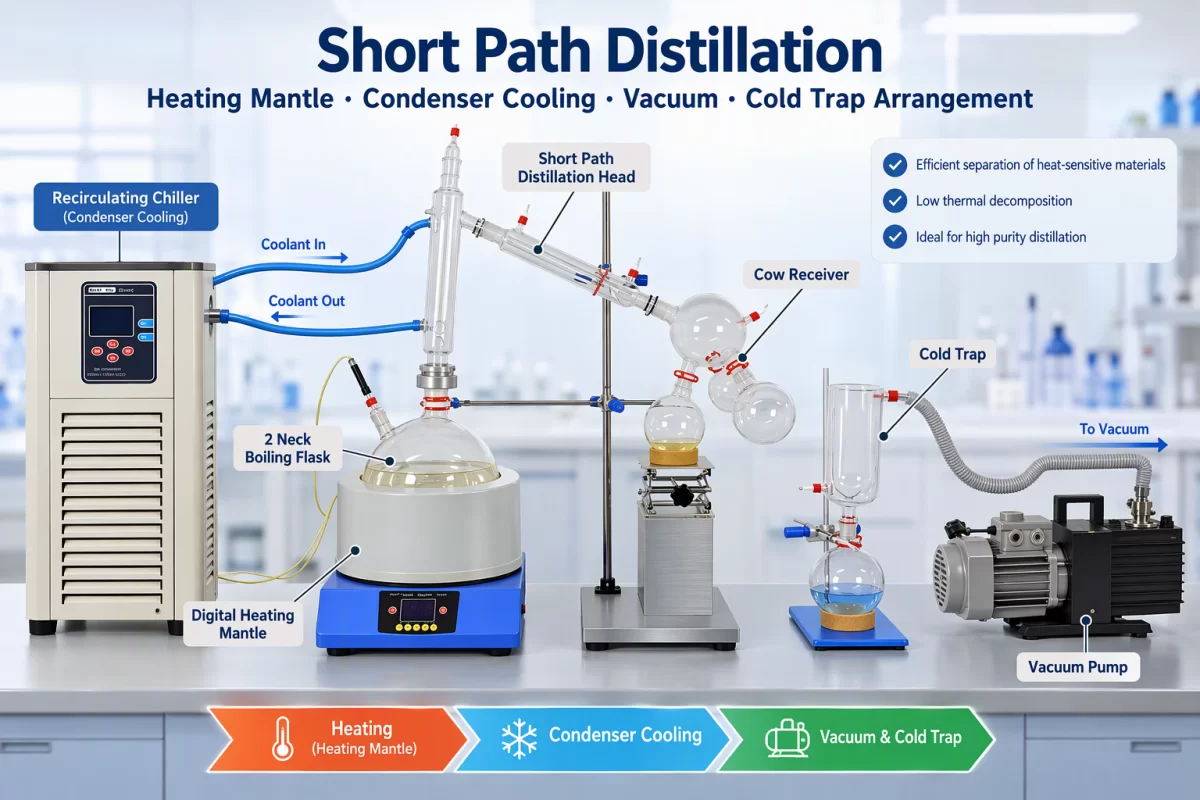
The core SPD configurations list a short path distillation head, a cow receiver, three round-bottom receiving flasks, seven plastic Keck clips, and supporting stand and clamp components. These parts provide the basic assembly, but the detailed bill of materials determines what arrives with the order.
The detailed 5L configuration additionally lists one cold trap, one PTFE magnetic stirring bar, one lifting platform, one backing ring, and one thermometer sensor. It specifies two cast iron stands, whereas the summary configuration lists one. Confirm the selected package’s stand quantity and accessories in writing.
The 10L and 20L summary configurations also list a cold trap. The 2L list does not specify one, so trap provision should be checked when selecting vacuum protection. Compare the 5L short path distillation kit with the intended process requirements and request a finalized configuration rather than assuming every package includes identical accessories.
Glassware and assembly check: request glass material, joint sizes, replacement-part availability, and operating limits. Plastic joint clips are retainers, not substitutes for structural support; confirm their temperature suitability at each installation point.
Compare Complete Configuration Costs
A meaningful short path distillation budget includes the main kit, vacuum pump, gauge, cooling equipment, trap cooling, connections, installation requirements, spare glassware, and delivery. A lower initial kit cost can lose its advantage if essential supporting components are omitted.
Request a current ZZKD quotation for the chosen model and accessory package. The available configuration information does not specify prices, so an exact company price must be confirmed before purchase. Compare quotations only after matching the supplied equipment and commercial terms.
What provides better purchasing value: a basic kit or a matched equipment package?
Alice’s assessment: I favor a matched package when compatible supporting equipment is not already available. A basic kit can be sensible for an established laboratory, but a coordinated package reduces uncertainty about vacuum connections, cooling requirements, sensors, and missing accessories.
Include Safety and Serviceability in the Decision
Heated glassware under vacuum requires trained operation, secure support, inspection for damage, and appropriate protection against implosion and hot surfaces. Review the material safety data, ventilation requirements, pump exhaust handling, and the manufacturer’s startup and shutdown instructions.
Standard laboratory equipment should not be assumed suitable for explosive atmospheres. Where flammable vapors are present, confirm the required electrical protection and installation measures through a site-specific safety assessment. Never use vacuum glassware for positive-pressure operation unless it is explicitly rated for that purpose.
For long-term usability, ask about replacement receivers, compatible seals, cleaning procedures, documentation, warranty terms, and technical support. Straightforward access to consumables and replacement glassware can be as important as the initial specification.
Choose a System That Fits the Entire Workflow
The answer to “How to choose a short path distillation system?” begins with process requirements and ends with a verified, complete configuration. Nominal flask size is important, but reliable operation also depends on achievable vacuum, temperature control, suitable condensation, practical fraction collection, and safe assembly.
- Define the feed composition, separation objective, and expected batch size.
- Select an SPD model using validated working volume, not nominal capacity alone.
- Confirm vacuum, cooling, measurement, and stirring requirements.
- Approve the exact parts list and identify separately supplied equipment.
- Request a company quotation and a representative process evaluation where appropriate.
ZZKD’s SPD-2L, SPD-5L, SPD-10L, and SPD-20L options offer a starting point for laboratory system selection. Submit the material details, expected charge volume, required fractions, existing utilities, and supporting equipment to request a configuration recommendation and current quotation.