




Which Rotary Evaporator Is Suitable for Pilot Plant Work?
The suitable rotary evaporator for pilot plant work is the one that gives repeatable evaporation data, realistic batch capacity, stable solvent recovery, and safe daily operation. For most teams moving beyond bench-scale experiments, that usually means choosing between a 10L, 20L, or 50L ZZKD rotary evaporator system.
Best general answer: choose a 20L rotary evaporator for most pilot plant work. It has enough capacity for real scale-up testing and repeated solvent recovery, but it is still easier to install, clean, and operate than a 50L system. Choose 10L for early pilot trials and choose 50L when the process is already proven and throughput is the main goal.
Why pilot plant work needs a different rotary evaporator
A laboratory rotary evaporator is usually selected for flexibility. A pilot plant rotary evaporator is selected for repeatability. At pilot scale, the equipment must help the user answer practical questions: how much solvent can be removed per hour, whether the condenser can keep up with the vapor load, how stable the vacuum remains during a long run, and how easy it is for an operator to unload and clean the system after each batch.
This is why the largest machine is not automatically the best machine. If the process is still changing, a large system may waste material and slow down learning. If the system is too small, the team may spend all day repeating tiny batches that do not represent real production. A pilot plant needs the middle ground between scientific testing and production discipline.
For users who are still reviewing the basic process, ZZKD has a helpful explanation of what a rotary evaporator does. In pilot plant selection, the same principle applies, but the focus shifts to batch size, solvent load, and equipment matching.
Start with the batch, not the model number
The first question is not “Which model is popular?” The better question is “How much liquid will I normally charge, and how many batches must be completed in one working day?” Rotary evaporator flasks are not meant to be filled completely. Operators need headspace for rotation, foaming control, vapor movement, and safe handling. If the normal charge is only a few liters, a 10L system may already be a pilot-scale tool. If the normal charge is closer to 6-10L, a 20L system becomes much more practical.
The second question is solvent behavior. Ethanol, acetone, water, and mixed solvents do not behave the same way under vacuum. A low-boiling solvent can evaporate quickly but also requires effective condensation. A high-boiling solvent may require stronger vacuum, more heating power, and more patience. A good pilot plant rotary evaporator must be paired with a suitable vacuum pump, chiller, condenser, and receiving flask capacity.
- 10L signal You are still developing the method, raw materials are costly, or different recipes are being tested.
- 20L signal You need meaningful pilot data, repeated solvent recovery, and a manageable daily workflow.
- 50L signal Your process is stable, batches repeat often, and higher solvent recovery throughput is now the bottleneck.
Why 20L is usually the best pilot plant choice
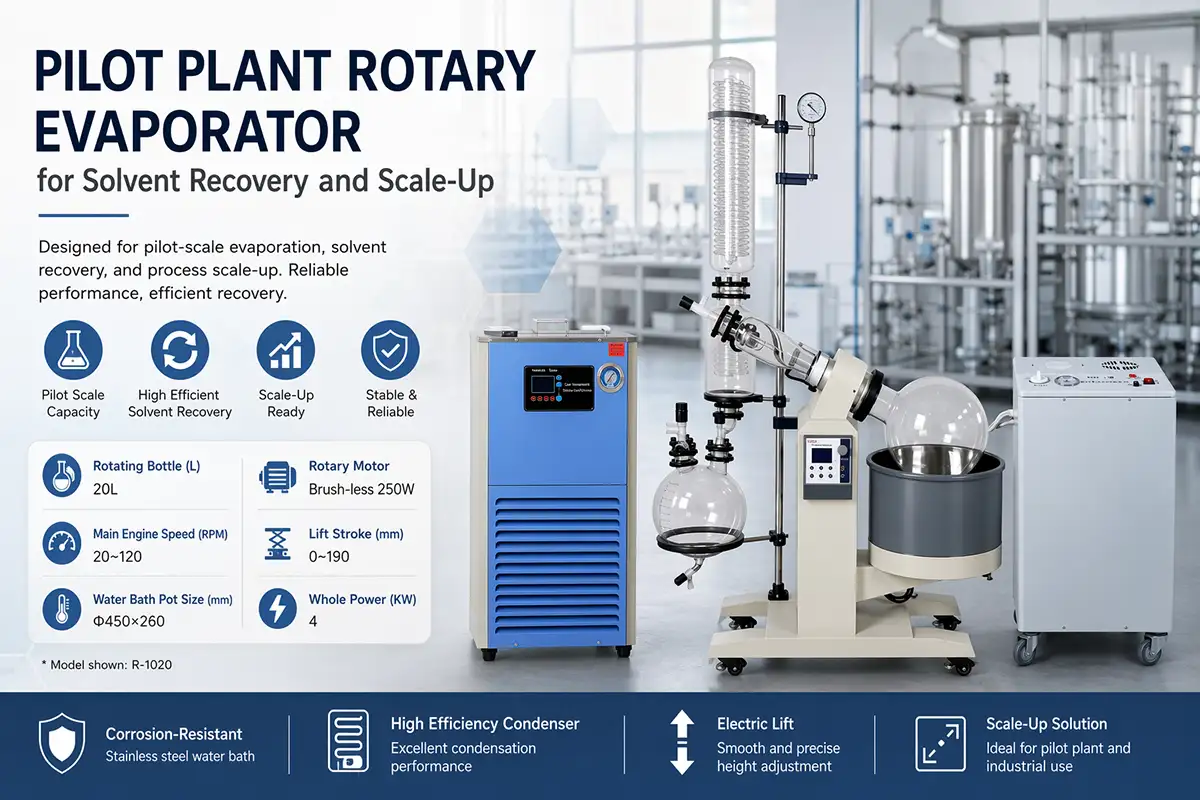
For most pilot plant users, the 20L rotary evaporator gives the best balance. It is large enough to generate useful scale-up data, but it does not require the same level of handling effort as a 50L machine. The ZZKD RE-2002 class uses a 20L evaporating flask and a 10L receiving flask, with a 250W rotating motor, 0-90 r/min speed range, 5000W water or oil bath power, and an evaporation rate above 5L/h for water under suitable conditions.
That capacity is useful for extraction concentration, solvent recovery after small production trials, crystallization preparation, pharmaceutical pilot testing, and chemical process optimization. It also helps the user evaluate the full system: vacuum pump demand, chiller performance, condensation efficiency, bath heat-up time, and operator handling.
The 20L rotary evaporator is especially sensible when the lab has already outgrown 5L equipment but is not ready for high-volume 50L operation. Based on the provided ZZKD price sheet and the middle-lower price selection rule, a practical 20L reference price is about $2,200.
Where 10L and 50L fit better
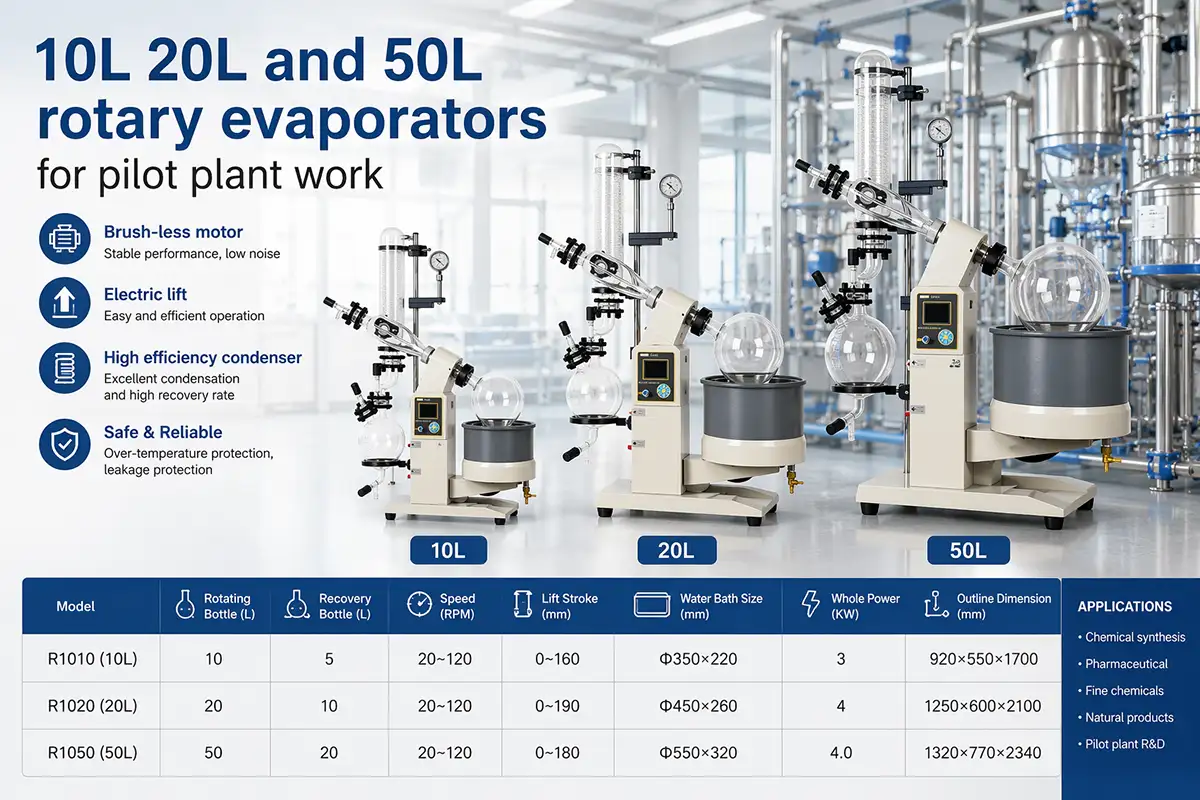
A 10L rotary evaporator is suitable for early pilot work. The ZZKD RE-1002 class has a 10L evaporating flask, 5L receiving flask, 180W rotating motor, 0-120 r/min speed range, 3000W bath power, and evaporation above 3L/h for water under suitable conditions. This size is useful when the team needs pilot information but still wants to protect expensive materials and test several conditions quickly. A practical 10L reference price from the provided price sheet is about $1,900.
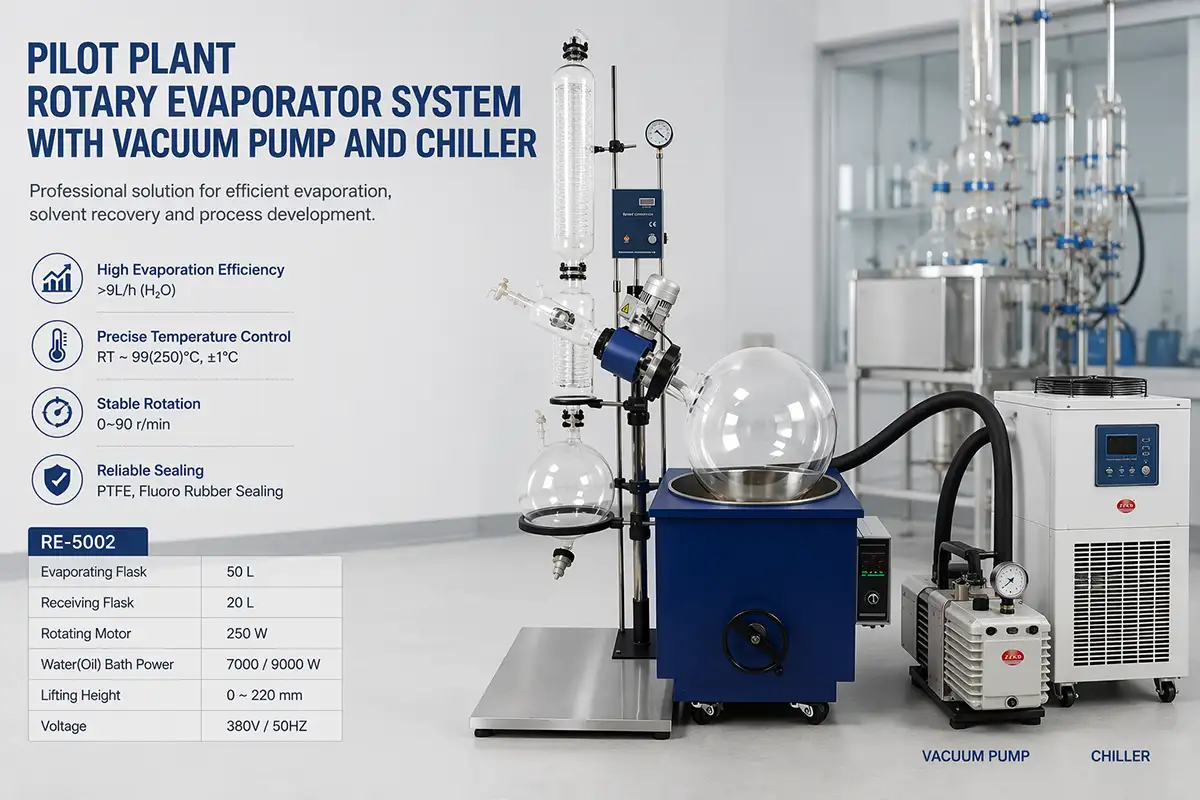
A 50L rotary evaporator is suitable when the process is no longer experimental. ZZKD RE-5002 and R1050 class systems offer a 50L evaporating flask and 20L receiving flask. The RE-5002 specification includes 7000/9000W bath power and evaporation above 9L/h for water under suitable conditions. The larger capacity can reduce batch count and improve recovery efficiency, but it also needs stronger support equipment, more floor space, careful glass handling, and trained operators.
If your facility already has reliable cooling and vacuum support, the 50L rotary evaporator can be the right choice for higher-throughput pilot production. Based on the same price rule, a practical 50L reference price is about $2,600.
Quick comparison for pilot plant buyers
The table below gives a simple way to compare the main ZZKD pilot-scale choices. Actual evaporation performance depends on solvent type, vacuum level, bath temperature, condenser temperature, flask fill ratio, and the whole system configuration.
| Choice | Typical ZZKD class | Flask capacity | Speed range | Evaporation reference | Best for | Reference price |
|---|---|---|---|---|---|---|
| Flexible scale-up | RE-1002 / 10L | 10L evaporating, 5L receiving | 0-120 r/min | >3L/h H2O | Method development, costly materials, small pilot trials | $1,900 |
| Balanced pilot work | RE-2002 / R1020 / 20L | 20L evaporating, 10L receiving | 0-90 r/min or 20-120 r/min class | >5L/h H2O | Most solvent recovery, concentration, and pilot validation work | $2,200 |
| Higher throughput | RE-5002 / R1050 / 50L | 50L evaporating, 20L receiving | 0-90 r/min or 20-120 r/min class | >9L/h H2O | Proven processes, repeated batches, larger solvent recovery loads | $2,600 |
Price note: when a capacity group had multiple prices, the value shown uses a middle and relatively economical price rather than the highest quotation.
How to avoid choosing the wrong pilot plant rotovap
A 20L flask does not mean every run should use 20L of liquid. Pilot operators need room for rotation, vapor, foam, and safe control.
Condensation capacity is one of the biggest limits in solvent recovery. A weak chiller can make a good evaporator feel slow.
A controlled vacuum ramp helps prevent bumping and foaming. Stable operation often saves more time than aggressive settings.
A 50L unit is excellent when the process is proven. During early development, a 10L or 20L system may help the team learn faster.
Supporting equipment matters as much as the evaporator
A pilot plant rotary evaporator should be chosen as a full system. The vacuum pump should hold the target pressure under vapor load. The chiller should remove heat quickly enough for the solvent. The condenser should suit the evaporation rate. The receiving flask should avoid constant stopping and emptying. Tubing and seals should be compatible with the solvent.
For solvent recovery applications, the whole setup should also support safe operation. Flammable solvents require ventilation, grounding, suitable pump selection, and local safety compliance. Heat-sensitive materials need controlled bath temperature and stable vacuum. If your process involves regular ethanol recovery, it is also useful to understand how rotary evaporation fits into the larger recovery workflow.
Common questions
Is a 5L rotary evaporator enough for pilot plant work?
Sometimes, but only for small pilot trials or expensive materials. For repeated pilot plant solvent recovery, 5L is often too slow. A 10L or 20L system usually gives more useful scale-up information.
Is 20L always the best choice?
No single size is always best, but 20L is the most balanced choice for many pilot plants. It offers meaningful capacity while keeping installation, cleaning, and operator handling manageable.
When should I move to 50L?
Move to 50L when your process is stable, batch recipes are repeatable, and the main problem is throughput. Before buying 50L, confirm that your chiller, vacuum pump, power supply, and workspace can support the larger system.
What is the best ZZKD recommendation?
Use ZZKD 10L for early pilot testing, ZZKD 20L for most pilot plant work, and ZZKD 50L for higher-throughput solvent recovery. If you are unsure, start by calculating normal charge volume and required batches per day.
Final answer
The rotary evaporator suitable for pilot plant work is usually a 20L system because it balances capacity, price, and usability. A 10L system is better for early scale-up and changing methods. A 50L system is better for proven processes and larger daily solvent recovery targets. ZZKD provides all three size ranges, so the right choice can follow your real batch volume instead of forcing the process to fit the machine.
Recommended default for most pilot plants: ZZKD 20L class