



Spray Drying Ceramic Powders: A Simple Guide to Better Flowability, Density, and Production Efficiency
Spray drying ceramic powders is not just about removing water. In real ceramic processing, it is a key step that helps turn slurry into free-flowing granules that press better, move better, and behave more consistently in later production stages. For manufacturers working with alumina, zirconia, tile bodies, ferrites, or advanced ceramic materials, understanding this process can make a big difference in product quality and overall cost.
Why spray drying matters in ceramic powder production
In ceramic manufacturing, raw powder is often mixed with water, binders, dispersants, and other additives to form a slurry. That slurry may have the right chemistry, but it is usually not ideal for direct pressing. It may dust too much, flow poorly, or create uneven filling in the die. This is where spray drying helps. By atomizing the slurry into very fine droplets and drying them quickly with hot air, the process creates granules with a more controlled size and shape.
These granules are usually more spherical and more uniform than untreated powder. That improves flowability and packing behavior, which are especially important for dry pressing, isostatic pressing, and some automated feeding systems. According to the U.S. Department of Energy, spray drying is widely used across materials processing because it can convert liquids or slurries into dry particles in seconds while maintaining controlled particle characteristics. In ceramics, this speed and consistency are major practical advantages.
Why not dry ceramic slurry in trays or ovens instead?
Answer from the author: Tray drying can remove moisture, but it usually creates hard cakes that need crushing and milling again. That adds time, labor, and variability. Spray drying is preferred because drying and granule formation happen in one continuous step, giving a more press-ready ceramic powder.
How the spray drying process works in simple terms
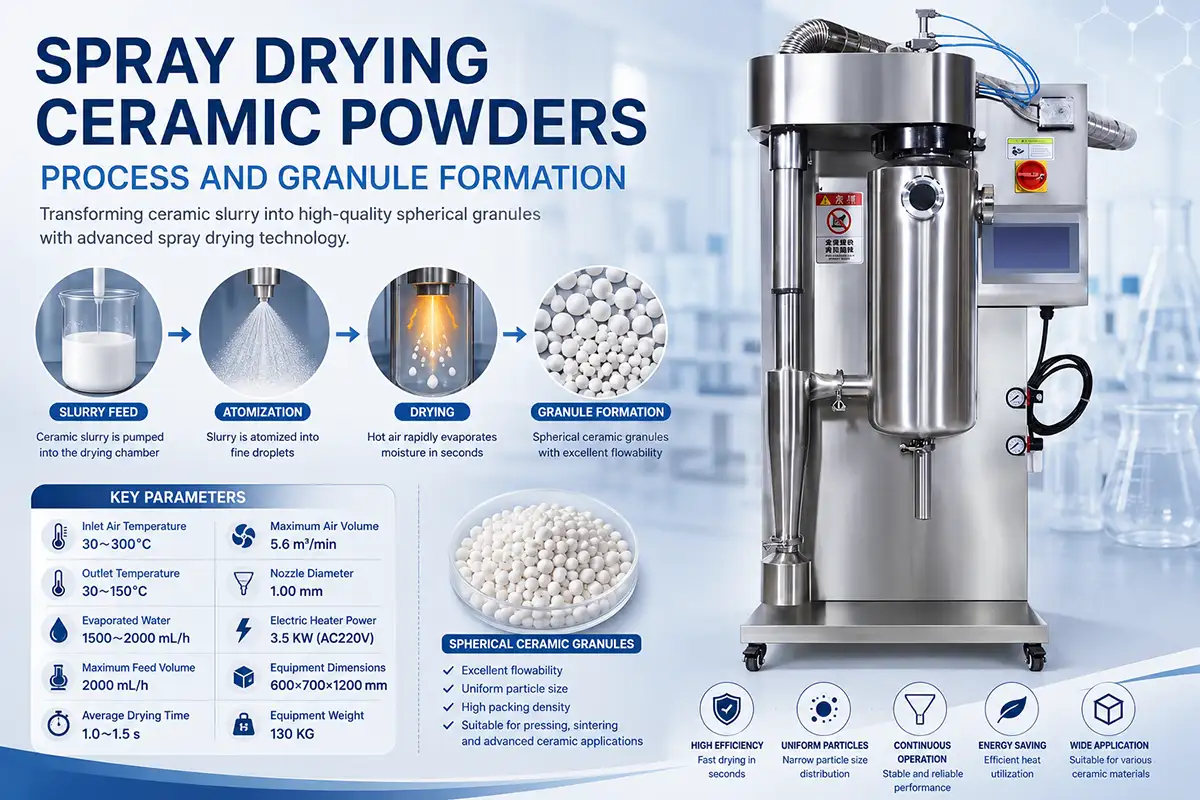
The basic idea is straightforward. Ceramic slurry is pumped into a spray dryer, where it is broken into tiny droplets through a nozzle or centrifugal atomizer. Those droplets meet hot drying air inside the chamber. Because each droplet has a very large surface area compared with its size, water evaporates extremely fast. In many lab-scale systems, the average drying time is only about 1.0 to 1.5 seconds. The result is a dry granular powder collected from the chamber and cyclone separator.
For ceramic applications, this matters because the droplet often becomes one granule. If droplet size is stable, granule size becomes more stable too. That is why nozzle design, feed concentration, viscosity, and inlet temperature all need attention. A well-controlled system can produce powder that fills molds more evenly and reduces problems such as lamination, weak green bodies, and density variation after pressing and sintering.
What ceramic manufacturers usually want to know
1. What kind of powder shape is ideal?
In many cases, rounded or near-spherical granules are preferred because they flow better and pack more consistently during pressing.
2. Can moisture be controlled accurately?
Yes. Outlet temperature, feed rate, and slurry solids content strongly affect residual moisture. Stable control helps avoid over-dry or sticky powder.
3. Will granules break too easily?
That depends on binder level, drying speed, and solids distribution. Good granules should be strong enough to flow, but weak enough to compact well.
4. Is lab testing really necessary?
Absolutely. Small changes in slurry rheology can change the final powder a lot, so pilot and lab validation are highly valuable before scale-up.
Useful industry data
According to the American Ceramic Society, powder characteristics such as particle size distribution, granule strength, and flowability directly affect forming quality and final ceramic performance. This is why spray drying remains one of the most important preparation steps in technical ceramics and powder-based ceramic manufacturing.
Key parameters that affect ceramic spray drying quality
When people search for spray drying ceramic powders, the real question is often this: which settings have the biggest effect on final powder quality? The answer is not complicated, but it is important.
- Slurry solids content: Higher solids can improve efficiency, but if viscosity becomes too high, atomization may become unstable.
- Binder and additive content: These control granule strength, compaction behavior, and moisture sensitivity.
- Inlet air temperature: Higher inlet temperature increases drying speed, but excessive heat can damage some organic additives.
- Outlet temperature: This often gives a better real-time indication of final moisture condition.
- Atomization method: Nozzle size and atomizer type affect droplet size and therefore powder size distribution.
- Feed rate: Feeding too fast can create wet particles or wall sticking; feeding too slowly may reduce productivity.
Is higher temperature always better for ceramic spray drying?
Answer from the author: Not always. Higher temperature can improve evaporation speed, but powder quality depends on balance. If drying is too aggressive, hollow granules, surface crusting, or unstable moisture may appear. The best result usually comes from matching temperature to slurry properties and target granule structure.
A practical look at lab and pilot spray dryer options
For research, formula development, and small-batch ceramic testing, a laboratory spray dryer is often the most cost-effective starting point. Based on the supplied equipment data, the SD-2L model offers inlet air temperature control from 30 to 300℃, outlet control from 30 to 150℃, evaporation capacity of 1500 to 2000 mL/h, and average drying time of 1.0 to 1.5 seconds. The LPG-3L model expands evaporation capacity to 1500 to 3000 mL/h, with inlet temperature control from 30 to 300℃ and outlet temperature control from 30 to 140℃.
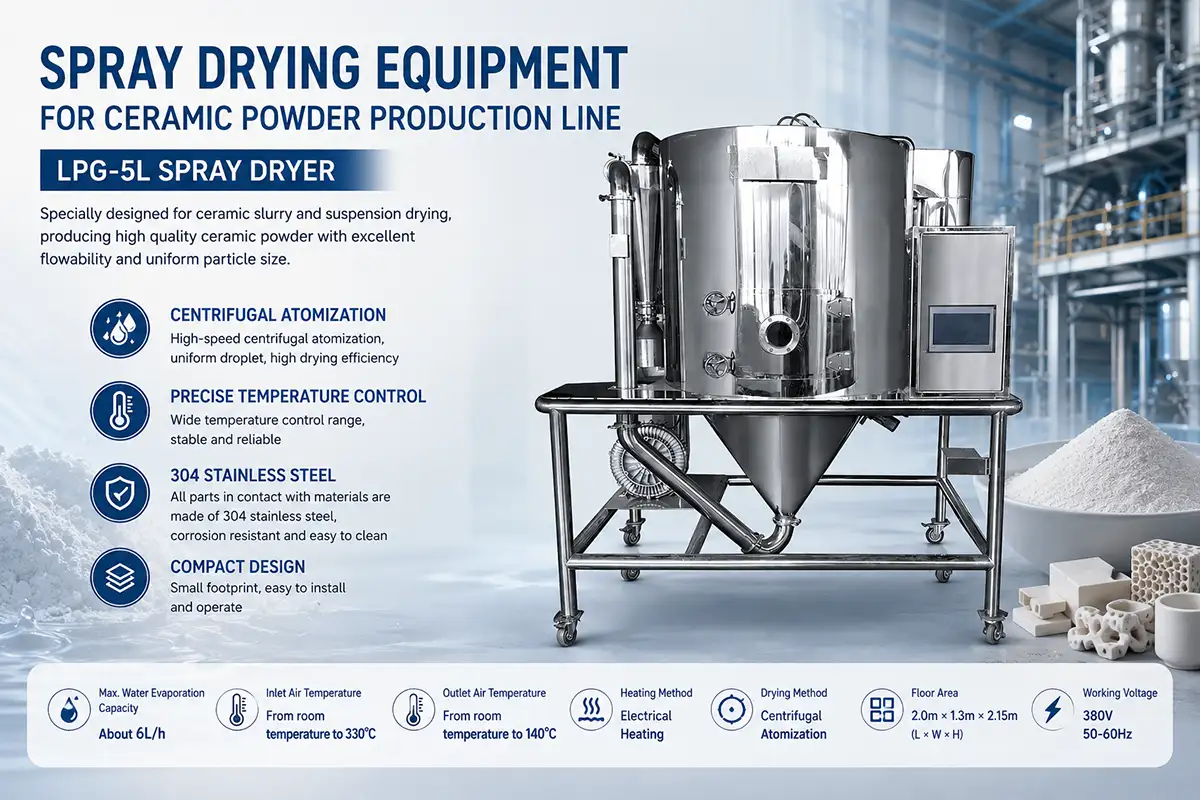
For users needing more throughput, the LPG-5L system provides about 6 L/h water evaporation and inlet air temperature up to 330℃, while larger LPG-10 scale options are aimed at pilot-level work. For many ceramic labs, the 2L to 5L range is a practical choice because it allows parameter screening without the cost and material consumption of a larger production unit.
Market pricing also shows a clear step between small lab units and pilot equipment. Using the middle but relatively lower price when multiple price options are listed, many 2L mini spray dryer machines are around US$2,800, 3L class machines are commonly around US$3,500, and 5L class spray dryers often fall near US$7,400. For users comparing spray drying machine options, these figures help set realistic expectations for budget planning.
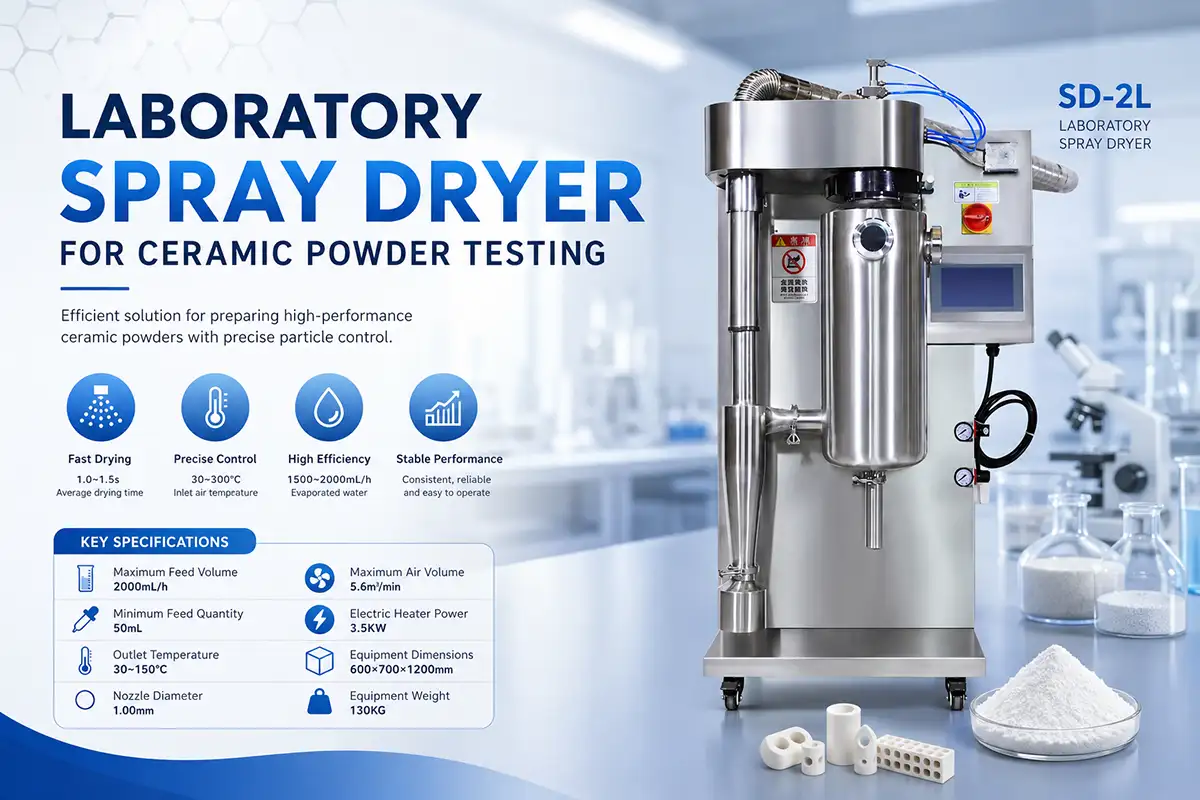
| Model | Inlet Temperature | Outlet Temperature | Evaporation Capacity | Typical Use | Reference Price |
|---|---|---|---|---|---|
| SD-2L | 30-300℃ | 30-150℃ | 1500-2000 mL/h | Formula screening, ceramic slurry trials | About US$2,800 |
| LPG-3L | 30-300℃ | 30-140℃ | 1500-3000 mL/h | Lab development and small pilot work | About US$3,500 |
| LPG-5L | Room temp to 330℃ | Room temp to 140℃ | About 6 L/h | Pilot-scale ceramic powder preparation | About US$7,400 |
How to choose the right spray dryer for ceramic powders
The best machine is not simply the largest one. It is the one that matches slurry behavior, output target, and development stage. For ceramic applications, these points matter most:
- If the goal is R&D or customer sample development, a compact lab unit is usually enough.
- If multiple ceramic formulas need to be screened quickly, good temperature control and stable feed adjustment are more important than maximum size.
- If the slurry includes heat-sensitive binders or organics, precise outlet temperature control becomes especially valuable.
- If scale-up is planned, selecting a machine family with similar process logic from lab to pilot scale can reduce development risk.
Users also often compare process options. For a broader overview of equipment categories and applications, related reading about how to turn liquid into powder can be useful, especially when evaluating whether spray drying is the right path for a given material system.
Common problems and what they usually mean
Even good ceramic slurries can produce poor powder if the operating window is off. Here are a few common signs and what they often indicate:
- Powder sticks to the chamber wall: Usually linked to low solids, insufficient drying, or sticky additives.
- Granules are too hollow or fragile: Drying may be too fast, or binder distribution may be uneven.
- Poor powder flow: Particle size distribution may be too broad, or granule shape may be irregular.
- Pressing density varies too much: Granule moisture or granule strength may not be consistent batch to batch.
Can a small spray dryer still be useful for industrial ceramic projects?
Answer from the author: Yes. A small spray dryer is often where good industrial decisions begin. It allows testing of solids loading, additive systems, drying temperature, and granule behavior before larger investment is made. In many cases, that saves much more money than it costs.
Final thoughts
Spray drying ceramic powders is valuable because it solves a very practical problem: turning unstable slurry into consistent, press-ready granules. When the process is controlled well, ceramic manufacturers gain better powder flow, more uniform die filling, improved green density consistency, and smoother downstream production. That is why this technology remains central in both traditional and advanced ceramics.
For labs and factories choosing between different spray dryers, the smartest approach is to begin with the material, not the machine size alone. Understand the slurry, define the target granule, and select equipment with the right temperature range, evaporation capacity, and control stability. That approach leads to better powder and better production results.