




Principles of Spray Drying for Faster Powder Production and Better Product Quality
The principles of spray drying are simple: turn liquid into tiny droplets, expose them to hot air, and collect dry powder in seconds. But in real production, the right spray dryer machine does much more than that. It helps improve powder uniformity, reduce processing time, protect heat-sensitive materials, and support smoother scale-up from lab testing to pilot production.
Many buyers do not just want a textbook explanation. They want to know what spray drying can really do for a product line. Can it make powder faster? Can it improve flowability? Can it reduce sticking, shorten testing cycles, and make process conditions easier to repeat? These are the questions that usually matter most.
Spray drying is widely used in food, pharmaceuticals, chemicals, plant extracts, ceramics, and biotechnology because it converts liquids, emulsions, suspensions, and solutions into fine powders quickly and continuously. According to the U.S. Food and Drug Administration (FDA), spray drying is a recognized and widely applied processing method in food and pharmaceutical manufacturing. The Food and Agriculture Organization of the United Nations (FAO) also highlights spray drying as a major industrial method for producing stable dry dairy powders and other food ingredients.
In other words, the value of spray drying is not only “drying.” The real value is fast powder formation with repeatable quality.
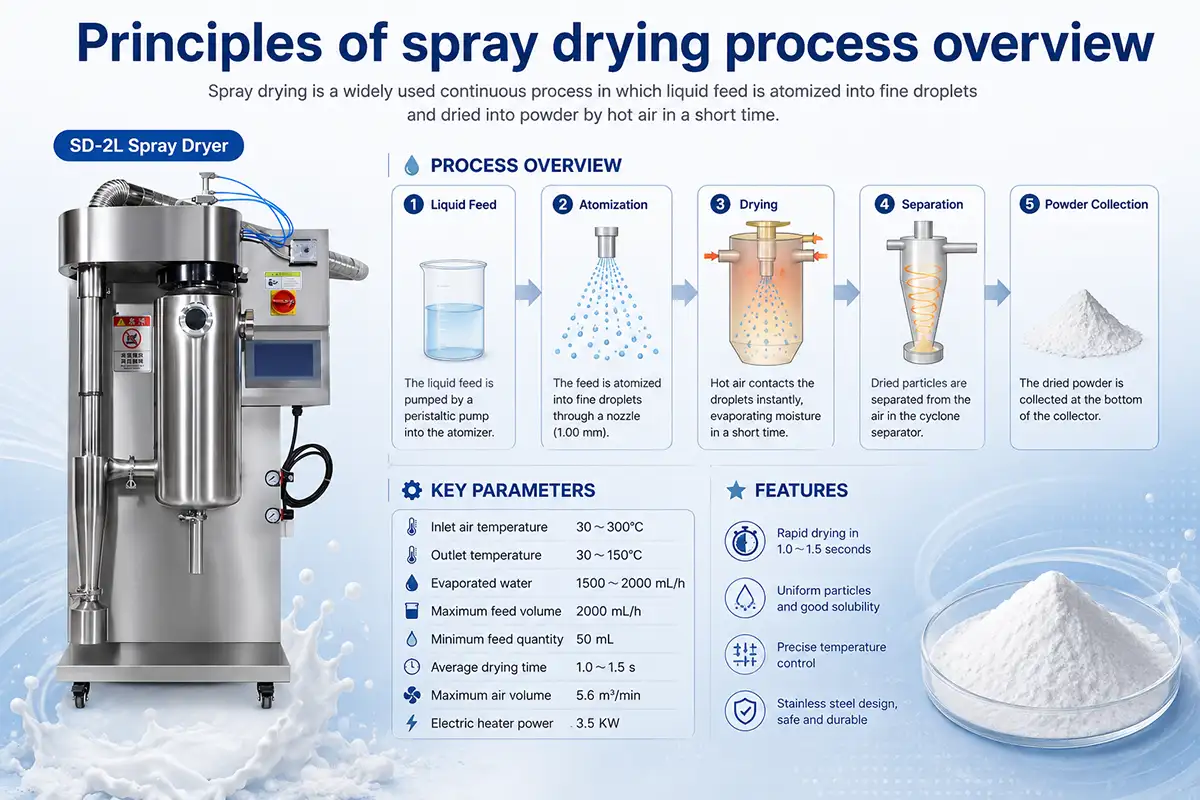
The Core Principles of Spray Drying
A spray drying machine works in three basic steps.
First, atomization. The liquid feed is broken into very small droplets by a nozzle or centrifugal atomizer. Smaller droplets mean larger total surface area, and that makes water evaporate much faster.
Second, contact with hot air. These droplets enter a stream of heated air inside the drying chamber. Because each droplet is tiny, moisture leaves very quickly.
Third, powder separation and collection. The dry particles are carried by airflow and then separated and collected, often by a cyclone separator or similar collection system.
This is why spray drying is so effective for making powders from milk, coffee, protein, herbal extract, enzymes, flavors, and many other liquid materials.
Why is spray drying so fast?
The answer is simple. The liquid is not dried as one large mass. It is divided into thousands of tiny droplets, and each droplet has a large surface area compared with its volume. From a process point of view, that is the reason drying can happen in seconds rather than hours.
If more background comparison is helpful, this related article on spray dryer machine advantages versus a dehydrator explains why spray drying is often chosen when powder quality and processing speed matter.
What a Good Spray Dryer Machine Can Help Achieve
- Convert liquid to powder quickly, which shortens development and production cycles.
- Improve powder consistency, especially for particle size, color, and moisture control.
- Reduce storage and transport costs by changing unstable liquid into easier-to-handle powder.
- Support testing of formulas for milk powder, coffee, plant extract, enzymes, flavors, and chemical materials.
- Make scale-up easier when laboratory and pilot process data are stable.
- Protect some heat-sensitive materials better than slower drying methods because residence time is very short.
Does high inlet temperature always damage the material?
Not necessarily. This is a common concern. In spray drying, droplets are exposed for a very short time, and evaporation itself cools the particle surface. That is why many sensitive products can still be processed successfully when the right inlet temperature, outlet temperature, feed rate, and atomization method are chosen together.
For industries handling food materials, another useful reference is this guide on spray drying food safety, which answers practical questions about process control and product safety.
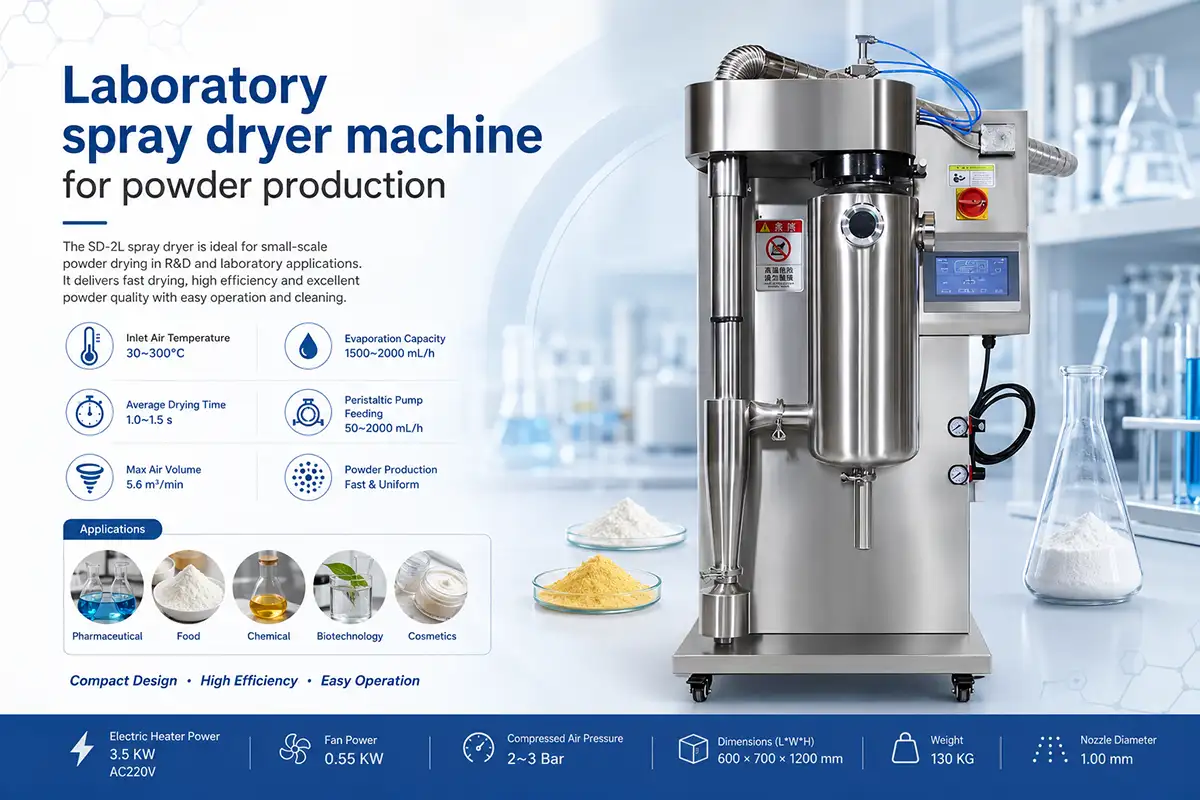
Lab Spray Dryer Parameters Buyers Often Compare
Based on the provided equipment data, compact lab and pilot spray dryers mainly differ in evaporation capacity, temperature range, atomization style, and installation requirements. A simple comparison is below.
| Model | Inlet Temperature | Outlet Temperature | Evaporation Capacity | Feed Capacity | Drying Time | Power / Notes |
|---|---|---|---|---|---|---|
| SD-2L | 30–300°C | 30–150°C | 1500–2000 mL/h | Max 2000 mL/h | 1.0–1.5 s | 3.5KW heater, compact lab unit |
| LPG-3L | 30–300°C | 30–140°C | 1500–3000 mL/h | Max 3000 mL/h | 1.0–1.5 s | 5KW / 220V, 1.00 mm nozzle standard |
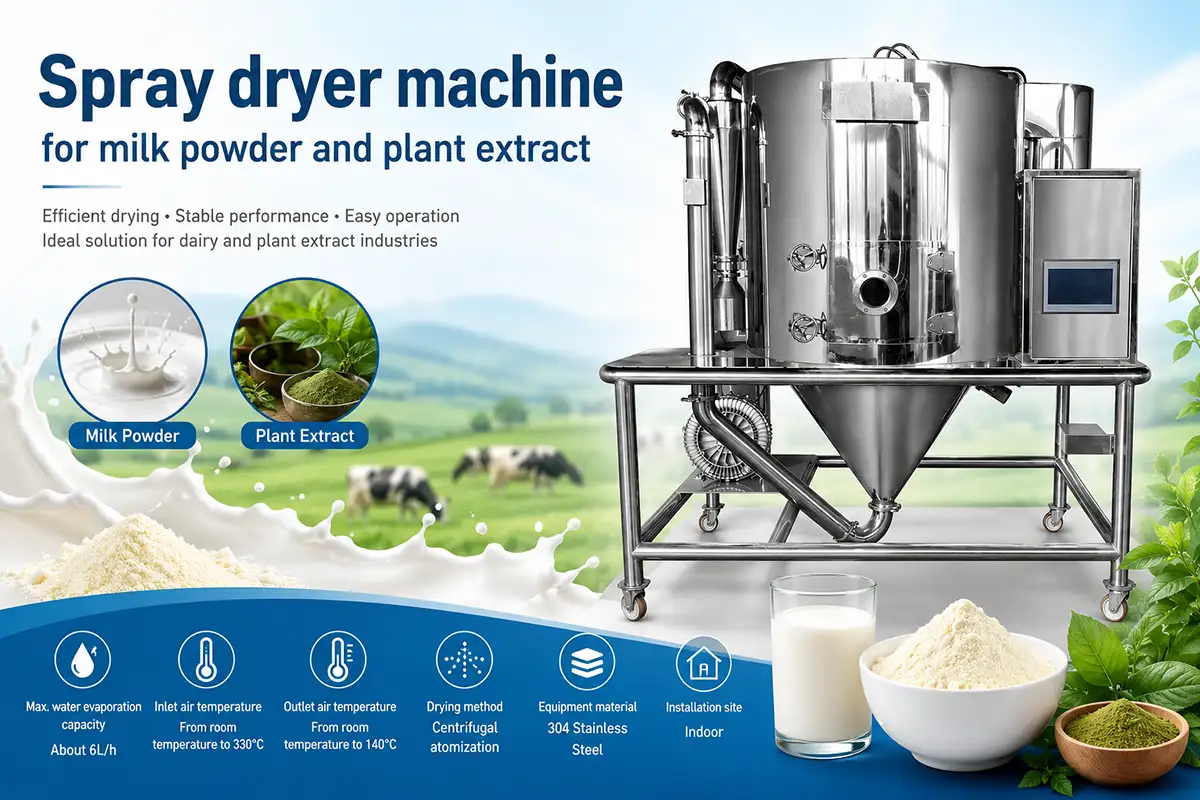
| LPG-5L | Room temperature–330°C | Room temperature–140°C | About 6 L/h | Solution / suspension feed | Fast continuous drying | Electrical heating, centrifugal atomization, 304 stainless steel |
| LPG-10 | 140–350°C | 80–90°C | About 10 kg/h class data listed | Pilot/industrial level | Continuous process | Higher throughput for expanded trials |
Note: The comparison above is organized from the supplied parameter sheets. Exact configuration should still be confirmed according to material type, viscosity, solids content, and target powder characteristics.
How Much Does a Spray Dryer Cost?
Buyers also want a direct answer on price. Based on the provided spray dryer price list, the market reference for small lab spray dryers looks roughly like this:
- 2L lab spray dryer: many listings cluster around $2,800 as a practical reference point.
- 3L spray dryer: several listings center around $3,500.
- 5L spray dryer: many listings fall around $7,428 to $7,850.
- 10L spray dryer: common listings appear around $9,000 to $12,000, with the more affordable middle reference commonly taken as $9,000.
For purchasing decisions, price alone is not enough. A lower initial price may still become expensive if powder recovery is poor, temperature control is unstable, or cleaning takes too long. A better choice is usually the machine that matches actual material behavior and target output.
Which model is often the best starting point for a new project?
In many cases, a 2L or 3L laboratory spray dryer is the most practical starting choice. It keeps testing cost lower, allows fast formula screening, and gives enough process data before moving to a 5L or 10L pilot unit. That makes investment more controlled and scale-up less risky.
What to Check Before Ordering Spray Drying Equipment
A serious buyer normally compares more than brochure data. These points matter in real use:
- Whether the machine can handle solution, emulsion, or suspension materials.
- Whether inlet and outlet temperature control is stable enough for repeatable results.
- Whether nozzle size and atomization type fit the product viscosity and solids content.
- Whether cleaning, disassembly, and maintenance are simple enough for regular use.
- Whether power supply and installation requirements match the actual site.
- Whether the supplier can support process suggestions, spare parts, and future scale-up.
If your project is specifically focused on milk powder or similar food materials, this internal resource about milk powder spray dryers can also help connect process theory with purchasing decisions.
Final Thoughts: The Right Spray Dryer Should Create Better Results, Not Just Dry Material
Understanding the principles of spray drying helps buyers make better decisions. The process itself is straightforward, but successful powder production depends on matching the right equipment to the right material and production goal. When the machine is selected correctly, spray drying can deliver fast evaporation, consistent powder quality, easier storage, and more efficient product development.
For laboratories, R&D teams, food processors, herbal extract producers, and pilot-scale users, a suitable spray dryer machine is often not an expense alone. It is a process tool that can shorten development time, improve product repeatability, and support future scale-up with more confidence.
If a project needs compact lab testing, a 2L or 3L unit may be the best entry point. If higher throughput is the goal, moving to a 5L or 10L system becomes more practical. The key is not choosing the biggest machine first. The key is choosing the most suitable one first.
Explore More Drying Equipment