




Custom Spray Drying Explained: A Simple Guide to Flexible Powder Production
Custom spray drying is not just about turning liquid into powder. It is about matching the drying process to the material, the target particle size, the thermal sensitivity, and the final use of the powder. For laboratories, pilot plants, and small-scale production lines, the right spray dryer makes that flexibility possible.
What is custom spray drying?
In simple terms, custom spray drying means adjusting the drying system and process conditions to fit a specific material instead of forcing every liquid through the same standard setup. Some feeds are simple water-based solutions. Others are suspensions, heat-sensitive extracts, food ingredients, pharmaceutical intermediates, ceramics, or specialty chemicals. Each one behaves differently during atomization and drying.
A custom spray drying setup may involve choosing the right nozzle, setting a suitable inlet and outlet temperature range, controlling feed rate, changing atomization style, or selecting equipment size that matches research or production goals. This matters because powder quality depends on more than just heat. It also depends on droplet formation, residence time, airflow, solids content, and collection efficiency.
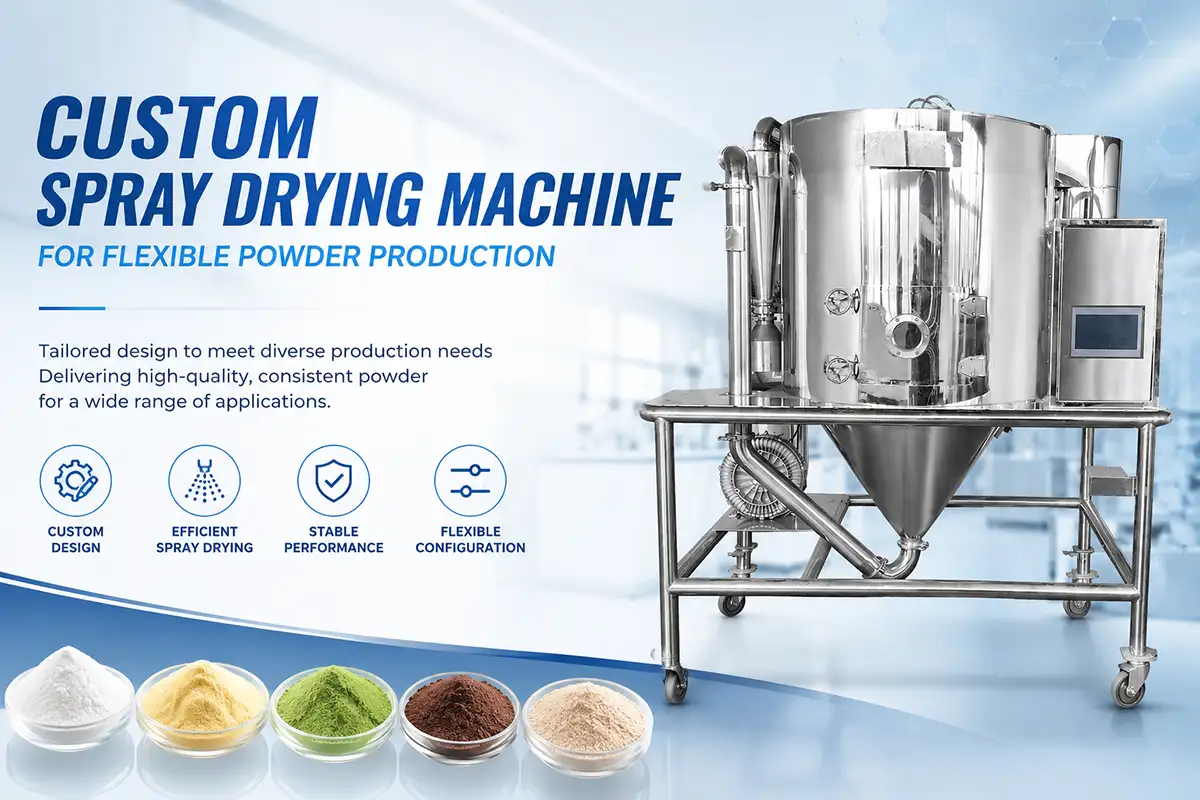
Why custom spray drying matters more than a standard machine
Many buyers are not just looking for a machine that works. They want a machine that works for their material. That is the real reason custom spray drying is important. A standard configuration may dry one product well but create wall sticking, uneven particle size, poor flowability, or heat damage with another product.
Better process match
Temperature, feed speed, and atomization can be adjusted to support fragile or difficult materials.
More stable powder quality
When droplets are formed and dried consistently, the resulting powder is more uniform and easier to handle.
Less waste during trials
Small-batch systems with precise control help reduce material loss during formulation development.
Easier scale-up planning
Lab and pilot parameters provide a practical foundation before moving toward larger equipment.
Could one spray dryer handle both simple solutions and some suspension liquids?
Yes, if the machine is designed with flexible feed control and the right atomization configuration. For example, the LPG-5L data provided for this project notes that the material can be a solution and can include some suspension liquids. From an equipment selection point of view, that is exactly the kind of flexibility many buyers want from custom spray drying.
How custom spray drying works step by step
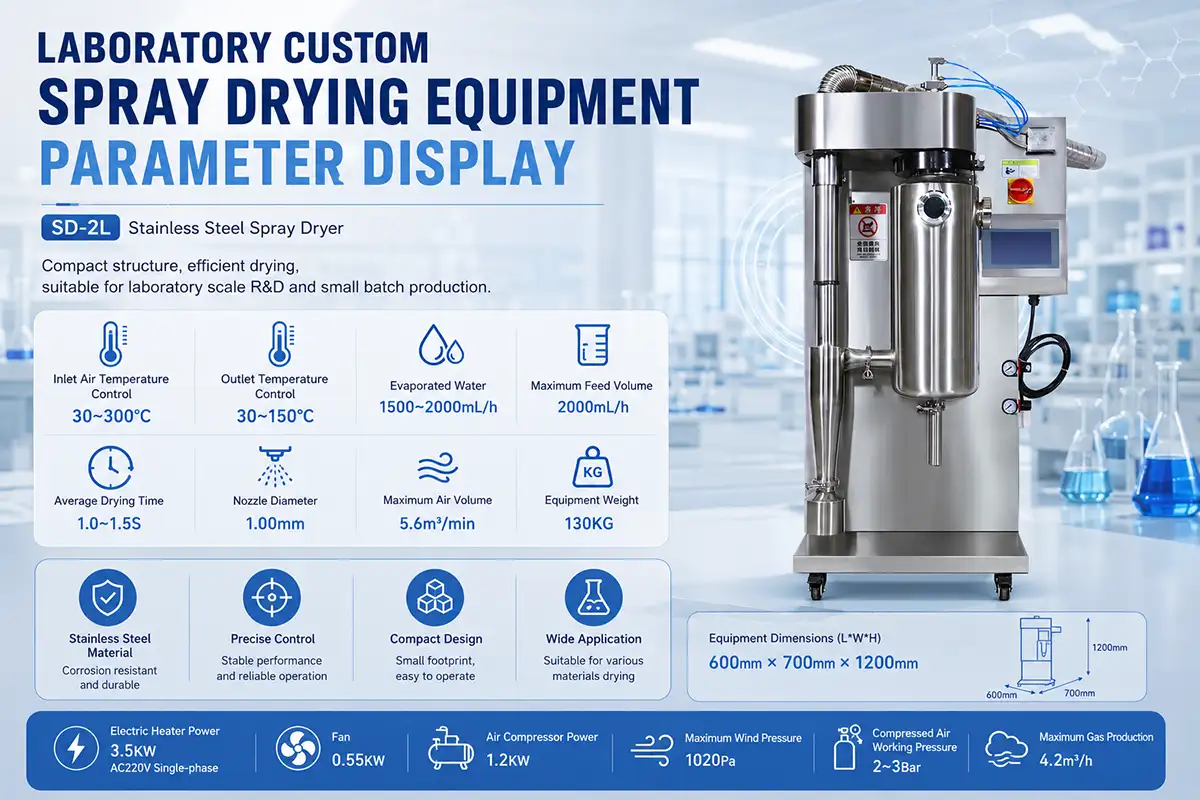
The process sounds technical, but the basic logic is easy to understand. A liquid feed enters the system through a pump. That liquid is then atomized into fine droplets by a nozzle or centrifugal atomizer. Hot air meets those droplets inside the drying chamber. Because the droplets are very small, water evaporates very quickly. In many lab systems, the average drying time is only about 1.0 to 1.5 seconds, based on the equipment parameters provided here for the SD-2L and LPG-3L models.
After evaporation, dry particles are separated and collected. What remains is a powder that can be easier to store, transport, blend, or use in downstream processing.
- Feed enters through a controlled pump system
- Liquid becomes tiny droplets through atomization
- Hot air removes moisture in seconds
- Powder is collected after drying and separation
Anyone wanting a deeper comparison of process behavior can also read this guide on whether a spray dryer is better than a dehydrator, especially for understanding why spray drying is so much faster for liquids.
What parameters matter most in a custom spray drying system?
When people search for custom spray drying, the real question is often this: what should be checked before choosing a machine? The answer usually comes down to a few practical parameters.
| Parameter | Why it matters | Examples from provided data |
|---|---|---|
| Inlet temperature | Controls how strongly heat enters the chamber and affects drying speed | SD-2L: 30–300℃; LPG-3L: 30–300℃; LPG-5L: room temperature to 330℃ |
| Outlet temperature | Helps show actual thermal load on the product and final moisture condition | SD-2L: 30–150℃; LPG-3L: 30–140℃; LPG-5L: room temperature to 140℃ |
| Feed volume | Determines throughput and affects residence balance inside the system | SD-2L: max 2000 mL/h; LPG-3L: max 3000 mL/h adjustable |
| Atomization | Directly influences droplet size and powder characteristics | Peristaltic pump feed with nozzle on small units; centrifugal atomization on LPG-5L |
| Nozzle or spray head size | Important for droplet formation and clogging control | LPG-3L nozzle diameter 1.00 mm, with 0.7 / 1.5 / 2.0 mm optional |
| Power and installation | Affects utility planning, site selection, and compatibility | SD-2L: 3.5KW heater, AC220V; LPG-5L: electrical heating, 380V, indoor installation |
Is higher inlet temperature always better in custom spray drying?
No. Higher inlet temperature can improve evaporation speed, but it is not automatically the best choice. The right setting depends on the material, feed solids, and desired powder quality. In practice, custom spray drying means balancing drying efficiency with product protection. That is why wide temperature ranges, such as 30℃ to 300℃ or even up to 330℃ on some systems, are useful: they give room to optimize instead of forcing one fixed condition.
Which spray dryer fits lab trials, pilot work, or flexible small-scale production?
For many users, the answer depends on batch size and the level of flexibility needed. A compact unit such as the SD-2L can be attractive when material is expensive and trials are frequent. It offers a maximum feed volume of 2000 mL/h, a minimum feed quantity of 50 mL, and a short drying time of 1.0 to 1.5 seconds. That makes it practical for formulation screening and small research batches.
The LPG-3L offers a higher maximum feed volume of 3000 mL/h, adjustable peristaltic pump feeding, and optional nozzle diameters. That combination is useful when a user needs more process tuning. Meanwhile, the LPG-5L moves toward a stronger pilot-style profile, with about 6 L/h maximum water evaporation capacity, centrifugal atomization, electrical heating, and 304 stainless steel construction.
For readers comparing process ideas, this article about turning liquid into powder in seconds gives a helpful overview of why the technology is so efficient. And for food-related concerns, this explanation of spray drying safety is also relevant.
Why fast drying is such a major advantage
Speed is not just a convenience. It can change product quality. According to the Food and Agriculture Organization of the United Nations, reducing water activity quickly is one of the key ways to improve storage stability in dried products. Spray drying supports that goal because moisture removal happens in a very short time. For many formulations, that means less time exposed to conditions that could cause degradation, microbial risk, or handling difficulties.
Research institutions and industrial publications have also long recognized spray drying as a preferred route for creating powders with controlled handling properties. That is especially useful when the final powder must dissolve well, flow well, or blend consistently into another formulation.
Why does custom spray drying often reduce development risk?
Because it allows the process to be tuned before scale-up problems become expensive. From an engineering point of view, it is better to test inlet temperature, outlet temperature, feed rate, and atomization options on a flexible system than to discover sticking, low yield, or unstable powder after moving into production. Custom spray drying is really about preventing mismatch.
How to choose the right custom spray drying equipment
If the goal is to promote the value of a spray dryer honestly, the most useful advice is simple: choose based on process fit, not just on headline capacity. A good buying decision usually starts with these questions:
- Is the feed a true solution, or does it include some suspended solids?
- How sensitive is the material to heat?
- What sample size is available for testing?
- Is flexible nozzle selection important?
- Does the installation site require 220V or 380V equipment?
- Will the system be used for research only, or for pilot-scale production as well?
For example, users needing compact, easy-to-control laboratory work may prefer models similar to the SD-2L or LPG-3L. Users aiming for broader material compatibility and higher evaporation may lean toward a system closer to the LPG-5L. In either case, the strongest advantage comes from flexible control over temperature, feed, and atomization.
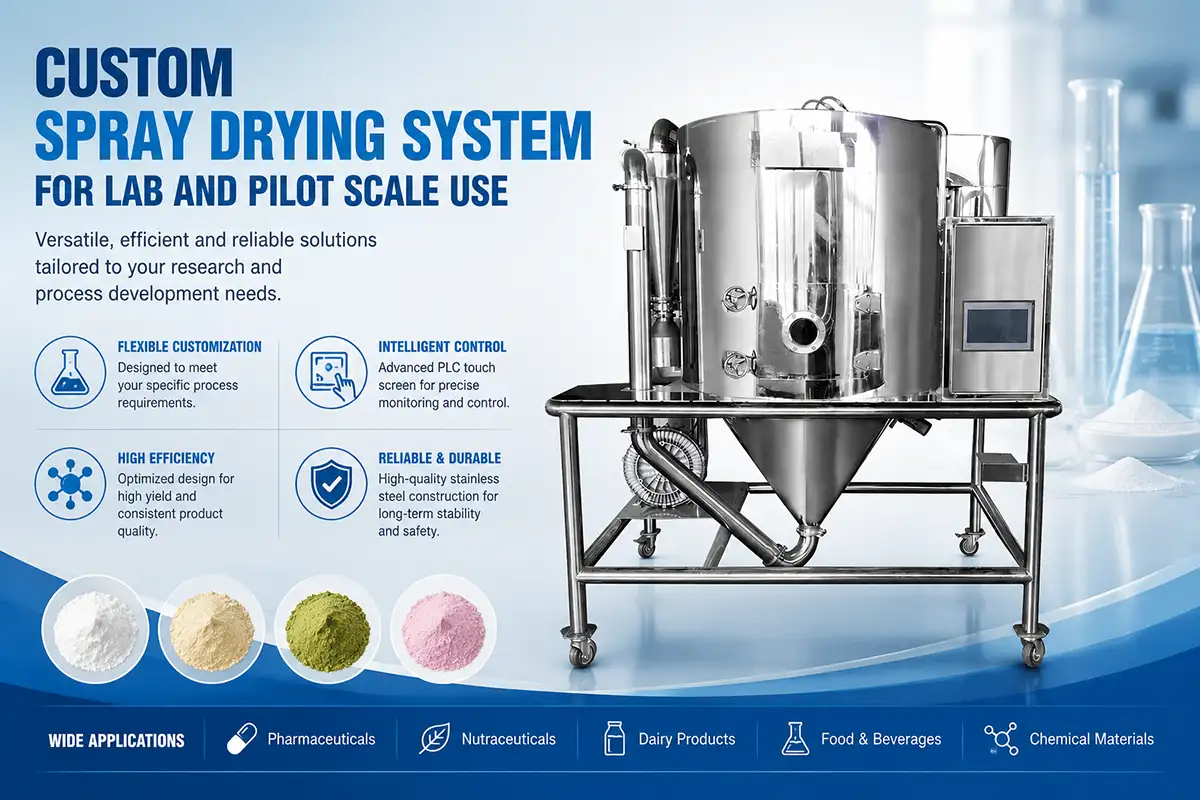
What is the real value of custom spray drying?
The real value of custom spray drying is control. It gives users a way to turn liquids into powders efficiently while adapting the process to the material instead of treating every formulation the same. That means better powder quality, better repeatability, safer scale-up, and a stronger chance of getting useful results from every batch.
For laboratories and growing businesses, that flexibility is often more important than raw size alone. A well-matched spray drying machine can save materials, shorten testing cycles, and improve confidence in the final product. That is why custom spray drying is not just a feature. It is a smarter way to choose spray drying equipment.