




Small Vacuum Oven Buying Guide for Labs and Material Drying
A small vacuum oven is often the best choice when drying heat-sensitive, oxygen-sensitive, or moisture-sensitive materials. It saves bench space, improves process control, and helps reduce oxidation risk compared with conventional hot air drying. For laboratories, universities, battery research, resin work, and sample preparation, choosing the right model can directly affect drying quality, repeatability, and operating cost.
Why a Small Vacuum Oven Makes Sense
Many buyers do not actually need a large drying system. In daily lab work, samples are usually limited in quantity, but the drying result must be precise. That is where a small vacuum oven becomes more practical than an oversized unit. A compact chamber heats faster, uses less energy, and is easier to integrate into crowded laboratory workflows.
According to the U.S. Department of Energy, industrial heating and drying processes account for a significant share of manufacturing energy consumption, which is why efficient thermal equipment selection matters even at smaller scales. In practical terms, a well-sized oven helps avoid paying for unused chamber volume while still delivering stable drying conditions.
What Buyers Usually Want to Know First
Most purchase decisions come down to a few simple questions: What size is enough? What temperature is needed? How strong is the vacuum? Is stainless steel included? And how much should a reliable small vacuum oven cost?
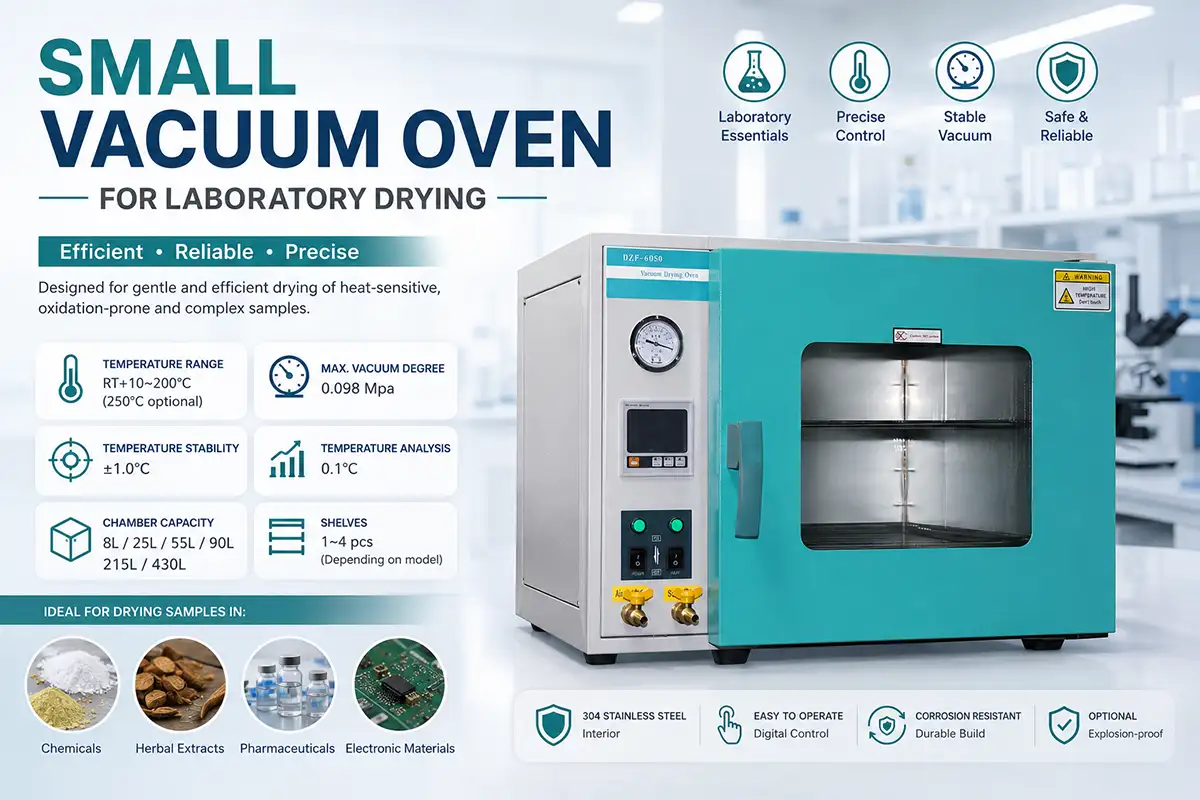
Based on the supplied product parameters, ZZKD small and medium vacuum oven models include:
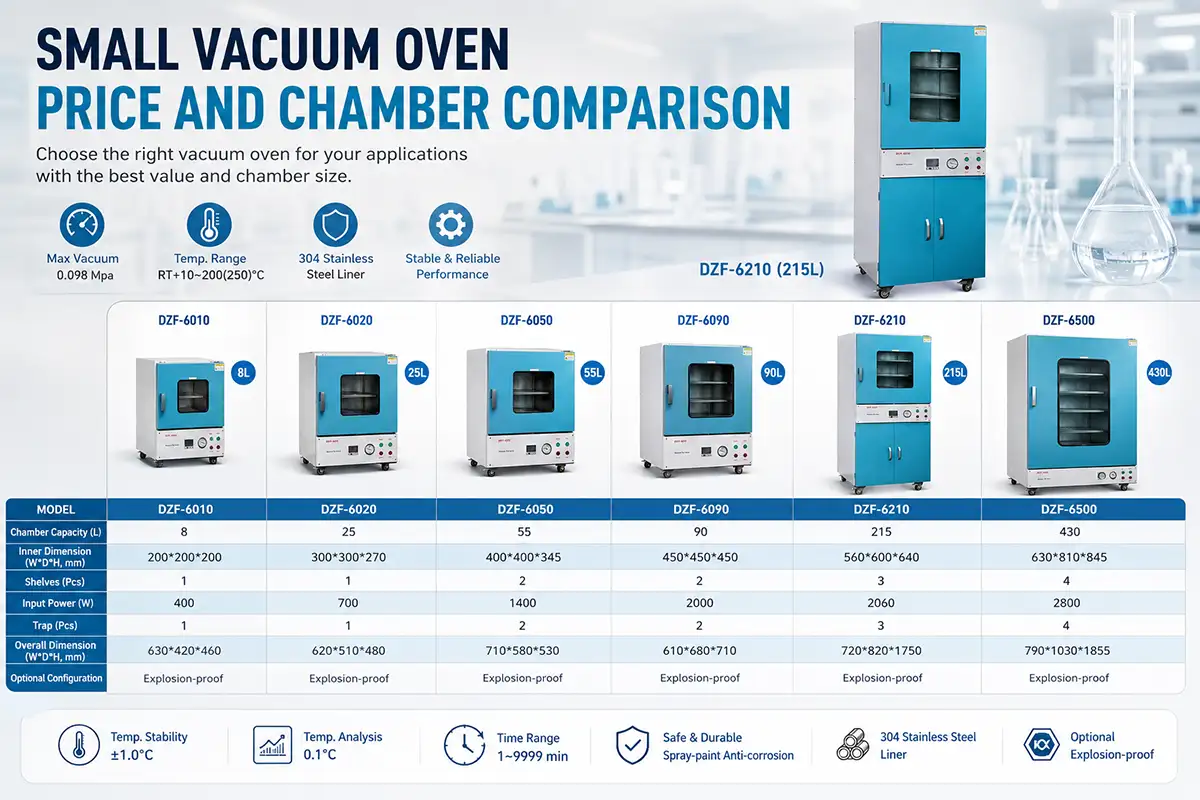
- DZF-6010: 8L chamber, 400W input power, 200 × 200 × 200 mm inner size
- DZF-6020: 25L chamber, 700W input power, 300 × 300 × 270 mm inner size
- DZF-6050: 55L chamber, 1400W input power, 400 × 400 × 345 mm inner size
- Temperature range: RT+10 to 200°C, with some models reaching 250°C
- Vacuum level: up to 0.098 MPa
- Temperature stability: ±1.0°C
- Liner material: 304 stainless steel
- Optional configuration: explosion-proof version
For users comparing drying technologies, it can also be helpful to read related process content such as what lyophilization is and why it is used, especially when deciding between vacuum drying and freeze drying for sensitive materials.
How to Choose the Right Capacity
8L Model for Basic Bench Work
The DZF-6010 is suitable when only small glass dishes, watch glasses, sample cups, or tiny batches need drying. It is a cost-effective starting point and a strong option when budget and bench space are tight.
Best for sample prep Compact footprint Entry-level budget25L Model for Everyday Laboratory Use
The DZF-6020 is usually the most balanced small vacuum oven size. It offers more room for trays, beakers, and routine drying tasks without becoming bulky. For many buyers, this is the sweet spot between price and practical usability.
Most balanced option Good for frequent use Easy upgrade path55L Model for Larger Batches
The DZF-6050 works well when more shelf area is required. It is still compact compared with full industrial systems, but it handles larger loads better and reduces the number of drying cycles.
More throughput Two shelves Production supportWhen to Step Beyond “Small”
If regular work involves bulk materials, large trays, or semi-production use, 90L and above may be more efficient. In that case, buying too small can slow operations instead of saving money.
Avoid under-sizing Think future demandReal Price Expectations for a Small Vacuum Oven
Price is often the deciding factor, but it only makes sense when compared with size and configuration. Based on the supplied price list, using the middle lower price when multiple prices appear, the market reference looks like this:
| Model / Type | Chamber Size | Reference Price | Comment |
|---|---|---|---|
| DZF-6010 | 8L | $360 | Very competitive entry point for small lab drying |
| DZF-6020 | 25L | $443 | Popular small vacuum oven size with better flexibility |
| DZF-6050 | 55L | $705 | Suitable for larger sample batches and routine use |
| Small vacuum oven with pump | Compact | $345 | Low entry cost, but pump specs should be verified carefully |
| Large 215L class oven | 215L | $4,000 | Much higher budget, intended for bigger workloads |
In short, a reliable small vacuum oven generally starts at around $360 to $705 depending on size, control system, and accessories. That gives buyers a realistic benchmark when comparing quotations.
Key Features That Matter More Than Marketing Claims
- 304 stainless steel liner: better corrosion resistance and easier cleaning
- Temperature stability of ±1.0°C: important for consistent sample results
- Temperature resolution of 0.1°C: useful for controlled laboratory processes
- Vacuum degree up to 0.098 MPa: supports low-pressure drying efficiency
- Explosion-proof option: worth considering for solvent-related work
- Reasonable shelf layout: affects actual usable capacity more than volume number alone
For many labs, vacuum performance is just as important as the oven itself. If a complete solution is being planned, related reading on lab vacuum pumps can help buyers understand matching and performance expectations.
There is also a practical process reason for using vacuum drying. According to the U.S. Food and Drug Administration, controlling moisture and processing conditions is essential in many pharmaceutical and laboratory environments because product quality can be strongly affected by thermal and environmental exposure. That is why gentle, low-oxygen drying methods remain important in modern lab workflows.
Small Vacuum Oven vs Other Drying Methods
A common misunderstanding is that every drying problem needs the same machine. In reality, a small vacuum oven is best when the goal is controlled low-pressure drying rather than extreme low-temperature sublimation or high-speed air circulation. Compared with a standard hot air oven, a vacuum oven reduces oxygen exposure and can lower the boiling point of moisture, which helps with sensitive samples. Compared with a freeze dryer, it is simpler, faster to deploy, and usually far more affordable.
Some users exploring drying systems may also compare vacuum drying with food or material dehydration. For broader background, see freeze dried food equipment to understand where each technology fits best.
Recommended Buying Direction
If the goal is to buy a small vacuum oven that delivers real value instead of just the lowest quote, the buying direction is clear:
Choose 8L if:
Only small sample batches are processed, space is limited, and price matters most.
Choose 25L if:
A balanced, everyday laboratory model is needed for general drying and R&D tasks.
Choose 55L if:
Higher throughput, larger containers, or fewer drying cycles are more important than compact size.
Final Thought
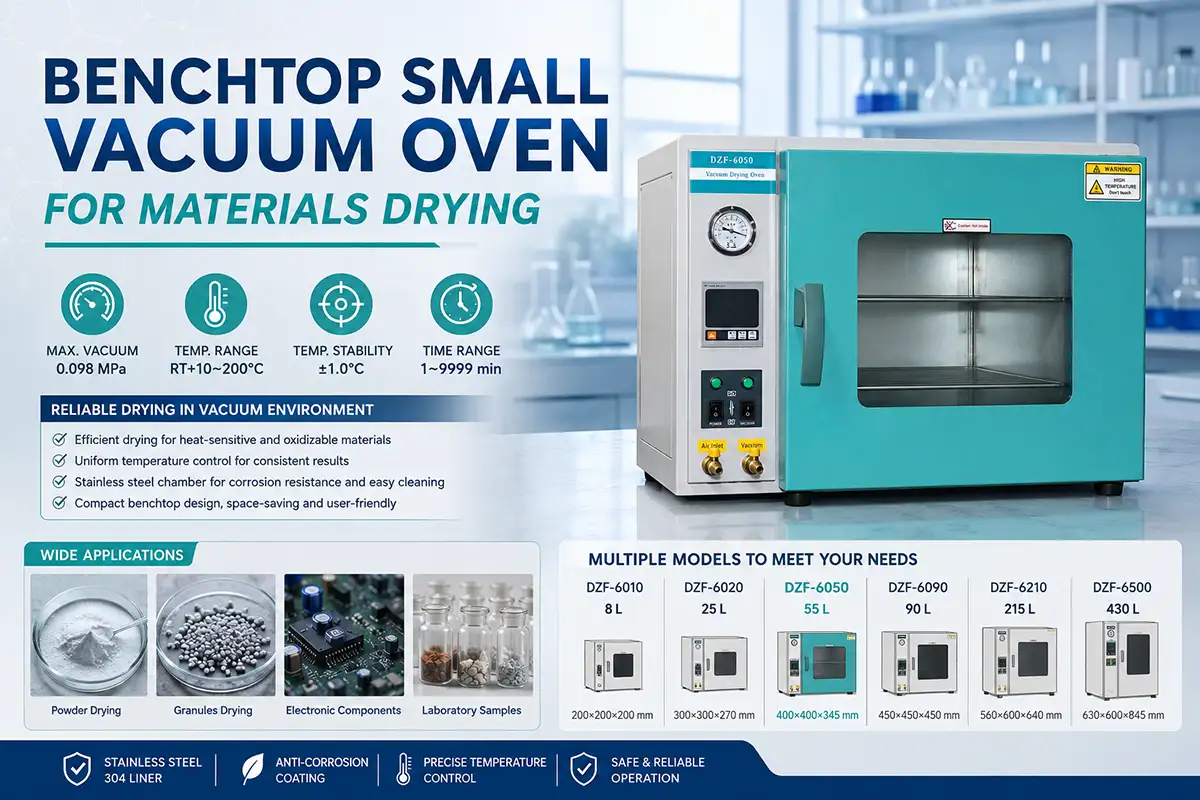
A good small vacuum oven should make drying easier, safer, and more repeatable. It should not be oversized, overpriced, or overly complicated. Based on the available specifications and pricing data, compact DZF series models offer a practical path for buyers who want dependable laboratory vacuum drying with clear cost control. When capacity, temperature range, vacuum degree, and chamber material are matched correctly, a small unit can deliver professional performance without forcing a large investment.
For most laboratories, the smartest purchase is not the biggest model. It is the model that fits the real job today while still leaving room for tomorrow’s workload.
Explore Drying Equipment