




Vacuum Oven With Vacuum Pump: Complete Buying Guide for Fast, Safe, and Precise Drying
A vacuum oven with vacuum pump is one of the most practical tools for laboratories, research centers, material processing lines, and light industrial production. It helps remove moisture and solvents at lower temperatures, protects heat-sensitive samples, and improves drying consistency. For buyers comparing specifications and prices, the real question is simple: which model delivers the right balance of chamber size, vacuum performance, temperature stability, and budget?
Why a Vacuum Oven With Vacuum Pump Is a Better Choice
Traditional hot air drying works for many basic jobs, but it is not always ideal for powders, pharmaceuticals, electronics, chemical intermediates, resin materials, plant extracts, or moisture-sensitive samples. Under vacuum, the boiling point of water and many solvents drops, so drying can happen at a lower temperature. That means less oxidation, less thermal damage, and often a cleaner final product.
According to the U.S. National Institute of Standards and Technology (NIST), pressure has a direct effect on boiling behavior and evaporation conditions, which is why reduced-pressure processing is widely used in laboratories and industrial drying systems. In practical terms, this is the reason a vacuum oven with vacuum pump can dry materials faster and more gently than many conventional ovens.
- Lower drying temperature for heat-sensitive materials
- Reduced oxidation risk during the drying process
- Better drying efficiency for solvents, powders, and porous samples
- Cleaner and more repeatable laboratory results
- Useful for research, chemicals, electronics, batteries, and pharmaceuticals
What Problems Does This Equipment Actually Solve?
Most buyers do not want a long list of features. They want answers to practical problems. A good vacuum drying oven solves four common issues: overheating, oxidation, poor drying uniformity, and long drying times. This is especially important when the product value is high or the material is sensitive.
Yes. Under reduced pressure, moisture and some solvents evaporate more easily. That is exactly why vacuum drying is preferred for many laboratory and industrial applications. In the author’s view, this is one of the biggest reasons users switch from standard ovens to vacuum models.
Key Specifications That Matter Before Buying
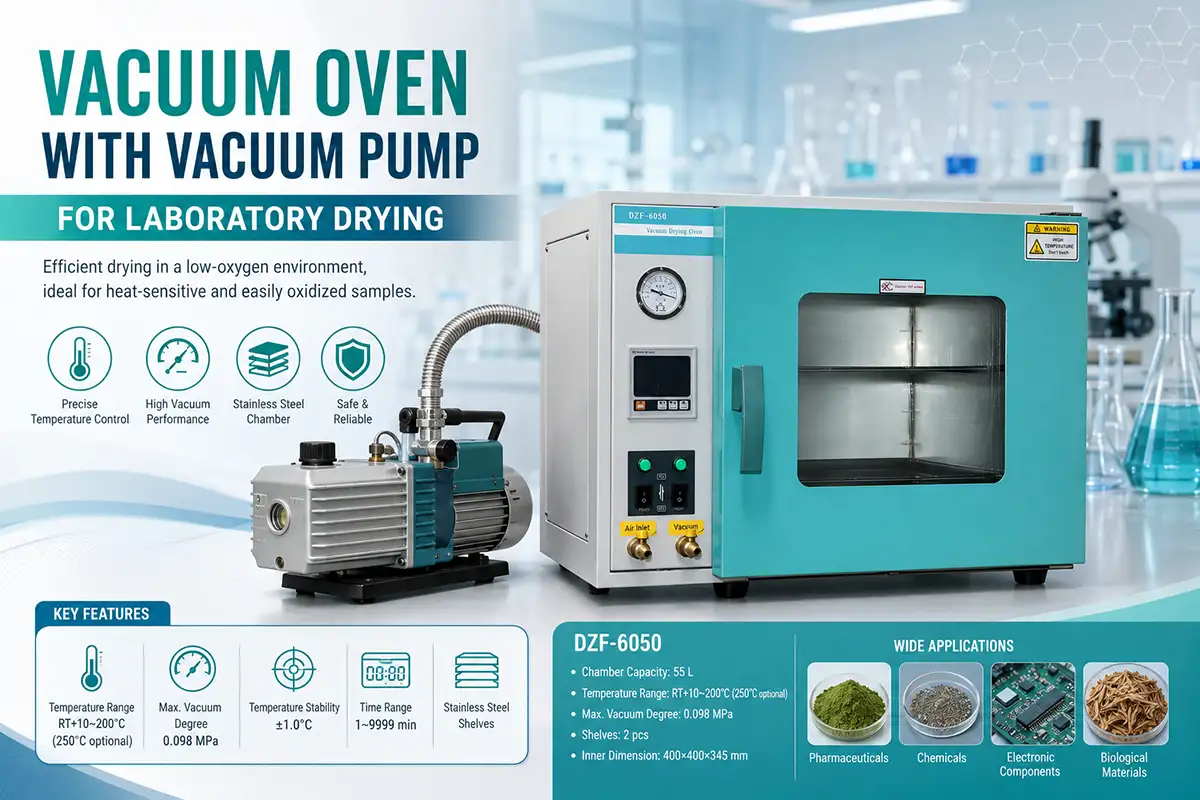
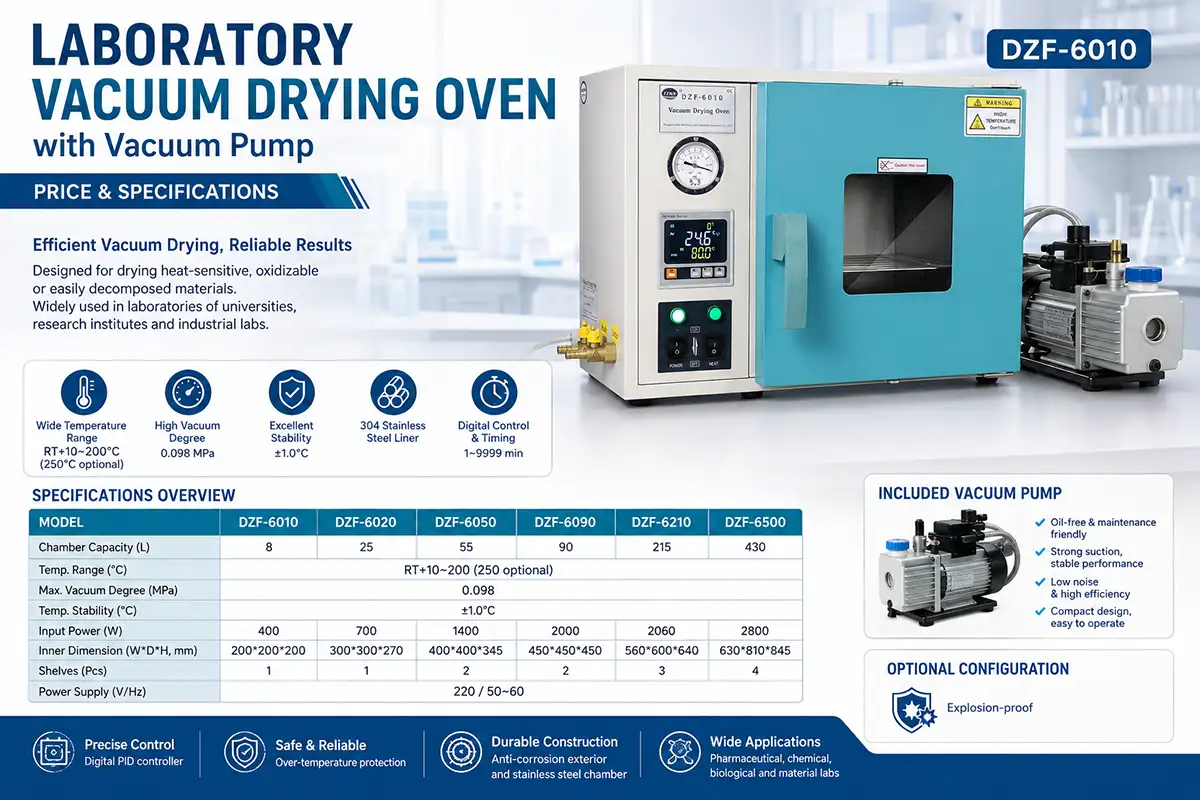
When comparing models, a few specifications are far more important than the rest. Based on the provided vacuum oven parameter sheet, ZZKD DZF series models are available from compact benchtop units to large-capacity systems. Most models offer a temperature range of RT+10 to 200°C, with some versions reaching 250°C. Maximum vacuum degree reaches 0.098 MPa, temperature stability is ±1.0°C, and temperature resolution is 0.1°C.
These numbers matter because they directly affect process quality. Stable temperature means more repeatable drying. Strong vacuum means lower-temperature evaporation. Stainless steel inner chambers improve cleanliness and corrosion resistance.
Recommended Model Overview and Reference Pricing
Based on the supplied product list and price sheet, the most useful way to compare options is by capacity. When a product had multiple price points, the middle but slightly lower value was selected, as requested. The vacuum pump reference price is also included because many buyers prefer a complete package rather than sourcing components separately.
| Model | Capacity | Temp. Range | Input Power | Shelves | Recommended Reference Price |
|---|---|---|---|---|---|
| DZF-6010 | 8L | RT+10~200°C | 400W | 1 | $360 |
| DZF-6020 | 25L | RT+10~200(250)°C | 700W | 1 | $443 |
| DZF-6050 | 55L | RT+10~200(250)°C | 1400W | 2 | $679 |
| DZF-6090 | 90L | RT+10~200(250)°C | 2000W | 2 | $519 |
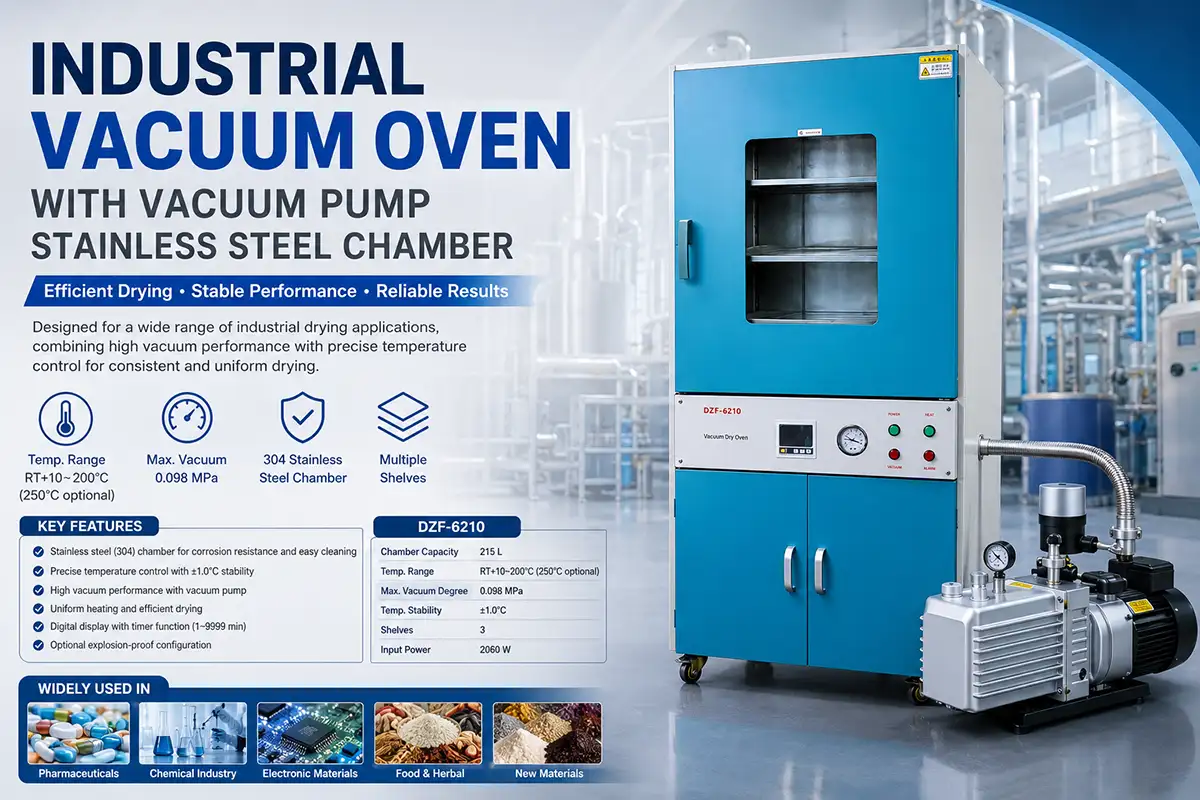
| DZF-6210 | 215L | RT+10~200(250)°C | 2060W | 3 | $4,500 |
| Vacuum Pump | Matching accessory | — | — | — | $177 |
Prices are reference values based on the supplied list and can vary by configuration, shipping region, explosion-proof option, and pump selection.
How to Choose the Right Size
A smaller chamber is usually enough for routine sample preparation, drying small batches, and benchtop research. A medium model works better for universities, testing centers, and pilot production. A large chamber is more suitable for batch processing, multiple trays, and industrial labs.
- 8L model: best for small sample drying, basic laboratory use, and limited bench space.
- 25L model: a practical entry-level option for labs needing more flexibility.
- 55L model: a strong choice for daily research work and multi-sample drying.
- 90L model: suitable for larger batches and more demanding throughput.
- 215L model: built for high-capacity tasks and process-oriented laboratories.
Not necessarily. From the author’s perspective, oversizing often increases cost, power consumption, and occupied floor space without improving real productivity. The better choice is the model that matches actual batch size and workflow frequency.
Who Should Buy a Vacuum Oven With Vacuum Pump?
This type of equipment is a smart fit for users who need dependable low-pressure drying and want to avoid quality loss caused by air exposure or excessive heat. Common buyers include:
- University laboratories and research institutes
- Pharmaceutical and biotech labs
- Chemical material processing facilities
- Electronics and battery material manufacturers
- Food, herbal, and extract processing applications
For users comparing drying technologies, it may also help to read about related processes such as lyophilization and broader freeze dried food equipment. Those pages are useful for understanding when vacuum drying is the right method and when freeze drying is the better fit.
What About Safety and Material Quality?
Safety should never be treated as a secondary detail. The provided specification list includes explosion-proof configuration as an optional feature, which is important for certain solvent-related applications. The 304 stainless steel liner also helps with corrosion resistance and easy maintenance.
According to the U.S. Occupational Safety and Health Administration (OSHA), equipment used with heat and volatile substances should be selected with proper attention to process hazards, ventilation, and material compatibility. In simple words, buying the right oven is not only about drying speed. It is also about safer operation, stable performance, and longer service life.
No. The answer depends on the materials being processed. For routine moisture drying of non-flammable samples, a standard model may be enough. For solvent-heavy or hazardous applications, the author strongly recommends evaluating the explosion-proof option before purchase.
What Makes ZZKD Vacuum Ovens Competitive?
The DZF series combines the core points buyers usually ask for: practical chamber sizes, reliable vacuum performance, stainless steel interior, fine temperature control, and a wide usable temperature range. Just as important, the price ladder is easy to understand. An 8L unit starts around $360, a 25L unit is around $443, a 55L unit around $679, and a larger 215L model around $4,500. A matching vacuum pump reference price of $177 makes package planning easier.
Buyers who also need general drying comparison can review related content on vacuum oven drying. This helps clarify the operating advantages of reduced-pressure drying for sensitive materials.
Final Answer: Which Vacuum Oven With Vacuum Pump Should Be Chosen?
If the goal is small-scale laboratory work, the DZF-6010 8L is a cost-effective start. If a better balance of capacity and affordability is needed, the DZF-6020 25L is a very practical option. For regular lab production and more demanding throughput, the DZF-6050 55L is often the sweet spot. For large-volume applications, the DZF-6210 215L is the more suitable choice.
In short, the right vacuum oven with vacuum pump should match the real material type, batch size, safety requirement, and temperature target. When those four points are clear, the buying decision becomes much easier.
A well-matched vacuum drying system can improve drying quality, shorten process time, and reduce product loss. That is why this equipment continues to be a strong investment for laboratories and industrial users that care about both precision and output.
Explore More Drying Equipment