




Solvent Recycling Ethanol: A Practical Guide to Choosing the Right Recovery Machine
Ethanol is one of the most widely used solvents in extraction, cleaning, laboratory work, and production. The problem is simple: fresh solvent costs money, waste disposal adds more cost, and unsafe handling creates real risk. A reliable solvent recycling machine turns that problem into savings by recovering usable ethanol and reducing waste at the same time.
Why solvent recycling ethanol matters
In many facilities, ethanol is not consumed only once. Much of it can be recovered, purified, and returned to production. That means a solvent recycling ethanol system is not just a machine purchase. It is a cost-control tool.
According to the U.S. Environmental Protection Agency, solvent recovery and reuse can help manufacturers reduce hazardous waste generation and improve overall environmental performance. This is important because solvent disposal is often more expensive than many teams expect. In practical terms, every batch of recovered ethanol reduces both purchasing pressure and waste-handling pressure.
What kind of users usually need an ethanol recovery machine?
The answer is usually very specific. Most buyers are not looking for general chemistry equipment. They want a machine that solves one clear issue: too much ethanol loss during production or cleaning.
- Extraction businesses that need to reuse ethanol in repeated batches
- Laboratories that want cleaner solvent management and lower operating cost
- Electronics, coating, printing, and cleaning plants handling organic solvent waste
- Cosmetics and fine chemical facilities that want stable solvent recovery and better compliance
Not at all. Smaller users often feel the cost of wasted ethanol even more directly. A compact unit can make sense when solvent is expensive, batches are frequent, and disposal is inconvenient.
Key machine data that actually helps with buying decisions
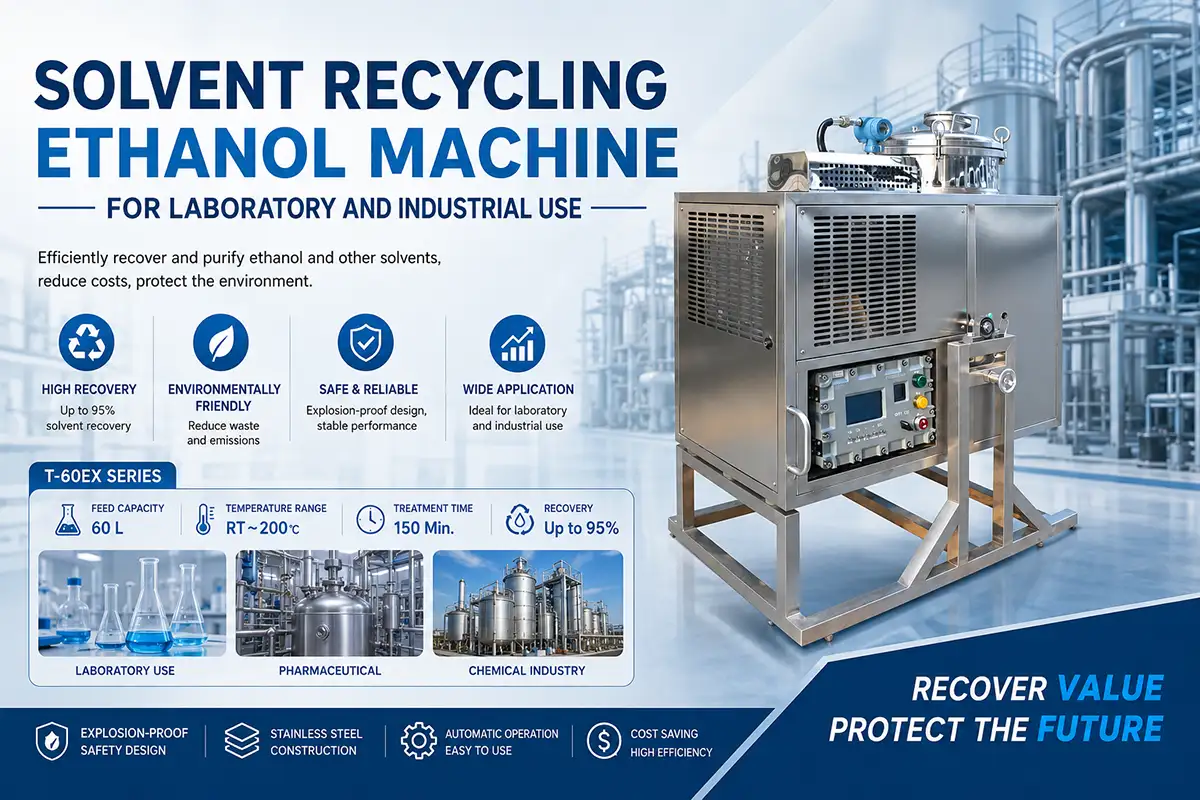
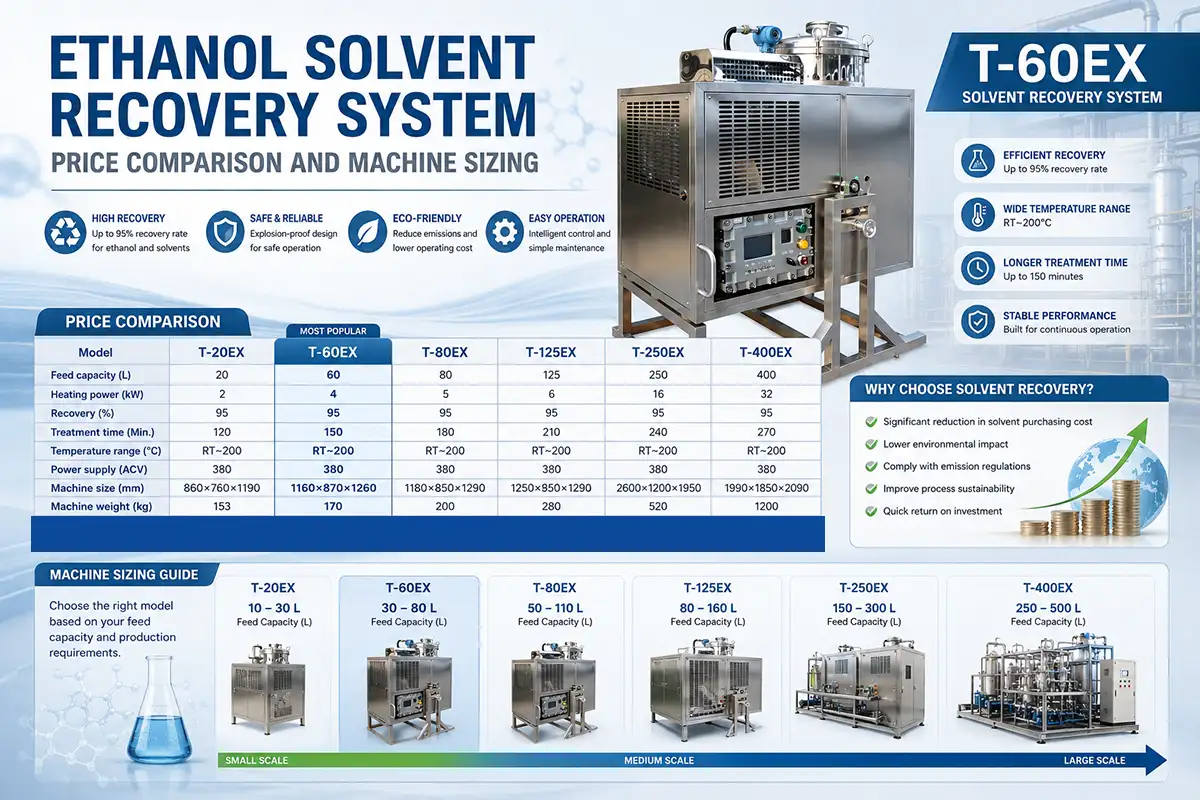
Many articles discuss solvent recycling in broad terms, but buyers usually want direct answers: what size is needed, how long each batch takes, how much can be recovered, and what the price range looks like. Based on the provided machine parameter sheet, the following models are available for ethanol and organic solvent recovery.
| Model | Feed Capacity (L) | Heating Power (kW) | Temperature Range | Treatment Time | Recovery Rate | Weight (kg) |
|---|---|---|---|---|---|---|
| T-20Ex | 20 | 2 | RT–200°C | 120 min | 95% | 153 |
| T-60Ex | 60 | 4 | RT–200°C | 150 min | 95% | 170 |
| T-80Ex | 80 | 5 | RT–200°C | 180 min | 95% | 200 |
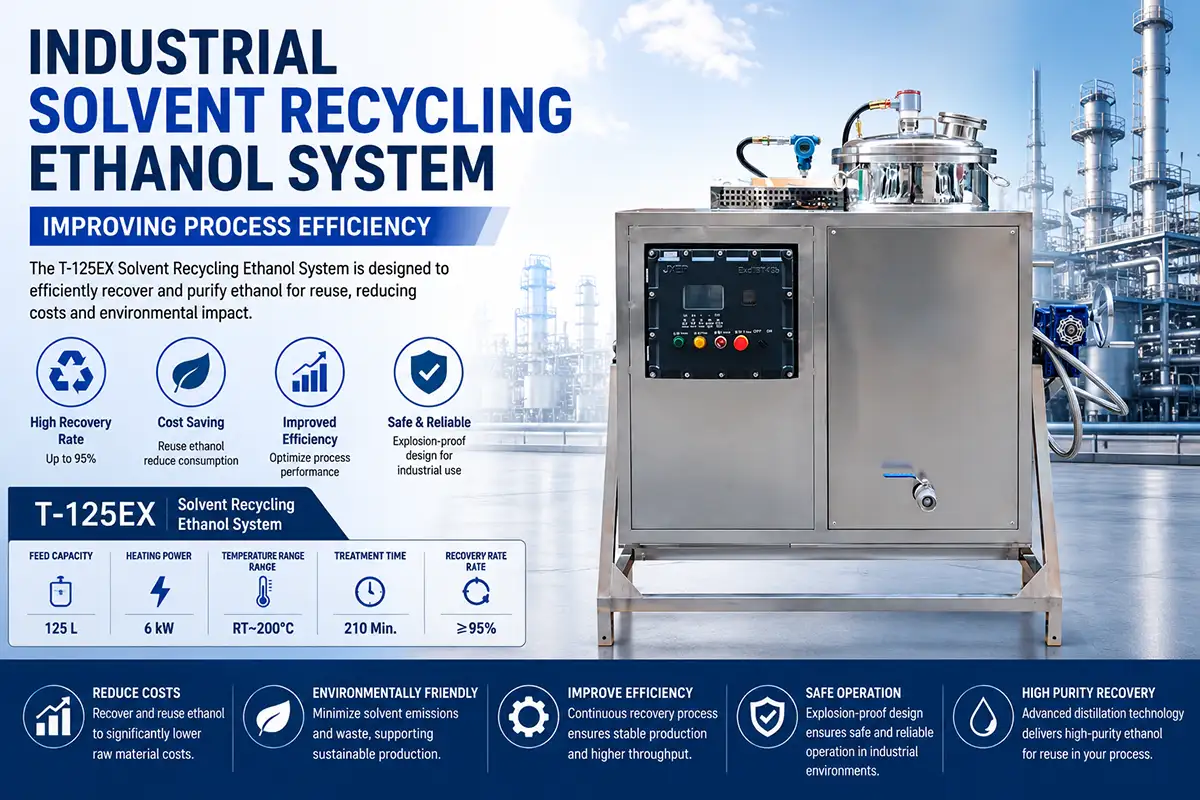
| T-125Ex | 125 | 6 | RT–200°C | 210 min | 95% | 280 |
| T-250Ex | 250 | 16 | RT–200°C | 240 min | 95% | 520 |
| T-400Ex | 400 | 32 | RT–200°C | 270 min | 95% | 1200 |
These figures make selection easier. If the daily volume is low, a 20L or 60L unit may be enough. If multiple batches run every day, moving up to 125L, 250L, or 400L can improve labor efficiency and reduce waiting time between cycles.
No. Oversizing can increase power demand, floor-space use, and initial investment. The better choice is the smallest machine that can comfortably handle real daily throughput with room for growth.
How much does an ethanol solvent recovery machine cost?
Price is one of the first questions buyers ask, and rightly so. From the provided product list, smaller related solvent distillation or rotovap-style units start around $1,900. For industrial solvent recovery machines with multiple price points, using the middle, lower option gives a more realistic reference of about $9,690 in the listed range of $2,971–19,500 for larger recovery distillation equipment.
For many standard industrial solvent recovery machine listings in the provided sheet, the visible range is $2,645–9,690. That suggests many buyers will compare systems in the mid-level budget zone before moving into heavier-duty explosion-proof or high-capacity units.
- Entry level: around $1,900 for small related solvent distillation equipment
- Common industrial comparison range: around $2,645 to $9,690
- Mid-level selected reference with multiple prices: around $9,690
- Specialized larger recovery equipment: $10,691 and above in some listings
Price alone should not decide the purchase. Recovery rate, treatment time, safety design, and actual ethanol loss in the current process matter much more over time. A cheaper unit that runs slowly or handles too little volume can cost more in labor and downtime.
What should be checked before buying?
In my view, buyers should focus on five practical checks instead of reading long lists of generic specifications.
- Daily solvent volume: How many liters of waste ethanol are created per shift or per day?
- Required recovery speed: Is one batch per day enough, or are multiple cycles needed?
- Site safety requirements: Does the process require explosion-proof design?
- Target solvent purity after recovery: Will the recovered ethanol be reused for extraction, cleaning, or lower-grade processes?
- Available utilities and space: Larger units need more power, more ventilation planning, and more installation room.
Treatment time. A machine with good recovery but slow turnover can create production bottlenecks. Capacity and treatment time should always be evaluated together.
For buyers comparing recovery technologies, it may also help to understand related evaporation equipment. See this internal reference on how does a rotovap work and this product collection for rotovap for sale. For a broader view of industrial recovery design, this page on solvent recovery systems is also relevant.
The business case is stronger than many expect
According to the U.S. Department of Energy, process optimization and material reuse are among the most practical ways for manufacturers to improve operating efficiency. That applies directly to ethanol recovery. If ethanol is purchased regularly and discarded after limited use, recovery equipment often pays back through reduced solvent purchasing, reduced disposal cost, and a more controlled workflow.
There is also a risk-control advantage. Centralizing solvent recovery can reduce uncontrolled storage of waste solvent around the facility. That supports cleaner production areas and more consistent operating procedures.
Final thought
A good solvent recycling ethanol machine is not simply a piece of support equipment. It directly affects solvent cost, waste volume, process stability, and production discipline. The right unit depends on actual batch size, daily throughput, and safety expectations, but the core buying logic is simple: choose a machine that matches real solvent volume, delivers stable recovery around the required cycle time, and leaves enough room for future scale.
If ethanol is being used repeatedly and disposal cost keeps rising, delaying recovery equipment often costs more than investing in it.
Explore ZZKD Equipment