




Can Glass Reactors Still Be Used for Pressurized Reactions? What Conditions and Safety Features Make a High Pressure Glass Reactor Suitable?
Many buyers like glass because it is clean, visible, and easy to operate. But once pressure becomes part of the process, the first question is always the same: can glass still be used safely? The short answer is yes, but only for the right process window, the right reactor design, and the right safety configuration.
A Clear Answer First: Can a Glass Reactor Handle Pressure?
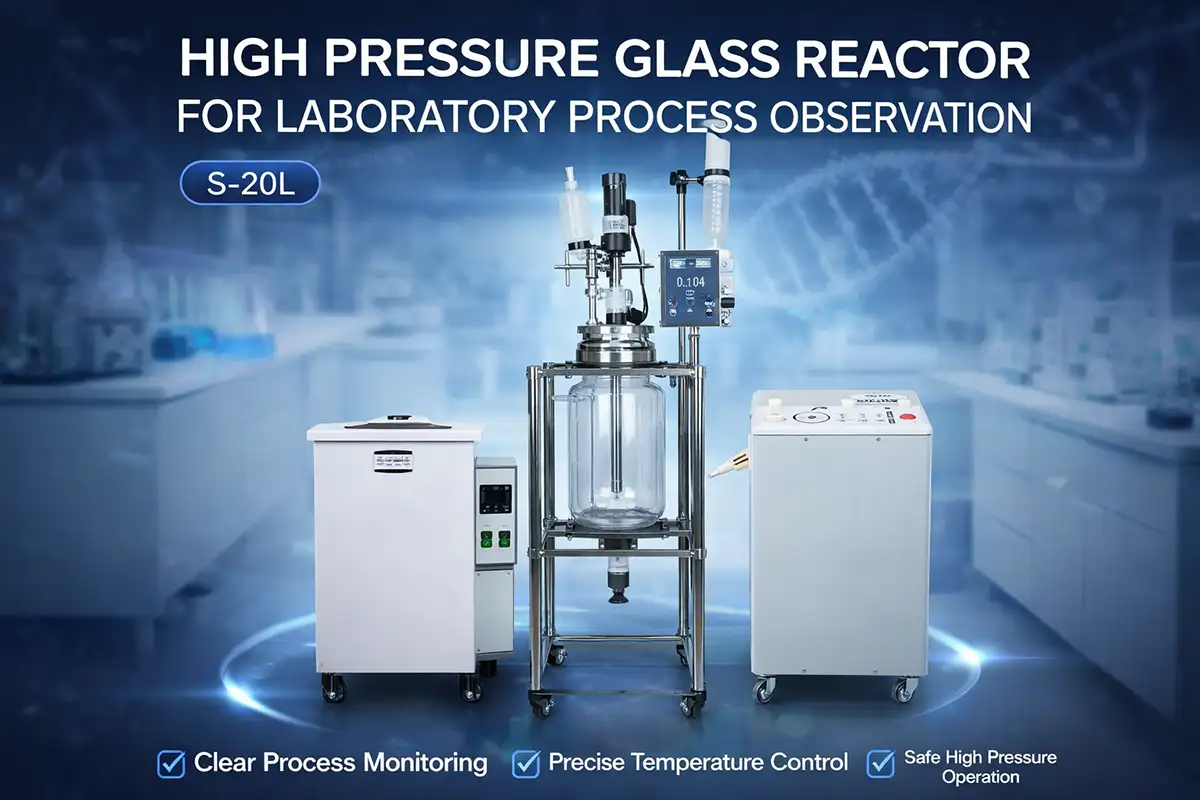
A high pressure glass reactor can be used for pressurized reactions, but it is important to understand that it is not a universal replacement for a stainless steel autoclave. Glass reactors are valued because operators can directly observe mixing, foaming, color change, crystallization, and phase separation. That visibility is a major advantage in research, pilot work, and process development.
However, glass has natural mechanical limits. Compared with metal vessels, glass is more sensitive to impact, thermal shock, and sudden pressure changes. That means the decision should not be based on “pressure reaction” alone, but on how much pressure, what chemistry, what temperature, and how stable the full process is.
In practical terms, a glass reactor is usually the better choice when the process needs visual monitoring, corrosion resistance, clean product contact, and moderate operating pressure. If the reaction includes very high pressure, violent gas release, hydrogenation at high load, or strong risk of runaway, a metal high-pressure reactor is generally safer.
Is a glass reactor suitable for every pressurized reaction?
No. From an equipment selection point of view, the answer is clear: a glass reactor is suitable for low-to-moderate pressure tasks where visibility and corrosion resistance matter, but it is not the best choice for extreme pressure or highly hazardous reaction systems.
Which Working Conditions Fit a High Pressure Glass Reactor Best?
The most suitable applications are not the most extreme ones. Instead, they are processes where the benefits of glass bring real value. Typical examples include:
Fine chemical synthesis
Useful when reaction color, precipitation, or layer formation needs to be observed in real time.
Pharmaceutical R&D
Glass offers clean contact surfaces and supports process development where contamination control matters.
Corrosive media handling
Many acids, solvents, and specialty chemicals are more compatible with borosilicate glass than with ordinary metals.
Low-foaming gas-liquid reactions
Suitable when pressure exists, but remains controlled and the reaction does not involve violent gas generation.
For many laboratories, the real question is not whether pressure is present, but whether pressure remains controlled and predictable. A well-designed glass reactor is often chosen for screening, route development, vacuum-assisted synthesis, distillation-related reactions, and temperature-controlled mixing.
If comparing common lab and pilot reactor ranges, capacity also matters. Based on the supplied equipment parameters, floor-type double-jacket reactor models cover 1L, 2L, 3L, 5L, 10L, 20L, 30L, 50L, and 100L. The stirring speed range is 0–600 rpm, with a maximum of 1300 rpm, and standard power supply is 220V, 50/60 Hz, while 110V/60Hz customization is available on some models. These details matter because stable stirring, proper vessel volume, and compatible power supply all affect safe pressure handling in daily operation.
If more background is needed on glass vessel structure and design logic, this guide on jacketed glass reactor vessel explains why jacket control, vessel shape, and sealing arrangement matter so much in laboratory processing.
What Safety Configurations Should Never Be Ignored?
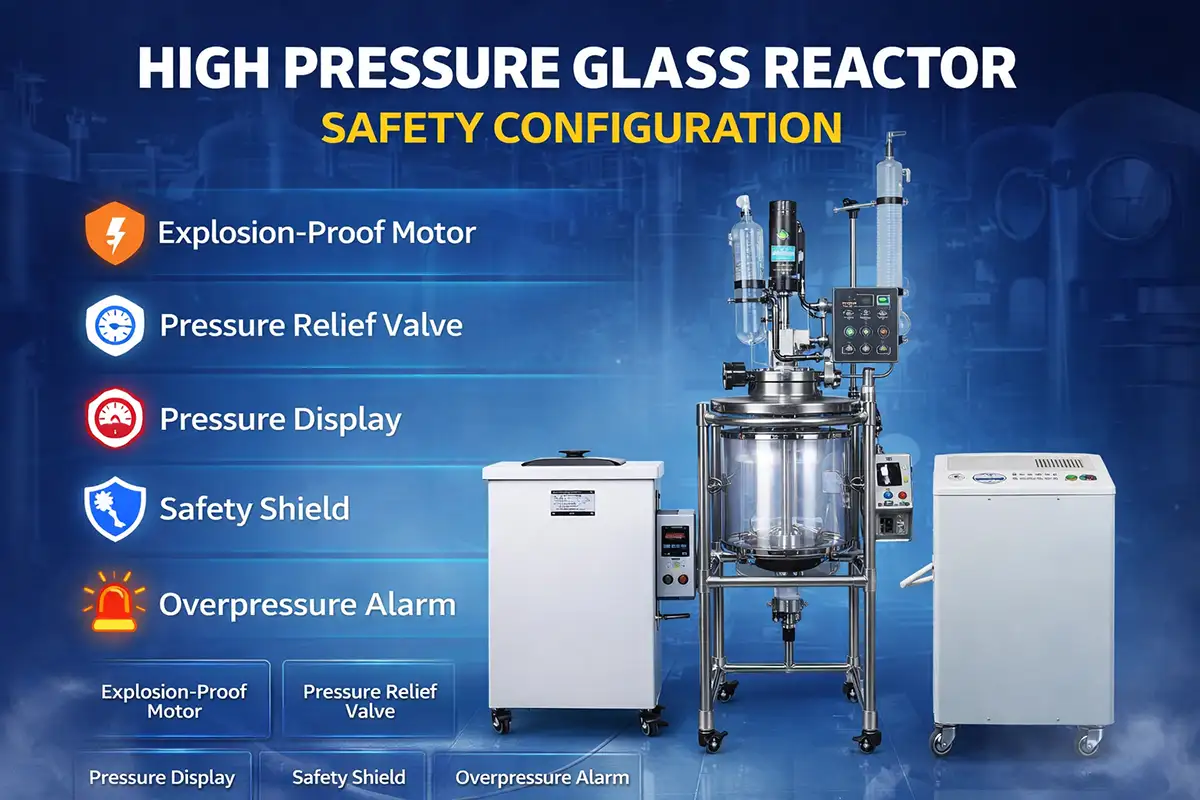
This is the part many buyers care about most, and rightly so. A high pressure glass reactor is only as safe as its full configuration. Pressure does not act on the glass body alone. It affects joints, seals, valves, stirring stability, temperature response, and even the frame.
- Reliable pressure measurement: a clear, accurate pressure gauge is essential for monitoring the real operating state.
- Pressure relief protection: a relief valve or rupture protection design helps prevent unsafe overpressure events.
- Explosion-proof motor option: especially important when flammable solvents are used. The supplied parameter sheets also note explosion-proof configurations.
- Stable stirring system: poor agitation may create local overheating, delayed gas release, or unstable mass transfer.
- Strong frame structure: larger models use a 304 stainless steel frame, which improves support and operating stability.
- Compatible sealing materials: seals must match solvent, temperature, and vacuum/pressure conditions.
- Temperature control system: jacketed heating or cooling must remain stable to reduce thermal stress on the glass.
- Protective shielding: transparent safety shields add an extra layer of operator protection.
If pressure is low, can safety accessories be simplified?
Not really. From a practical equipment perspective, low pressure does not mean low risk. Problems often come from temperature swings, wrong solvent choice, blocked vent lines, or operator error. A complete safety setup is still necessary.
How Do the Basic Parameters Affect Real Use?
A reactor is not selected by volume alone. Stirring power, torque, shaft diameter, and structural design all influence the process. The supplied product data shows a practical range for different batch sizes.
| Series | Model Range | Capacity | Stirring Power | Speed Range | Key Notes |
|---|---|---|---|---|---|
| S-1-5L | S-1L / S-2L / S-3L / S-5L | 1–5L | 60W | 0–600 rpm (Max. 1300) | Floor type, explosion-proof option, 12 mm shaft |
| S-10-100L | S-10L / S-20L / S-30L / S-50L / S-100L | 10–100L | 120W / 250W | 0–600 rpm (Max. 1300) | 304 stainless steel frame, explosion-proof option |
In real operation, larger capacity often means more demand on torque, structural support, and temperature uniformity. For example, the smaller 1–5L range lists motor torque values up to 4800 g/cm, while the 10–100L range includes torque values such as 1000, 1200, 1500, and 3000 g/cm depending on model. These details help determine whether the reactor can maintain stable agitation when viscosity changes or solids begin to form.
For buyers comparing visible glass systems with pressure-oriented alternatives, it can also be helpful to review this page on glass reactor pressure vessel solutions and this product page for a high pressure lab reactor when the process may exceed what standard glass configurations can comfortably handle.
What Do Authoritative Data Sources Suggest About Safety Thinking?
Equipment selection should never rely only on marketing language. It should also follow recognized safety and engineering principles. According to the U.S. Occupational Safety and Health Administration (OSHA), pressure systems require proper design, inspection, pressure control, and hazard prevention because stored energy in pressurized equipment can become dangerous very quickly if not managed correctly. That principle strongly supports the need for gauges, relief devices, and correct operating procedures in any pressurized glass system.
In addition, guidance from the American Chemical Society emphasizes that glassware under pressure deserves extra caution because glass failure can be sudden and fragments can be hazardous. This is exactly why protective shielding, gradual pressurization, and careful material compatibility checks are not optional details. They are core parts of safe reactor use.
When should a metal reactor be chosen instead of a glass reactor?
The answer is straightforward: when the process involves high pressure beyond normal glass design limits, flammable gas at elevated load, aggressive exothermic behavior, or a strong risk of shock and thermal stress, a stainless steel or alloy pressure reactor is the more suitable option.
Final Recommendation
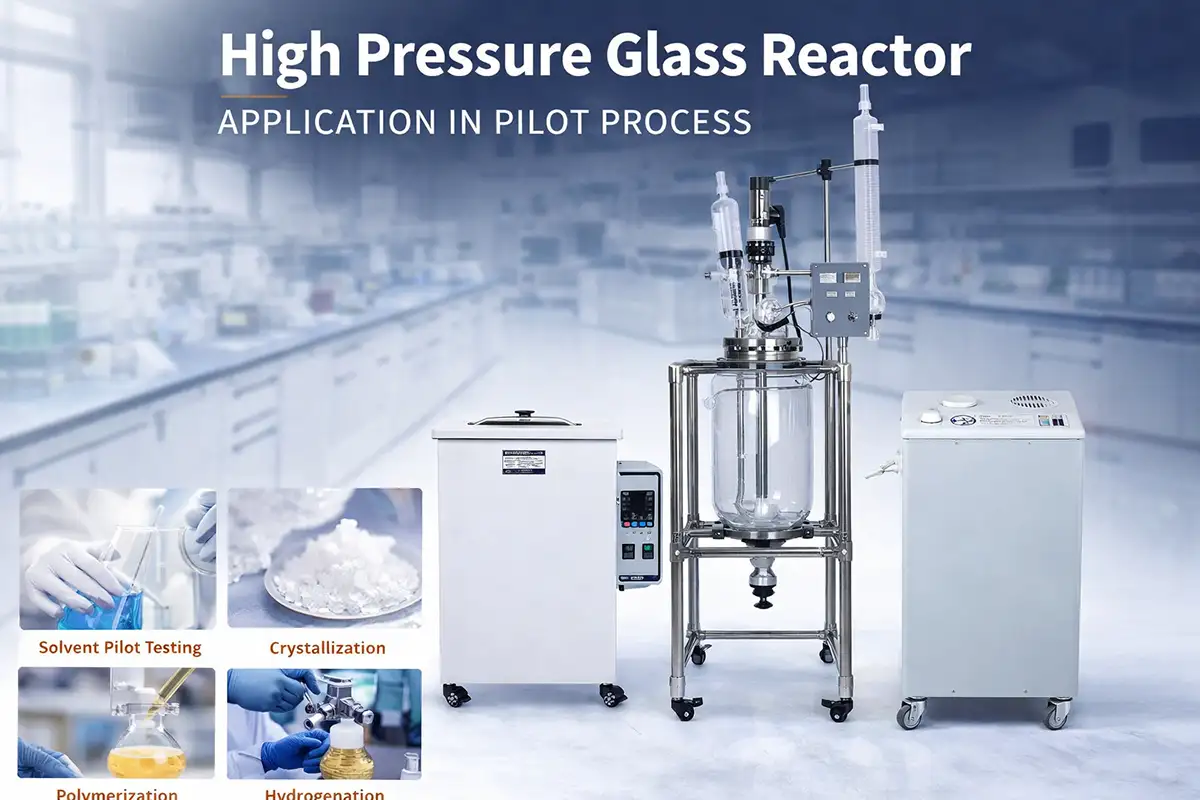
A high pressure glass reactor is a smart choice when the process needs visibility, corrosion resistance, clean handling, and controlled low-to-moderate pressure operation. It is especially useful in laboratory development, fine chemicals, pharmaceutical testing, and pilot work where process observation matters.
But the correct answer to the original question is not simply “yes” or “no.” It is this: glass can be used for pressure reactions only when the operating conditions match the reactor’s design limits and the safety configuration is complete.
For buyers, the safest path is to evaluate five points first: operating pressure, reaction temperature, chemical compatibility, gas generation behavior, and required safety accessories. Once those are clear, choosing between a glass system and a metal pressure vessel becomes much easier.