Price comparison for industrial agitated nutsche filter dryers
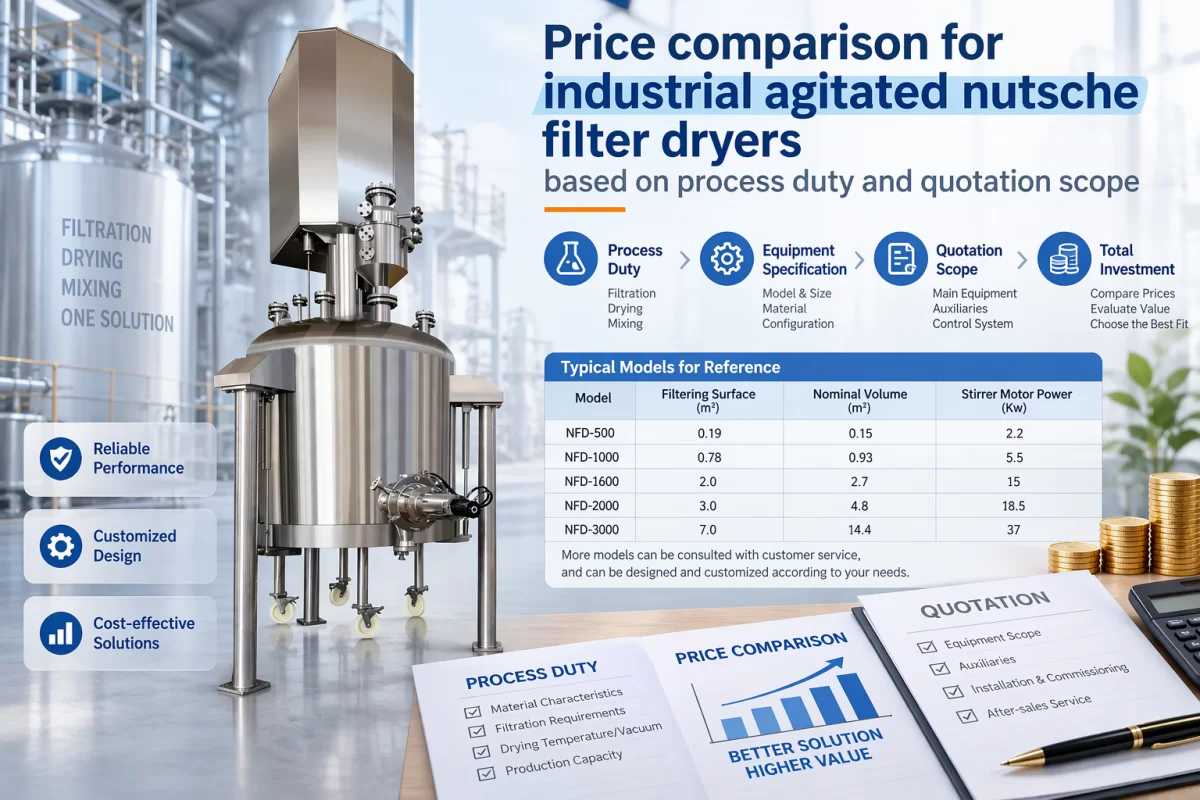
A meaningful price comparison for industrial agitated nutsche filter dryers starts with the process, not simply the vessel size. Filtration area, cake depth, agitation, construction materials, and installation requirements all influence whether a proposed system represents good purchasing value.
Compare quotation scope before comparing price
An Agitated Nutsche Filter Dryer is intended to bring solid–liquid separation, cake washing, and drying into an integrated processing sequence. For pharmaceutical and chemical manufacturers, the purchasing decision should reflect the material being processed and the required batch outcome. A lower initial equipment price is not automatically a lower-cost production solution.
Pricing is quotation-based; this guide does not present a numerical company reference price. The actual quotation depends on configuration and the inquiry result. To compare proposed configurations fairly, use the same material description, batch requirement, operating conditions, and supply boundary for each quotation.
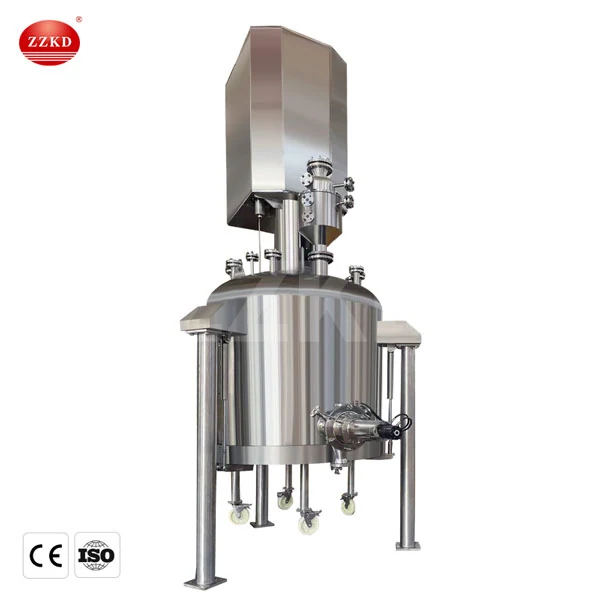
The Agitated Nutsche Filter Dryer product page is a useful starting point for discussing an NFD configuration or a customized equipment proposal.
What makes two filter dryer quotations genuinely comparable?
I recommend matching the processing duty and included equipment first. Filtration area, allowable operating conditions, material specification, agitation arrangement, and ancillary equipment should describe the same job. Only then does comparing quotation totals become useful.
How an agitated nutsche filter dryer works
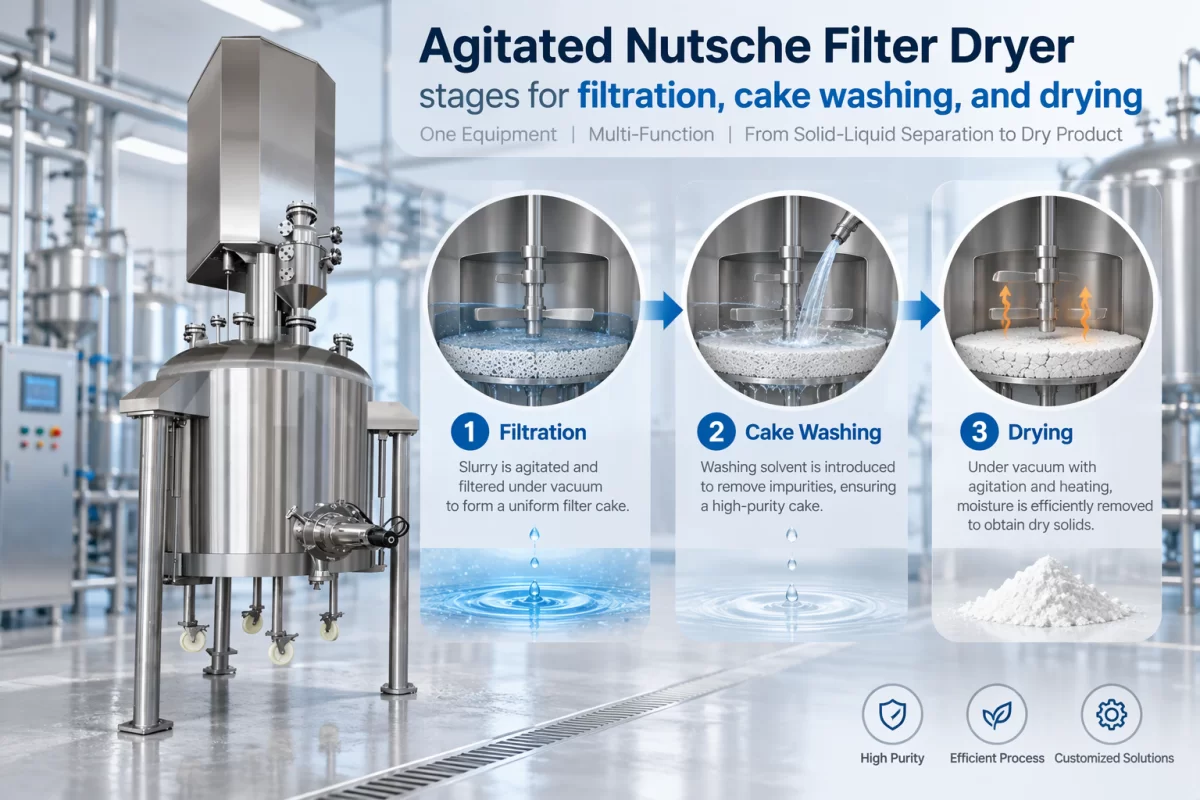
In a typical nutsche filtration sequence, slurry enters a vessel containing a filter support and suitable filter medium. A pressure difference drives liquid through the filter while solids remain as a cake. The cake can then be washed to remove retained mother liquor or soluble components, according to the process requirements.
Agitation provides a means of working the material during the processing sequence. During drying, heat supplied through the jacket supports evaporation, while material movement can help expose wet solids to heat transfer. The vapor-removal arrangement must be selected for the solvent and operating conditions; a positive-pressure specification should not be treated as a vacuum rating.
This equipment category is relevant to pharmaceutical and chemical raw-material processing where the required product is a separated solid. Candidate applications include batch processing after precipitation or crystallization, provided the cake behavior, chemical compatibility, and drying conditions are suitable. Upstream equipment also matters: the discussion of stainless steel chemical reactors in process production provides context for planning the reaction-to-filtration workflow.
NFD-200 operating and construction specifications
The NFD-200 specifications below provide a compact-equipment reference for configuration discussions. Vessel and jacket values are shown separately because they describe different parts of the equipment. These values should not be applied to the larger NFD models listed later.
| Parameter | Inside the tank | Jacket |
|---|---|---|
| Maximum working pressure (MPa) | 0.2 | 0.2 |
| Design pressure (MPa) | 0.3 | 0.35 |
| Working temperature (°C) | 85 | 85 |
| Design temperature (°C) | 90 | 95 |
| Working medium | Pharmaceutical and chemical raw materials | Hot water or thermal oil |
| Main pressure-component material | 316L stainless steel | 304 stainless steel |
The specified stirring speed is 0–25 rpm, with 0.55 kW stirring power and a 100 mm agitator stroke. The shaft seal is a packing seal. Equipment weight is 200 kg, and overall dimensions are 600 × 800 × 1600 mm, expressed as length × width × height.
For purchasing purposes, distinguish working limits from design values. A design temperature is not a recommendation to run the process above the listed working temperature. Likewise, the stated material grades identify the main pressure components; chemical compatibility still needs to be assessed against the actual feed, wash liquid, and cleaning procedure.
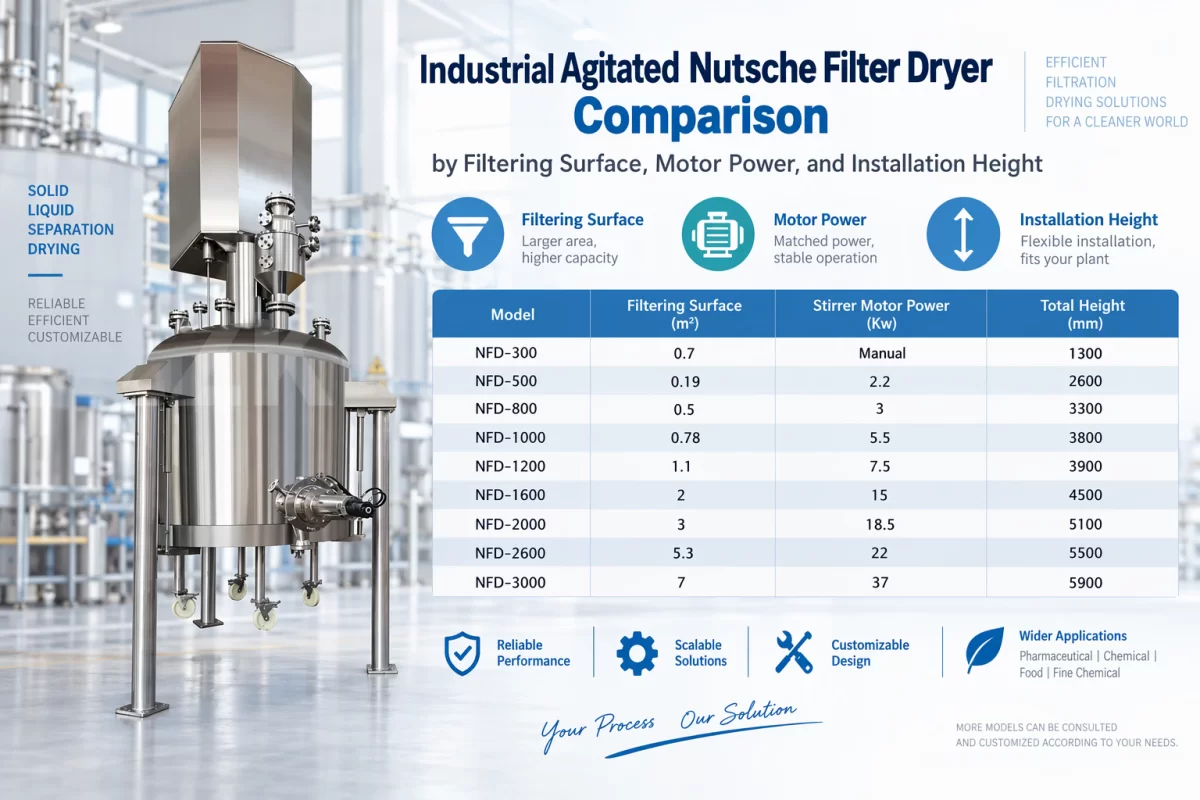
Industrial NFD model comparison: area, agitation, and space
The selected models below show how filtration area, cake height, motor power, and physical installation requirements vary across the NFD range. Motor ratings describe the listed models; they do not establish drying time, production throughput, or energy consumption per batch.
| Model | Filtering surface (m²) | Filter cake height (mm) | Paddle lifting height (mm) | Stirrer motor power (kW) | Net weight (kg) | Total height (mm) |
|---|---|---|---|---|---|---|
| NFD-500 | 0.19 | 140 | 160 | 2.2 | 1450 | 2600 |
| NFD-1000 | 0.78 | 220 | 250 | 5.5 | 3600 | 3800 |
| NFD-1600 | 2 | 300 | 350 | 15 | 7400 | 4500 |
| NFD-2000 | 3 | 400 | 450 | 18.5 | 11500 | 5100 |
| NFD-3000 | 7 | 550 | 600 | 37 | 25000 | 5900 |
Does a larger filtering surface always deliver better purchasing value?
I would not select by area alone. Cake permeability, solids loading, washing requirements, and drying behavior determine how useful that area is. A larger model also brings different weight and height requirements, so the purchase should balance process suitability with installation and operating needs.
Selection factors that shape filter dryer purchasing value
A technically useful inquiry describes what the equipment must achieve, rather than requesting only a model and price. The following information helps establish an appropriate configuration:
- Feed and batch duty: Identify the material, solvent, expected solids concentration, working batch quantity, and production schedule.
- Filtration behavior: Describe particle characteristics, cake compressibility, and available filtration test results. These influence filter-medium selection and practical cake depth.
- Washing and drying targets: State the wash liquid, intended washing sequence, final moisture or residual-solvent target, and acceptable material temperature.
- Construction and sealing: Specify compatibility requirements, cleaning expectations, and the sealing arrangement needed for the process.
- Utilities and location: Provide available heating services, intended pressure conditions, installation space, access requirements, and site lifting constraints.
- Supply boundary: Define whether controls, vapor handling, supporting equipment, commissioning, and documentation are required within the quotation.
Where solvent handling is part of the process, evaluate the downstream liquid and vapor streams separately from the filter dryer itself. The guide to industrial solvent recovery systems offers useful background for considering recovery equipment as a separate part of the project.
Which costs deserve attention beyond the equipment quotation?
I include installation, utility connections, cleaning labor, seal maintenance, filter-medium replacement, and batch turnaround in the evaluation. These are purchasing considerations, not predicted savings. Their importance depends on the material, operating schedule, and final system design.
The integrated processing concept can reduce the need to transfer wet cake between separate filtration and drying equipment. Whether that translates into worthwhile labor, handling, or scheduling benefits depends on the existing production arrangement. Additional models and customized designs are available for discussion, allowing the inquiry to focus on the required process rather than forcing the process into a predetermined model.
Make the price comparison process-led
A sound price comparison for industrial agitated nutsche filter dryers connects the quotation to filtration duty, cake handling, drying targets, construction, and installation. The NFD specifications provide concrete selection references, but the best purchasing decision comes from matching those specifications to the actual material and batch requirements.
Compare equivalent supply scopes, keep working conditions distinct from design values, and consider the full operating workflow alongside the initial purchase. This approach supports a more useful assessment of both equipment suitability and long-term purchasing value.
For a configuration-specific proposal, provide the material description, working batch quantity, target operating conditions, drying endpoint, and required accessories. The actual quotation is determined by the selected configuration and inquiry result.