Laboratory equipment • DZF series
Laboratory vacuum drying oven with stainless steel chamber price.
A laboratory vacuum drying oven with a stainless steel chamber should be evaluated by more than price alone. Chamber dimensions, sample compatibility, heating requirements, and the vacuum arrangement all influence whether a Drying Oven fits a laboratory’s daily work. The DZF models discussed here feature 304 stainless steel liners and offer several chamber sizes for different batch requirements.
This guide explains the drying principle, compares model-specific specifications, and sets out practical purchasing considerations. Our company’s reference price is USD 610; the actual quotation depends on configuration and the results of the inquiry.
How a laboratory vacuum drying oven works
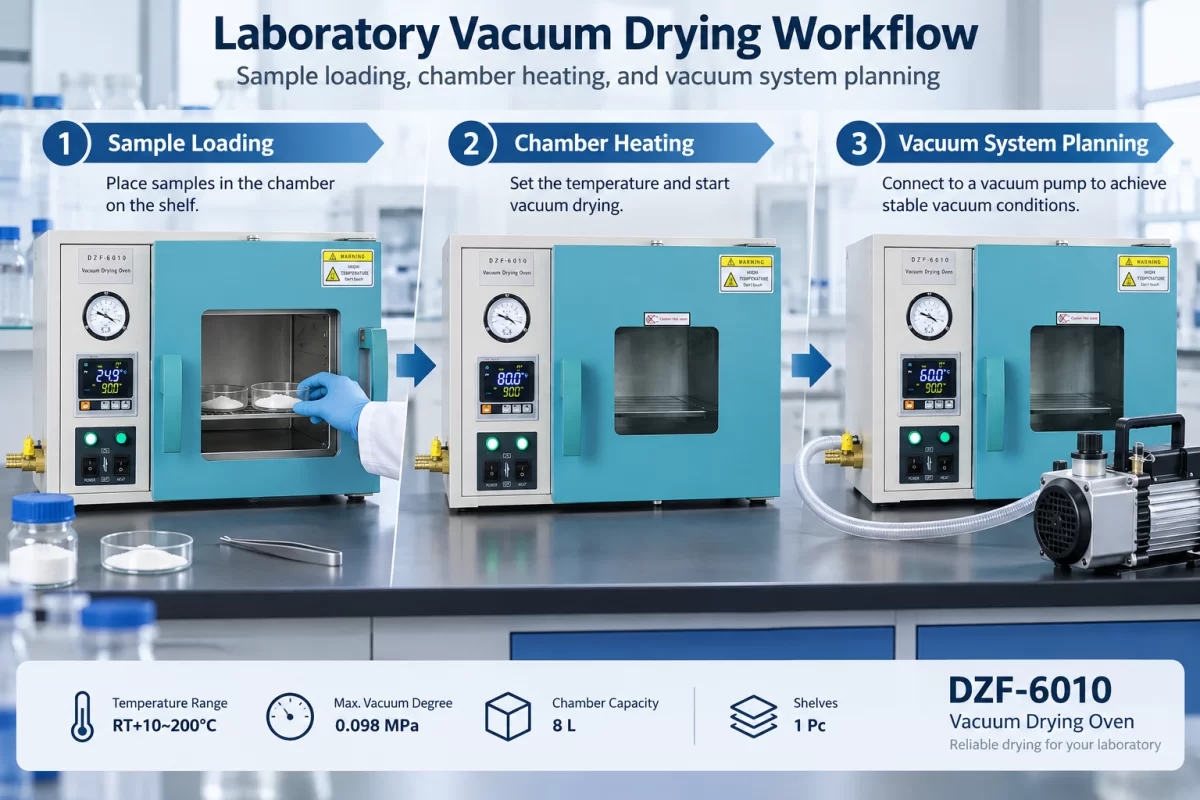
Vacuum drying combines heat with reduced chamber pressure. A suitable vacuum system removes gas and vapor from the chamber, while heating supplies energy for evaporation. Lowering pressure can allow moisture or compatible volatile components to evaporate at lower temperatures than would be required at atmospheric pressure. This makes vacuum drying worth considering when a material’s allowable heat exposure is limited.
The useful drying conditions depend on the material, its moisture content, sample thickness, container arrangement, and the performance of the connected vacuum system. A programmed duration is not, by itself, proof that a sample has reached its required dryness. Laboratories should establish an endpoint appropriate to the method, such as a defined moisture result or stable sample mass.
What distinguishes vacuum drying from conventional air drying?
As Alice, I would start with the pressure requirement of the process. Vacuum drying uses reduced pressure to support evaporation, whereas conventional air drying operates with air around the sample. I recommend comparing the material’s heat tolerance and drying endpoint before choosing either approach. The guide to vacuum drying versus air drying provides useful background for that decision.
Stainless steel chamber specifications by DZF model
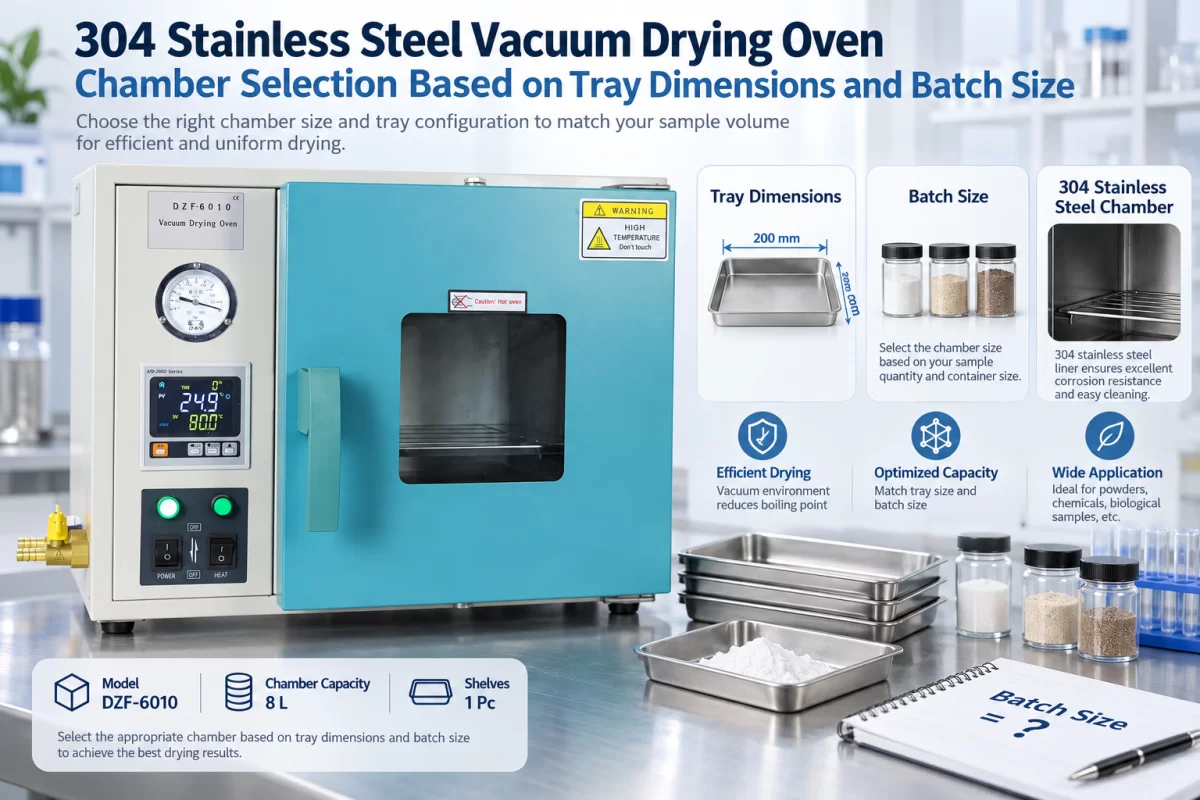
The following comparison keeps each chamber size, input power, and internal dimension tied to its corresponding model. The four models have 304 stainless steel liners and spray-painted anti-corrosion shells. Internal dimensions are especially useful when selecting trays or checking whether existing sample containers will fit.
| Model | Chamber capacity (L) | Input power (W) | Internal W × D × H (mm) | Shelves (pcs) |
|---|---|---|---|---|
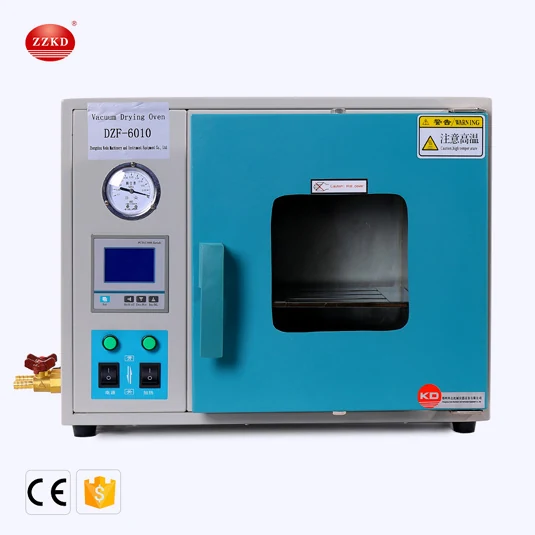
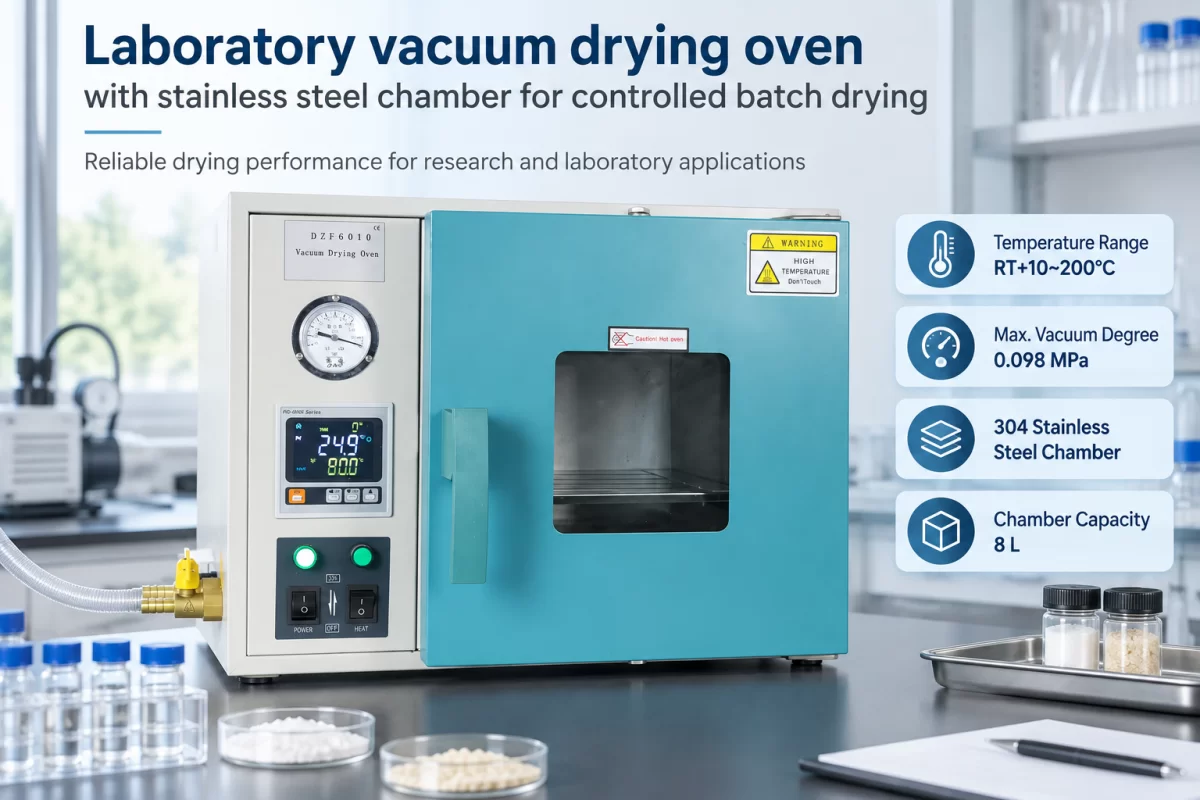
| DZF-6010 | 8 | 400 | 200 × 200 × 200 | 1 |
| DZF-6020 | 25 | 700 | 300 × 300 × 270 | 1 |
| DZF-6050 | 55 | 1400 | 400 × 400 × 345 | 2 |
| DZF-6090 | 90 | 2000 | 450 × 450 × 450 | 2 |
For these four models, the listed temperature stability is ±1.0 °C, the working ambient temperature is +5 to 40 °C, and the timer range is 1–9999 minutes. Temperature stability describes a different characteristic from temperature uniformity across a loaded chamber; it should not be treated as a guarantee that every sample has the same temperature.
The DZF-6010 offers the smallest chamber in this comparison. The DZF-6020 provides more container space, while the DZF-6050 and DZF-6090 offer two shelves. Larger volume can help accommodate a broader sample arrangement, but nominal capacity should not be equated with a permitted sample weight or guaranteed batch throughput.
Applications and material compatibility
A laboratory vacuum Drying Oven can be considered for batch moisture removal, polymer and resin drying, and the drying of suitable laboratory samples after preparation or processing. For heat-sensitive materials, the relevant question is whether the required drying endpoint can be reached within the material’s acceptable temperature and pressure conditions.
The 304 stainless steel liner is a useful construction feature to include in purchasing specifications. Nevertheless, a stainless steel chamber does not establish compatibility with every chemical. Sample residues, released vapors, cleaning agents, and the vacuum system’s wetted components all deserve consideration before a drying method is approved.
Explosion-proof configuration is listed as an option for the compared models. This option should be discussed in relation to the complete application; it is not a statement that a standard oven is suitable for flammable vapors. Solvent-containing samples require an appropriate safety assessment, vapor handling arrangement, and equipment selection.
Which chamber size is appropriate for routine laboratory batches?
I recommend starting with the actual containers rather than selecting by liters alone. Measure their footprint and height, then assess the sample depth and shelf arrangement needed for the drying method. An 8 L chamber may suit a small loading requirement, while the 25 L, 55 L, and 90 L models provide progressively more nominal chamber space. For temperature-sensitive work, I also suggest reviewing selection considerations for heat-sensitive material drying.
Selection points that affect purchase value
- Define the material and endpoint. Identify what must be removed, the starting moisture or solvent content, and the acceptance criterion for the dried sample.
- Describe the intended operating conditions. Include the target drying temperature, required pressure conditions, planned cycle duration, and any limits on heat exposure.
- Check usable loading space. Compare container dimensions with chamber dimensions, and allow for the loading arrangement needed by the method.
- Specify the vacuum system. Establish whether the quotation needs to include a pump, connections, and any vapor protection or collection equipment.
- Plan installation and cleaning. Consider laboratory space, access for maintenance, electrical requirements, and a cleaning procedure compatible with the materials involved.
A pump should be chosen for both pressure requirements and vapor compatibility. Pump selection also affects how the system handles a wet load during drying. The article on laboratory vacuum pump selection and operating considerations is relevant when defining the complete equipment package.
Laboratory vacuum drying oven with stainless steel chamber: reference price
For budget planning, our company’s reference price is shown below. This is a company reference figure, not a fixed price assigned to every DZF model or a promise that a particular accessory package is included.
The actual quotation depends on configuration and the results of the inquiry.
The purchasing value lies in matching the equipment to the process rather than simply choosing the lowest initial figure. A chamber that fits the intended containers, an appropriate vacuum arrangement, and clearly defined accessory scope make the quotation more useful for procurement. Input power is an equipment specification, not a direct measurement of energy consumed per completed batch.
What information helps obtain a relevant vacuum drying oven quotation?
I recommend providing the material name, working batch size, container dimensions, target operating conditions, and configuration needs. Include whether a vacuum pump and vapor handling accessories are required, together with any application-specific safety requirements. This gives our team a practical basis for proposing an oven and preparing a quotation with a clear supply scope.
Choose a stainless steel vacuum drying oven around the process
When evaluating a laboratory vacuum drying oven with a stainless steel chamber and its price, connect the budget to the actual drying task. The DZF-6010, DZF-6020, DZF-6050, and DZF-6090 provide distinct chamber sizes with 304 stainless steel liners, allowing laboratories to compare container fit and shelf arrangements against their batch needs.
Use our company’s USD 610 reference price as a budgeting starting point, with the actual quotation determined by configuration and inquiry results. Share the material, batch requirement, target conditions, and desired equipment package with ZZKD Instrument to request a corresponding solution and quotation.