




Jacketed Glass Reactors for Chemical Synthesis and Crystallization
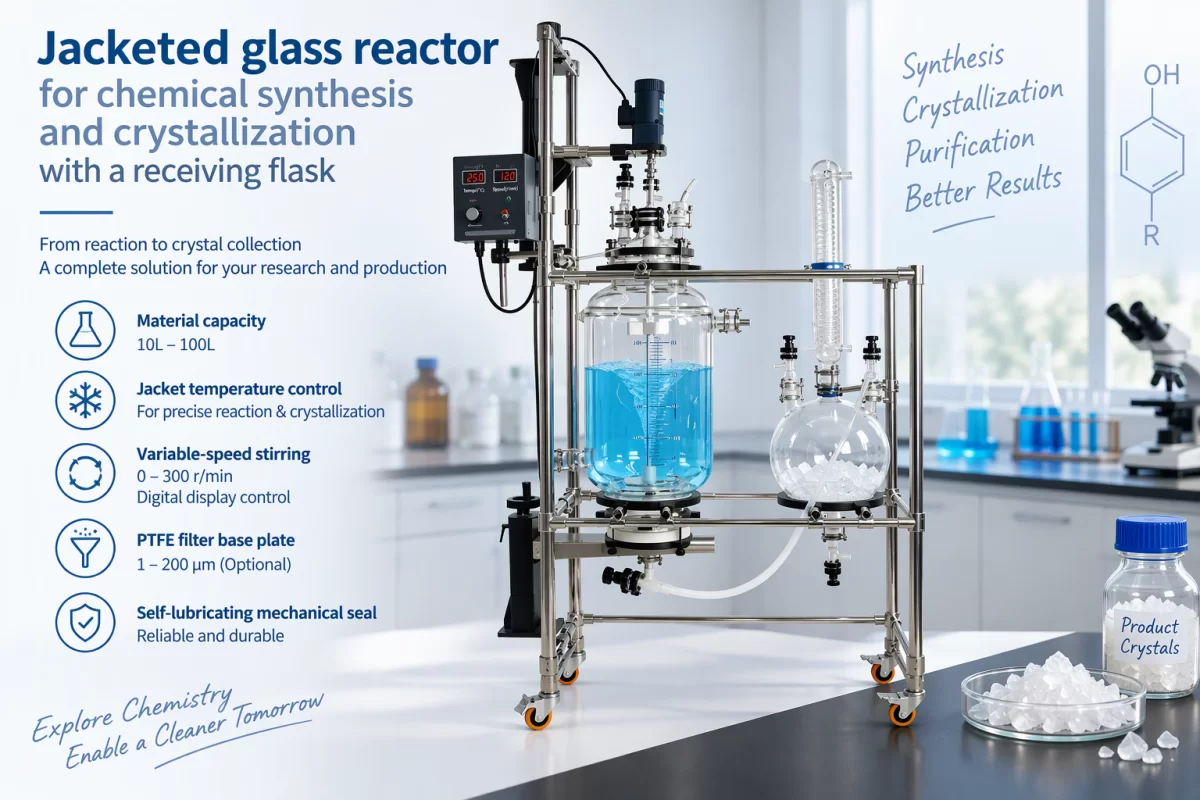
Reliable crystal production begins with controlled process conditions. Jacketed glass reactors for chemical synthesis and crystallization bring temperature management, adjustable agitation, and visible batch processing together in a practical equipment platform. For laboratories and pilot facilities, these capabilities support the transition from reaction development to crystal formation and solid–liquid separation.
A Versatile Platform for Reaction and Crystal Development
Chemical synthesis and crystallization often require different operating conditions within the same batch. A reaction may need heating and mixing, while the subsequent isolation stage may require controlled cooling, crystal growth, and filtration. A jacketed vessel allows a compatible heat-transfer fluid to circulate around the process chamber without directly mixing with the reaction contents.
The transparent vessel also makes changes in solution appearance, solids suspension, and crystal formation easier to observe. Visual access is valuable during development, although it does not replace analytical measurements of conversion, purity, or particle-size distribution. The GF-series configuration combines a jacketed reactor with a PTFE filter base plate and a receiving flask, supporting crystallization workflows that include liquid collection.
Additional application background is available in the crystallization reactor guide, which provides useful context for evaluating glass equipment for crystal-processing tasks.
GF-Series Capacities from 10 L to 100 L
The GF range offers five material capacities. Selection should consider the intended batch volume, solvent loading, solids concentration, and necessary headspace. Listed material capacity should not automatically be treated as an approved working fill: suitable operating volume depends on the process and the manufacturer's operating instructions.
On smaller screens, scroll horizontally to compare all capacity columns.
| Model | Material capacity | Jacket capacity | Receiving flask |
|---|---|---|---|
| GF-10L/5L | 10 L | Approximately 2 L | 5 L |
| GF-20L/10L | 20 L | Approximately 5 L | 10 L |
| GF-30L/10L | 30 L | Approximately 8 L | 10 L |
| GF-50L/20L | 50 L | Approximately 15 L | 20 L |
| GF-100L/20L | 100 L | Approximately 20 L | 20 L |
Larger vessels offer room for expanded batch development, but scale-up requires more than increasing the charge. Mixing behavior and heat transfer can change with vessel size. The 100 liter glass reactor overview provides relevant background for planning larger glass-reactor installations.
Adjustable Agitation and Clear Operating Readouts
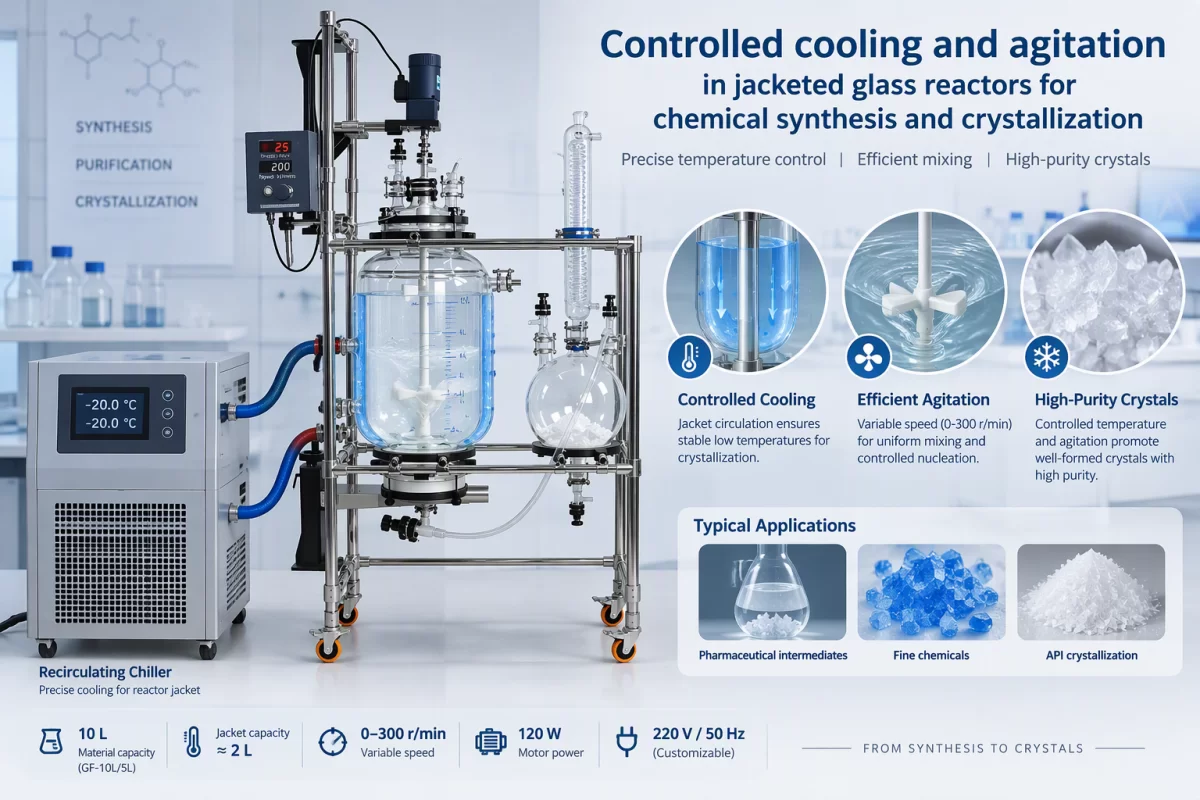
GF-series equipment features a variable-frequency speed governor and digital temperature and rotation-speed indication. The specified rotation range is 0–300 r/min. This adjustment range supports process development across dissolution, reaction mixing, and crystal suspension stages, subject to the installed motor, impeller, and slurry load.
Agitation should be selected for the material rather than set to the highest available speed. Insufficient mixing can allow settling or local concentration differences. Excessive agitation can contribute to crystal attrition in sensitive systems. Temperature indication also supports monitoring, but achievable temperature stability depends on the complete heating and cooling arrangement.
- Mechanical sealing: A self-lubricating mechanical seal is specified. Compatibility and maintenance requirements should be checked against the intended solvent and operating conditions.
- Electrical supply: The listed supply is 220 V / 50 Hz, with customization available according to customer requirements.
- Drive configuration: The parameter sheet lists standard motor powers of 120 W and 200 W, and explosion-proof motor entries of 180 W and 370 W. Exact model allocation and gearing should be confirmed in the quotation.
- Body-to-cover connection: The supplied instructions call for vacuum grease on the connection surface between the upper reactor body and cover. Grease selection should consider chemical compatibility and product-contamination limits.
PTFE Filtration for Crystal Isolation
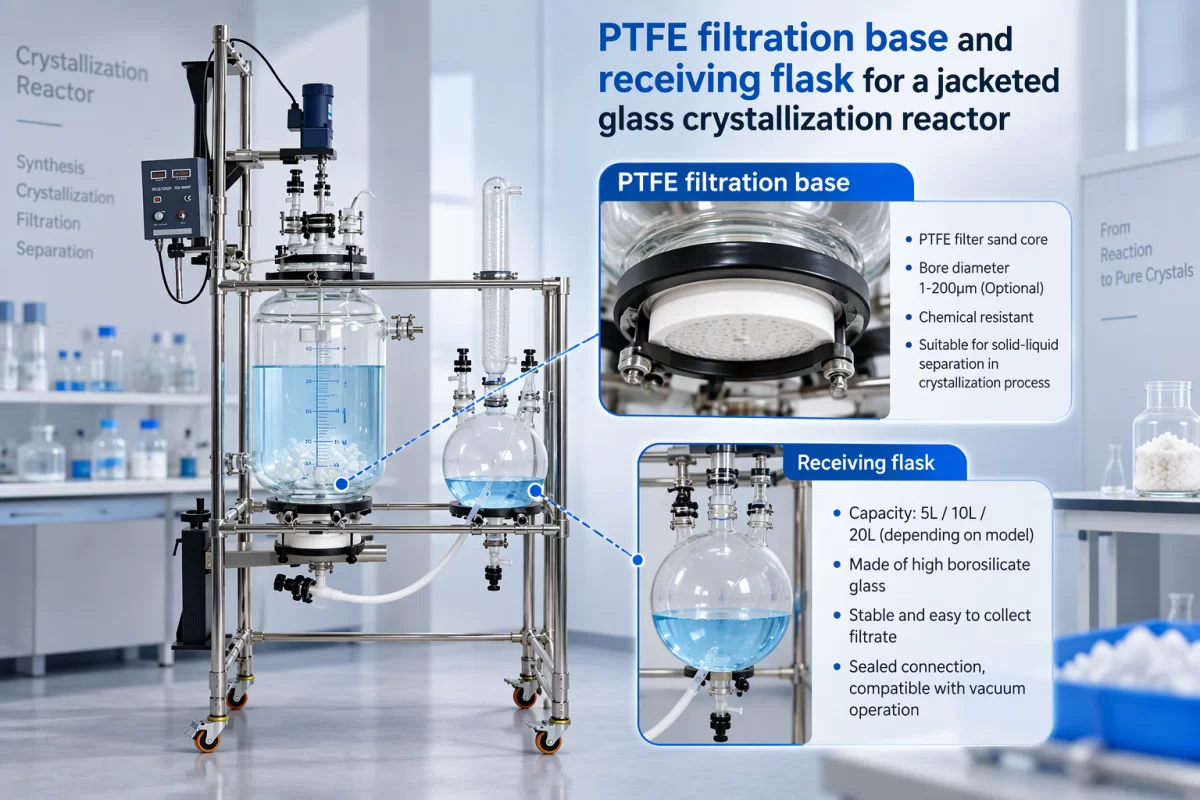
The GF specification includes a PTFE filter sand core with optional pore diameters across 1–200 μm. This selection range allows the filtration configuration to be matched to different crystal populations and separation requirements. The appropriate pore size depends on the smallest particles that must be retained, acceptable fines loss, cake properties, and the required liquid flow.
A smaller pore size is not automatically the better choice. Fine pores may improve retention but can also increase resistance or become blocked. Filtration trials using representative slurry are therefore important. The receiving flask must also be sized for the expected collected liquid; the 50 L and 100 L models both list a 20 L flask, making collection-volume planning particularly relevant for larger batches.
A Practical Synthesis-to-Crystallization Workflow
Jacketed glass reactors for chemical synthesis and crystallization are most effective when equipment features are connected to a defined process. A typical development sequence can include the following stages, adapted to the chemistry and validated operating limits.
- Prepare and inspect. Check glass condition, connections, seals, filter installation, and compatibility of wetted materials before charging.
- Run the synthesis or dissolution stage. Establish appropriate agitation and circulate the selected thermal fluid while monitoring temperature and process progress.
- Develop supersaturation. Apply a tested cooling profile or another validated crystallization method. Introduce seed crystals only where the process requires them.
- Allow crystal growth. Maintain a suitable hold period and suspension conditions, using sampling or analysis to assess the endpoint.
- Separate and assess. Collect liquid through the selected filter configuration and evaluate crystal recovery, purity, particle size, and subsequent drying needs.
Supporting equipment must be selected as part of the system rather than as an afterthought. The jacketed lab reactor guide offers additional context on jacketed-vessel operation and laboratory integration.
Company Price Reference and Configuration Value
A useful purchase comparison considers both the vessel and the equipment required to operate it. Cooling and heating equipment, vacuum components, electrical options, filter selection, and installation requirements can affect the final package. A clear specification helps avoid comparing configurations with different included accessories.
Reference listing: 50L Jacketed Glass Reactor With Vacuum and Crystallization Features. This is a company product-listing reference, not a confirmed quotation for every GF-50L/20L configuration or a complete turnkey system.
The reference provides a practical starting point for budgeting a 50 L jacketed crystallization setup. Final pricing and scope should be confirmed for the selected model, motor arrangement, electrical supply, filtration specification, auxiliary equipment, delivery, and any applicable taxes.
Specify the Reactor Around the Process
The strongest equipment choice is the configuration that fits the chemistry, batch objective, and installation conditions. Before ordering, define the following requirements in a written specification.
- Batch requirements: Target working volume, solids loading, foaming tendency, and required headspace.
- Thermal duty: Required process temperatures, cooling profile, reaction heat release, and compatible circulation fluid.
- Separation requirements: Crystal-size distribution, filter-pore selection, and expected liquid collection volume.
- Operating limits: Confirmed temperature, vacuum, and pressure ratings. The supplied parameter table does not establish numerical limits, so these must be verified before operation.
- Installation scope: Electrical supply, motor configuration, auxiliary equipment, access for cleaning, and required safety documentation.
Build a Better-Controlled Crystallization Process
Jacketed glass reactors for chemical synthesis and crystallization offer a practical combination of visible processing, adjustable agitation, jacket-based thermal management, and configurable PTFE filtration. With GF-series capacities from 10 L to 100 L, the range provides options for laboratory development and larger batch trials.
Successful selection starts with a defined process specification. Confirm the operating limits, match the filter to the slurry, and size the supporting thermal and collection equipment carefully. A configuration-specific quotation can then turn a promising reactor platform into a well-planned synthesis and crystallization installation.