




Bench-top Rotary Evaporator System for Small Scale Labs
A compact rotary evaporator gives research, education, formulation, extraction, and quality-control laboratories a controlled method for solvent removal, sample concentration, purification, and recovery without occupying excessive workspace.
Compact evaporation designed around laboratory workflows
A Bench-top rotary evaporator system for small scale labs combines a rotating flask, heated water or oil bath, condenser, receiving flask, vacuum source, and sealing assembly in a relatively compact configuration. Rotation spreads the liquid into a thin film over the internal surface of the evaporating flask. At the same time, reduced pressure lowers the solvent’s boiling point, allowing evaporation at a gentler temperature than conventional atmospheric boiling.
This combination is especially valuable for temperature-sensitive extracts, pharmaceutical intermediates, natural products, analytical samples, and research chemicals. Instead of exposing a sample to prolonged high heat, a laboratory can coordinate rotation speed, vacuum level, bath temperature, and condenser cooling to establish a controlled evaporation rate.
Compact RE-201D, RE-301, and RE-501 systems provide evaporating flask capacities of 2, 3, and 5 liters. These capacities cover common small-batch requirements while retaining practical controls such as stepless rotation adjustment, digital temperature management, and manual lifting. For a broader explanation of operating principles, the guide to how a rotovap works provides useful background on pressure, heat transfer, and condensation.
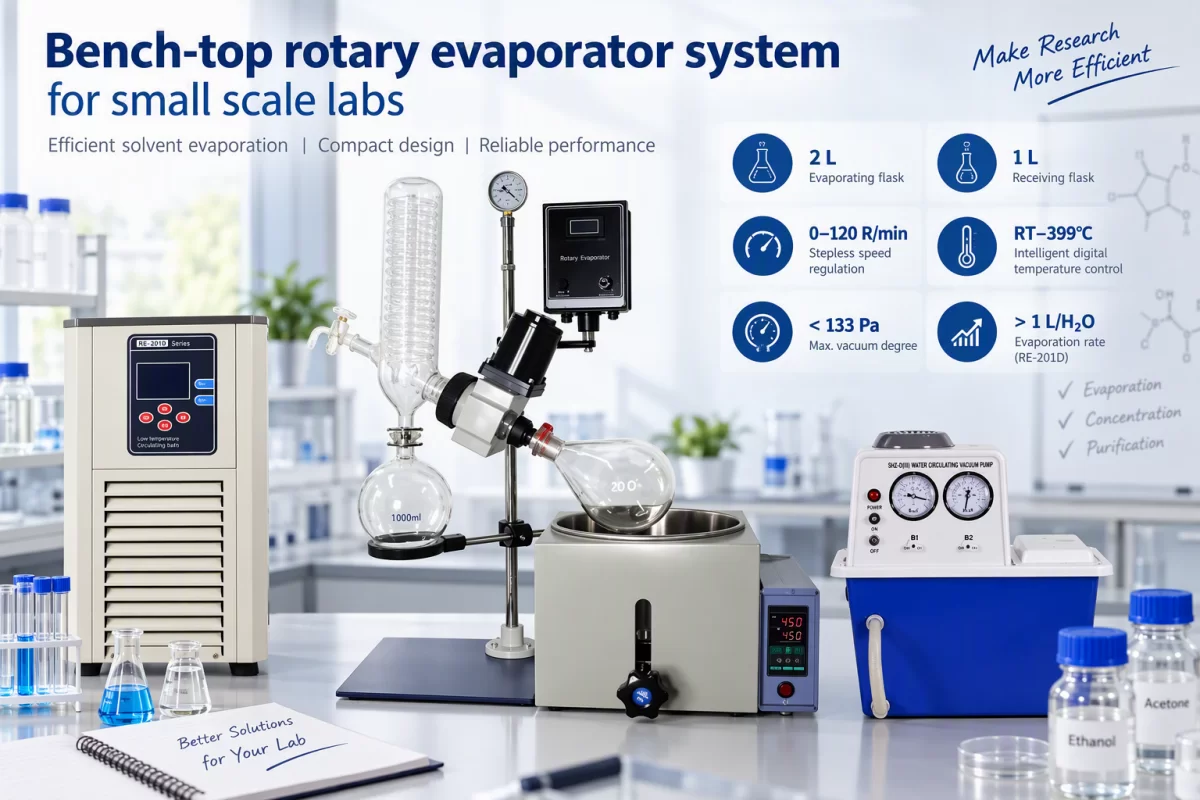
Compact laboratory rotary evaporator with bath, condenser, and receiving flask.
Why a bench-top rotary evaporator suits smaller laboratories
Small laboratories rarely benefit from selecting equipment only by maximum vessel capacity. Available bench area, sample volume, solvent type, desired throughput, ventilation, cooling capacity, and vacuum performance must be considered together. A compact system can reduce setup complexity while supporting repeatable batch processing.
- Space-conscious construction: A compact frame is easier to position inside or near an appropriate fume-control area.
- Flexible batch capacity: The 2L, 3L, and 5L evaporating flask options support different research and production-development workloads.
- Stepless speed regulation: Rotation from 0 to 120 rpm allows adjustment according to viscosity, foaming tendency, and evaporation stability.
- Controlled heating: Intelligent digital temperature control supports water- or oil-bath operation within the specified system range.
- Strong vacuum capability: A specified maximum vacuum below 133 Pa supports reduced-pressure evaporation when the complete system is correctly sealed and matched.
- Convenient flask positioning: The lifting mechanism helps move the flask into or out of the bath during setup and shutdown.
Which flask capacity offers the best balance for routine laboratory work?
From my perspective, the 3L RE-301 is a practical middle option for laboratories handling varied sample quantities. The RE-201D is better suited to limited batches and method development, while the RE-501 provides additional volume for more frequent or larger processing.
RE-201D, RE-301, and RE-501 technical parameters
The three models share the same basic evaporation principle, rotation range, temperature-control method, and specified vacuum capability. Their main differences are flask capacity, receiving volume, bath power, bath dimensions, and lifting travel.
Swipe horizontally to view the complete specification table.
| Technical Parameter | RE-201D | RE-301 | RE-501 |
|---|---|---|---|
| Evaporating flask | 2 L | 3 L | 5 L |
| Receiving flask | 1 L | 2 L | 3 L |
| Rotating motor | 40 W, stepless speed regulation | ||
| Rotation speed | 0–120 rpm | ||
| Water/oil bath power | 1200 W | 1500 W | 1500 W |
| Temperature control | Intelligent digital control, room temperature to 399°C* | ||
| Temperature resolution | ±2°C | ||
| Evaporation rate (water) | >1 L/h | >1.5 L/h | >1.5 L/h |
| Maximum vacuum | <133 Pa (1.33 mbar, 1 Torr, approximately −0.098 MPa gauge) | ||
| Lifting height | 0–150 mm | 0–120 mm | 0–120 mm |
| Bath size | 24 × 15 cm | 26 × 15 cm | 28 × 17 cm |
| Sealing mode | PTFE and fluoro-rubber sealing assembly | ||
*The actual operating temperature must remain within the limits of the selected bath fluid, glassware, sample, accessories, and laboratory safety procedure. Water must not be used as a high-temperature oil-bath substitute.
Matching capacity to sample volume and throughput
RE-201D: compact 2L processing
The RE-201D uses a 2L evaporating flask and a 1L receiving flask. It is suitable for method development, teaching laboratories, analytical preparation, botanical research, and low-volume solvent removal. Its 1200W bath and lifting range of up to 150 mm support routine bench-scale work while keeping the overall process manageable.
RE-301: balanced 3L configuration
With a 3L evaporating flask, 2L receiving flask, and 1500W bath, the RE-301 provides additional working capacity without moving into large pilot equipment. This model is useful when sample sizes vary or when a laboratory needs more throughput than a 2L system can comfortably provide.
RE-501: higher-capacity 5L bench-scale operation
The RE-501 includes a 5L rotating flask and 3L receiving flask. It can support larger extracts, formulation batches, and repeated solvent-recovery tasks. Although it remains a small-scale laboratory unit, sufficient bench clearance must be provided for the glassware, lift movement, cooling hoses, vacuum tubing, and safe operator access.
Does a larger evaporating flask automatically produce faster solvent recovery?
My answer is no. Capacity alone does not determine evaporation speed. Solvent properties, flask fill level, rotation speed, available heating power, vacuum stability, condenser temperature, cooling flow, and system tightness all affect actual performance.
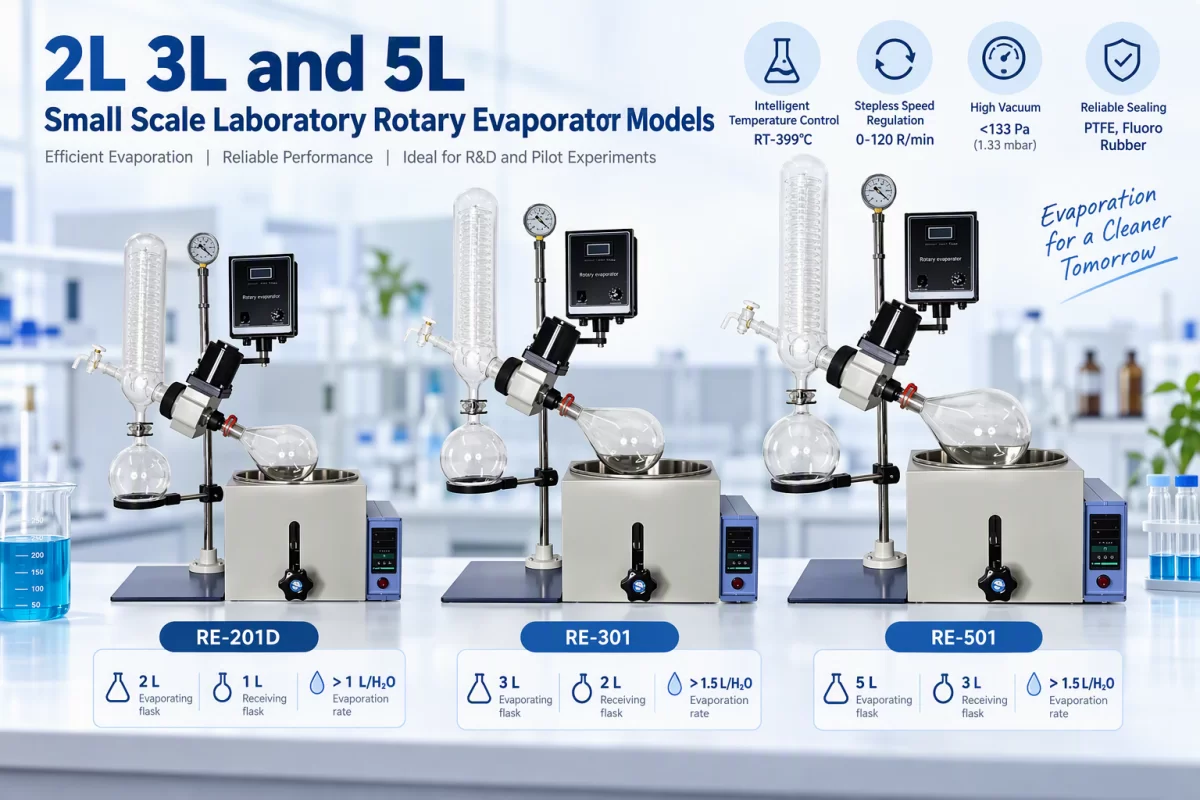
Comparison of 2L, 3L, and 5L laboratory rotary evaporator configurations.
The complete system matters more than the evaporator alone
A rotary evaporator should be evaluated as part of an integrated system. The evaporator creates the rotating film and supplies heat, but the vacuum pump establishes reduced pressure, while the condenser and recirculating chiller remove vapor heat and return solvent to liquid form. Poor matching between these components can cause slow evaporation, unstable boiling, vapor loss, or excessive pump exposure.
Important supporting equipment
- A chemically compatible vacuum pump with suitable ultimate vacuum and pumping speed.
- A vacuum controller or regulator for stable pressure and reduced bumping risk.
- A recirculating chiller selected according to solvent vapor load and target condensation temperature.
- Vacuum-rated tubing, secure clamps, clean joints, and intact seals.
- A cold trap where required to protect the pump and capture residual solvent vapor.
Vacuum pump selection is particularly important for volatile or chemically aggressive solvents. The detailed resource on choosing a rotovap vacuum pump explains vacuum depth, chemical resistance, flow rate, and pump protection in greater detail.
A practical sequence for stable rotary evaporation
Good results depend on a controlled startup and shutdown procedure. Process parameters should be confirmed through the solvent safety data sheet, equipment manual, risk assessment, and established laboratory protocol.
Is maximum bath temperature always the best operating temperature?
In my view, the best setting is the lowest temperature that maintains efficient and stable evaporation. Excessive heat may damage sensitive compounds, increase bumping, overload the condenser, or create unnecessary solvent vapor.
Where compact rotary evaporation delivers value
Bench-top rotary evaporators are used wherever controlled solvent separation is required at laboratory scale. Common applications include concentrating natural-product extracts, removing reaction solvents, preparing analytical samples, recovering ethanol or acetone, concentrating flavors and fragrances, and supporting formulation research.
Rotary evaporation is also commonly positioned downstream from extraction equipment. After a target compound has been transferred into a solvent, the evaporator can remove a substantial portion of that solvent under reduced pressure. Laboratories planning a complete workflow can review common extraction lab equipment to understand how extraction vessels, filtration devices, chillers, pumps, and evaporators work together.
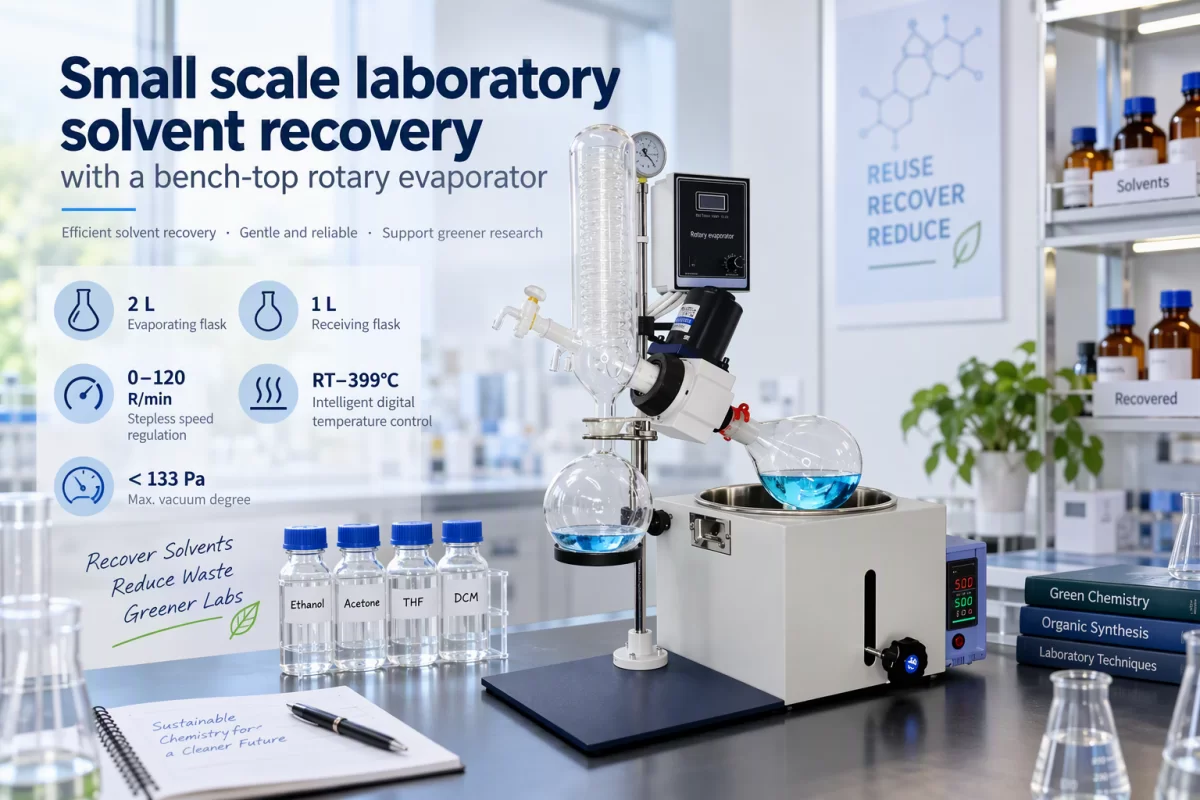
Solvent condensation and collection during small-scale rotary evaporation.
Protecting glassware, seals, samples, and operators
Rotary evaporation involves heated fluids, vacuum, rotating glassware, and potentially flammable or hazardous solvents. Operation must take place with suitable ventilation, compatible components, appropriate personal protective equipment, and trained supervision.
- Never operate chipped, scratched, or cracked vacuum glassware.
- Confirm that the selected solvent is compatible with seals, tubing, pump materials, and bath conditions.
- Keep glass joints clean and correctly assembled to minimize vacuum leakage.
- Monitor the receiving flask and empty it before solvent can reach an unsafe level.
- Clean residue from the vapor path and condenser after each compatible process.
- Inspect PTFE and fluoro-rubber sealing components regularly for wear, swelling, or deformation.
- Use shielding and engineering controls when required by the risk assessment.
Preventive maintenance improves vacuum stability and process repeatability. A gradual decline in evaporation performance may indicate seal wear, a loose connection, contaminated condenser surfaces, insufficient coolant flow, or reduced pump performance rather than a problem with the rotating motor.
Choosing the right small-scale rotovap configuration
A dependable Bench-top rotary evaporator system for small scale labs should be selected according to normal batch size rather than the largest theoretical batch. The RE-201D is an efficient starting point for low-volume research, the RE-301 provides a versatile middle capacity, and the RE-501 offers greater processing volume for laboratories with higher throughput requirements.
Capacity, however, is only one part of the decision. Vacuum control, condenser cooling, chemical compatibility, bath performance, glassware availability, ventilation, cleaning requirements, and workspace clearance should all be reviewed before a system is configured. When these elements are properly matched, compact rotary evaporation can provide gentle solvent removal, better sample handling, and more repeatable laboratory workflows.
Build a rotary evaporator system around the actual process
Provide the solvent type, typical feed volume, target concentration, required throughput, cooling-water conditions, and available power supply when requesting a configuration. These details make it easier to match the evaporator, vacuum pump, chiller, glassware, and accessories to the intended application.