




Glycol Recycling: A Practical Guide to Choosing the Right Solvent Recovery Machine
Glycol recycling is no longer just an environmental topic. For many factories, workshops, chemical users, and cleaning operations, it is directly connected to cost control, safer handling, and more stable production. When used glycol is thrown away too early, businesses pay twice: once for fresh solvent and again for disposal. A properly matched solvent recovery machine changes that equation by turning used glycol into reusable liquid for the next cycle.
Why glycol recycling matters in real operations
In simple terms, glycol recycling means separating usable glycol from contaminants such as water, oils, inks, dirt, residues, or mixed process waste. Instead of buying new solvent again and again, a recovery system helps reclaim value from liquid that still has useful components.
This matters because solvent costs can rise fast in repeated-use industries. It also matters because waste handling is getting stricter. According to the U.S. Environmental Protection Agency, solvent waste management is closely tied to hazardous waste compliance, which means better recovery can reduce both waste volume and handling pressure. In practical purchasing terms, buyers usually want answers to three questions: how much can be recovered, how long does one batch take, and how much does the machine cost.
What buyers usually want to know first
Most buyers are not looking for complicated theory. The main concern is straightforward: can the machine recover glycol efficiently and lower total operating cost? Based on the provided equipment data, the answer is yes when the correct size is selected for the actual liquid volume and working schedule.
The current model range includes:
- T-20Ex with 20 L feed capacity, 2 kW heating power, and 120-minute treatment time
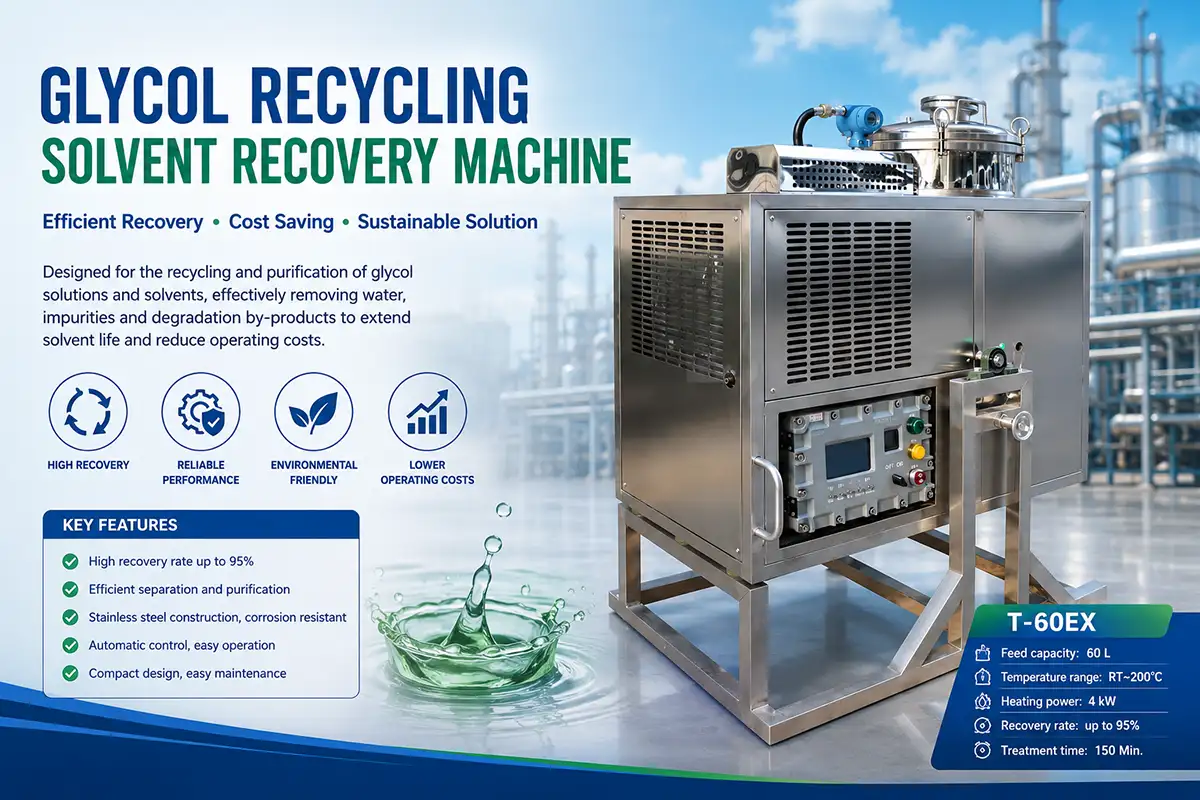
- T-60Ex with 60 L feed capacity, 4 kW heating power, and 150-minute treatment time
- T-80Ex with 80 L feed capacity, 5 kW heating power, and 180-minute treatment time
- T-125Ex with 125 L feed capacity, 6 kW heating power, and 210-minute treatment time
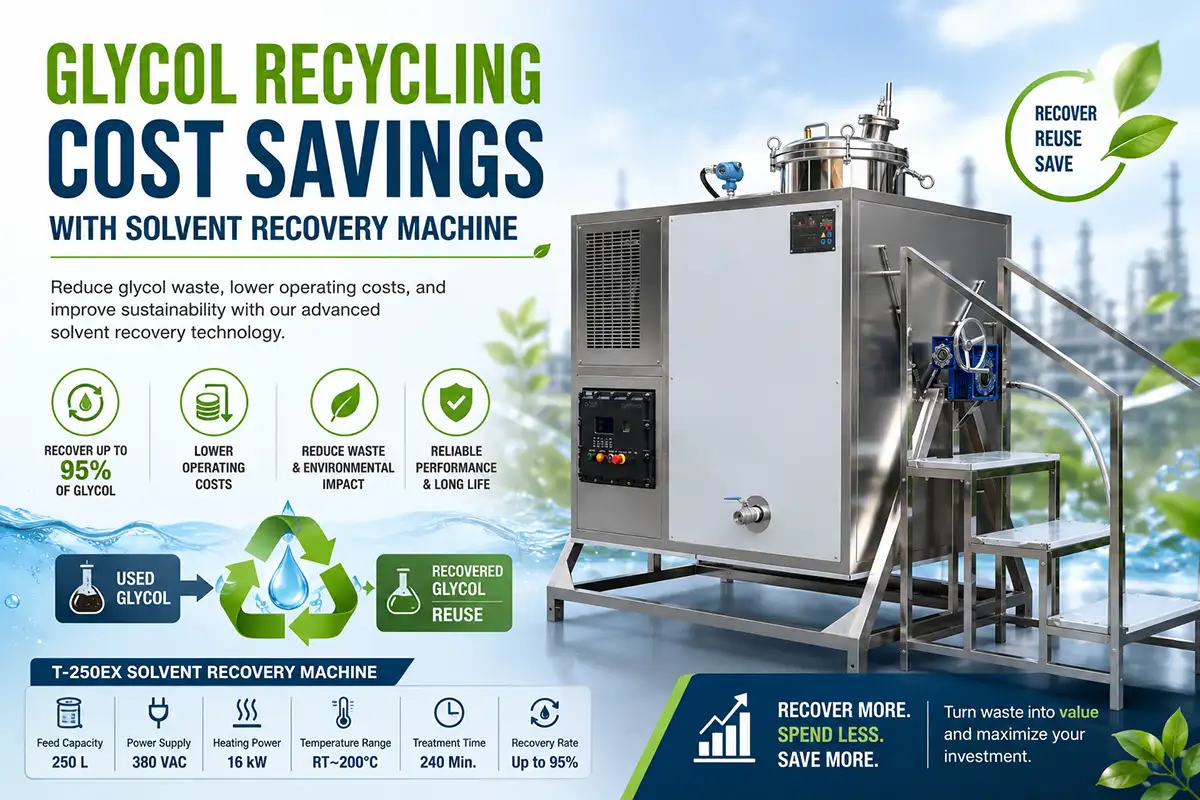
- T-250Ex with 250 L feed capacity, 16 kW heating power, and 240-minute treatment time
- T-400Ex with 400 L feed capacity, 32 kW heating power, and 270-minute treatment time
All listed models show a 95% recovery rate in the provided specifications, with a temperature range of RT to 200℃. That is important because it gives buyers a clear baseline: the equipment is designed to recover most of the usable solvent rather than only a small fraction.
Is a higher-capacity machine always the better choice for glycol recycling?
From the author’s perspective, not always. A larger machine sounds attractive, but the best choice depends on actual daily waste volume, batch frequency, power availability, and floor space. If the process only generates 20 to 60 liters at a time, an oversized system can increase energy use and upfront cost without improving payback speed. In many cases, matching machine size to the real production rhythm delivers the best return.
How to choose the right glycol recycling machine
For glycol recycling projects, four practical selection points matter most:
- Batch volume: Choose by actual feed amount per cycle, not by the biggest possible future estimate.
- Cycle time: If turnaround speed is important, compare treatment time carefully.
- Electrical setup: The listed models use 380V AC, so site compatibility should be confirmed before ordering.
- Safety requirement: Explosion-proof style matters when flammable or mixed solvents are involved.
For example, if a plant produces around 50 to 70 liters of used glycol in one shift, the T-60Ex may be more practical than jumping directly to a very large system. If a production line regularly handles above 200 liters, then the T-250Ex or T-400Ex becomes more logical.
Buyers comparing broader recovery strategies may also find it useful to review related process content such as solvent recovery system and solvent recovery equipment. For operations where alcohol is part of the workflow, ethanol recycling equipment is also relevant.
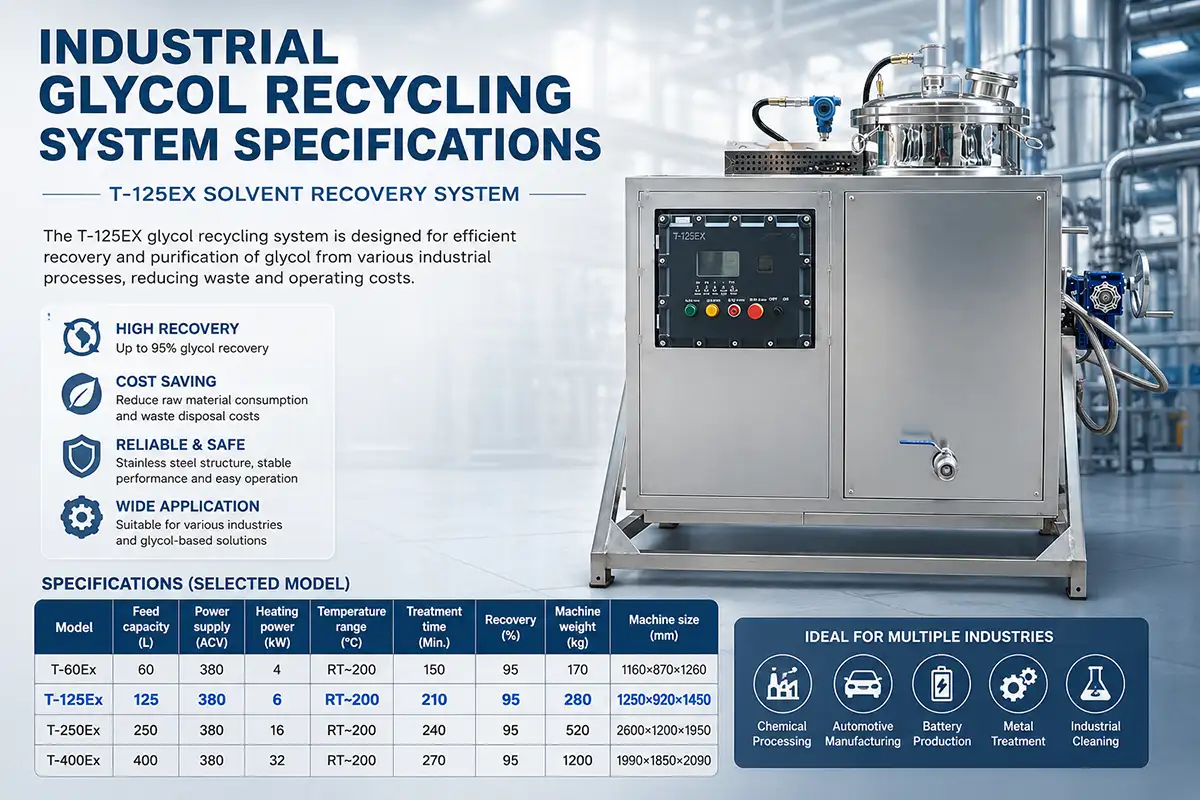
Specification table for quick comparison
| Model | Feed Capacity | Power Supply | Heating Power | Temperature Range | Treatment Time | Recovery Rate | Weight |
|---|---|---|---|---|---|---|---|
| T-20Ex | 20 L | 380V | 2 kW | RT–200℃ | 120 min | 95% | 153 kg |
| T-60Ex | 60 L | 380V | 4 kW | RT–200℃ | 150 min | 95% | 170 kg |
| T-80Ex | 80 L | 380V | 5 kW | RT–200℃ | 180 min | 95% | 200 kg |
| T-125Ex | 125 L | 380V | 6 kW | RT–200℃ | 210 min | 95% | 280 kg |
| T-250Ex | 250 L | 380V | 16 kW | RT–200℃ | 240 min | 95% | 520 kg |
| T-400Ex | 400 L | 380V | 32 kW | RT–200℃ | 270 min | 95% | 1200 kg |
What kind of price should be expected for glycol recycling equipment?
From the author’s perspective, buyers should not focus only on the lowest advertised number. Based on the provided price sheet, many industrial solvent recovery machines are listed in a range of $2,645 to $9,690. Using the instruction to choose the middle, relatively lower price when multiple prices appear, a practical reference point is $4,271. That is a more realistic benchmark than the cheapest edge of the range. Higher-efficiency offers also appear around $10,691, while some larger-capacity or specialized systems go much higher.
In other words, glycol recycling equipment is not one-price-fits-all. Capacity, safety class, automation level, and materials all influence the final quotation.
Will glycol recycling actually save money?
In many cases, yes. The financial logic is usually easy to understand. If a machine recovers about 95% of usable solvent, then only a small portion needs replacement after each cycle. That can reduce fresh glycol purchases significantly. At the same time, lower waste volume can reduce disposal cost and handling time.
According to the U.S. Department of Energy, improving process efficiency and reducing material losses remain major opportunities for industrial cost reduction. While that statement applies broadly to manufacturing, it fits solvent recovery very well. Reusing purified glycol is often one of the simplest ways to reduce material loss in operations that depend on repeated solvent use.
The strongest payback cases are usually found in industries that use solvent every day, such as cleaning lines, printing, coating, chemical processing, and some extraction applications. In those settings, the machine is not just an expense. It becomes part of the cost-control system.
What is the clearest sign that a solvent recovery machine is needed?
From the author’s perspective, the clearest sign is repeated solvent purchase combined with regular waste disposal. When used glycol keeps leaving the site while new glycol keeps arriving, that usually means money is being lost in a loop. A recovery machine becomes especially attractive when solvent replacement is frequent and waste volumes are stable enough for batch recovery.
Final buying advice for glycol recycling projects
If the goal is practical glycol recycling, the best buying decision usually comes down to fit, not marketing claims. A good machine should match the real batch size, recovery target, electrical conditions, and safety level of the site. The provided specifications show a solid foundation: recovery rates up to 95%, capacities from 20 L to 400 L, and treatment times that scale in a predictable way.
For smaller operations, a compact model can keep investment under control. For larger plants, higher-capacity systems can improve throughput and reduce labor frequency. Either way, the important point is simple: glycol recycling works best when the recovery machine is chosen around real operating needs.
For businesses trying to reduce solvent waste, lower fresh chemical spending, and improve daily process control, a well-selected solvent recovery machine is not just useful equipment. It is a practical sales-worthy upgrade with measurable economic value.