




What is the Best Double Layer Glass Reactor for Research?
The best double layer glass reactor for research is not always the biggest or the most expensive one. It is the reactor that gives your lab clear observation, stable stirring, safe temperature control, and enough capacity for repeatable results without wasting material.
The best choice for most research labs
A double layer glass reactor, also called a glass jacketed reactor, uses an outer glass jacket around the reaction vessel. Heating or cooling fluid flows through this jacket, so the sample inside can be heated, cooled, refluxed, crystallized, dissolved, mixed, extracted, or distilled under controlled conditions. For research, that visual control matters. You can watch color change, foaming, solids formation, phase separation, viscosity change, and boiling behavior in real time.
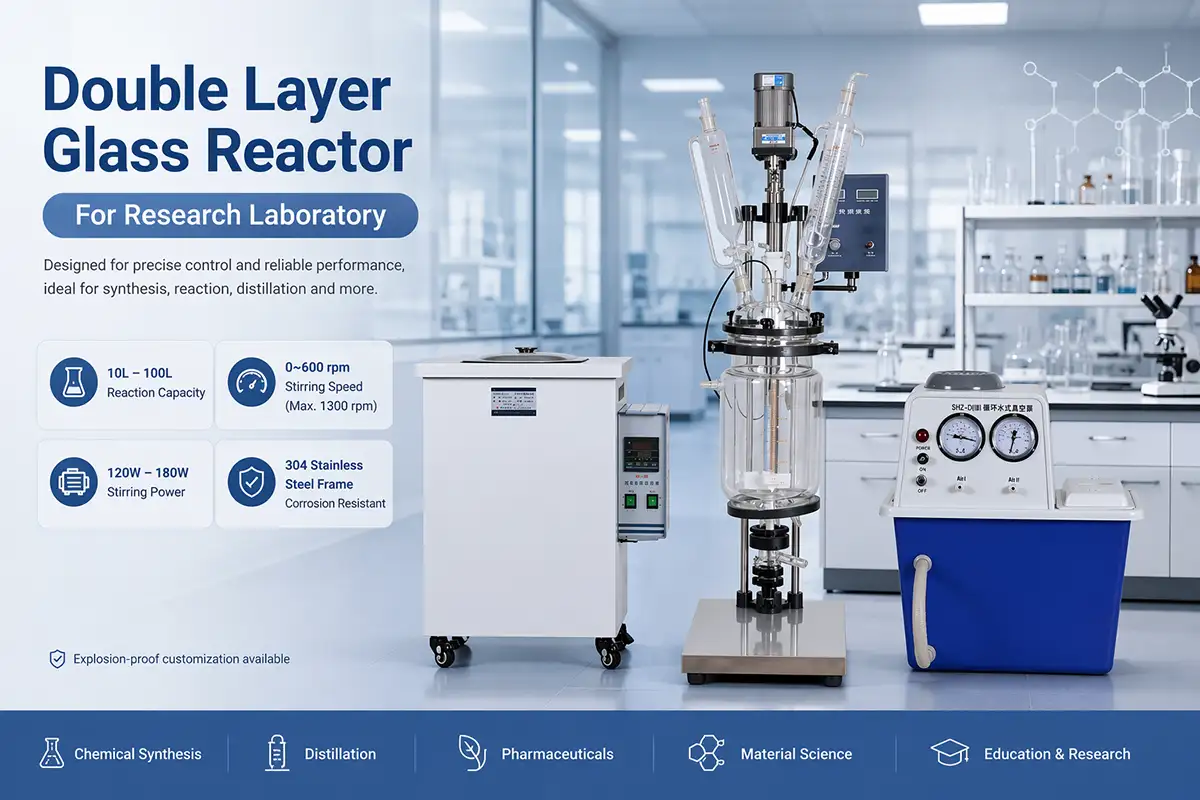
ZZKD double layer glass reactor in a research laboratory.
What makes a double layer reactor good for research?
A research reactor must help the scientist control the experiment, not fight the equipment. The vessel should be transparent, chemically resistant, easy to clean, and stable during long stirring runs. The temperature jacket should connect smoothly with a circulating chiller, heater, or heating and cooling circulator. The stirrer should be strong enough to move the liquid evenly without shaking the whole frame.
ZZKD double layer glass reactors are designed around these practical needs. The 1L, 2L, 3L, and 5L models use 60 W stirring power, 12 mm stirring shaft diameter, and 0-600 rpm regular stirring speed with a maximum speed up to 1300 rpm. Larger S-10L, S-20L, S-30L, S-50L, and S-100L models keep the same common stirring speed range, while increasing stirring power and frame strength for heavier batches. The larger series uses a 304 stainless steel frame, which is important when the reactor becomes tall, full, and connected to external accessories.
- Clear reaction visibilityResearchers can see the whole process instead of relying only on temperature or pressure readings.
- Controlled heating and coolingThe jacket supports stable temperature transfer for synthesis, crystallization, reflux, and extraction.
- Flexible batch sizesZZKD covers small 1L research vessels up to 100L pilot research reactors.
- Useful stirring range0-600 rpm covers most laboratory mixing needs, with higher maximum speed available when suitable.
Which ZZKD model should you choose?
The easiest way to choose is to start with the real working volume. A glass reactor should not be selected only by total vessel capacity. Many reactions need headspace for foaming, reflux, gas release, or safe mixing. In everyday research, a comfortable working volume is often about 50% to 70% of the nominal vessel capacity, depending on the material behavior.
| Research Need | Recommended ZZKD Model | Nominal Capacity | Why It Fits |
|---|---|---|---|
| Screening, expensive samples, teaching labs | S-1L, S-2L, S-3L | 1L, 2L, 3L | Low material use, easy cleaning, good for early method exploration. |
| Daily research and formulation work | S-5L | 5L | A balanced lab size that is large enough for useful data but still easy to operate. |
| Process development and extraction trials | S-10L, S-20L | 10L, 20L | Better for repeat runs, solvent work, botanical extraction, and scale-up checks. |
| Pilot research and pre-production optimization | S-30L, S-50L, S-100L | 30L, 50L, 100L | Suitable when the lab needs more material, stronger frame support, and bigger accessories. |
Practical recommendation: choose S-5L if you want a versatile first research reactor. Choose S-10L or S-20L if your research needs regular scale-up data. Choose S-50L or S-100L only when your lab already has enough space, utilities, and batch demand.
ZZKD double layer glass reactor specifications
The following specifications are based on ZZKD double layer reactor parameter sheets. They show the main differences between small laboratory models and larger pilot research models. For research buyers, the most important details are capacity, stirring power, shaft size, power supply, and frame design.
| Model Series | Capacity Options | Stirring Power | Stirring Speed | Shaft Diameter | Power Supply | Frame / Notes |
|---|---|---|---|---|---|---|
| S-1L to S-5L | 1L, 2L, 3L, 5L | 60 W | 0-600 rpm, max. 1300 rpm | 12 mm | 220V 50/60 Hz, 110V 60 Hz customizable | Floor type, explosion-proof option available |
| S-10L to S-100L | 10L, 20L, 30L, 50L, 100L | 120 W to 250 W | 0-600 rpm, max. 1300 rpm | 12 mm to 15 mm | 220V 50/60 Hz, 110V 60 Hz customizable | 304 stainless steel frame, explosion-proof option available |
Material matters too. A borosilicate glass reactor is preferred in research because borosilicate glass has good thermal shock resistance, high transparency, and strong chemical compatibility with many acids, solvents, and reaction mixtures. It is not the right tool for every high-pressure reaction, but it is excellent for controlled atmospheric, reflux, vacuum, and low-pressure laboratory processes.
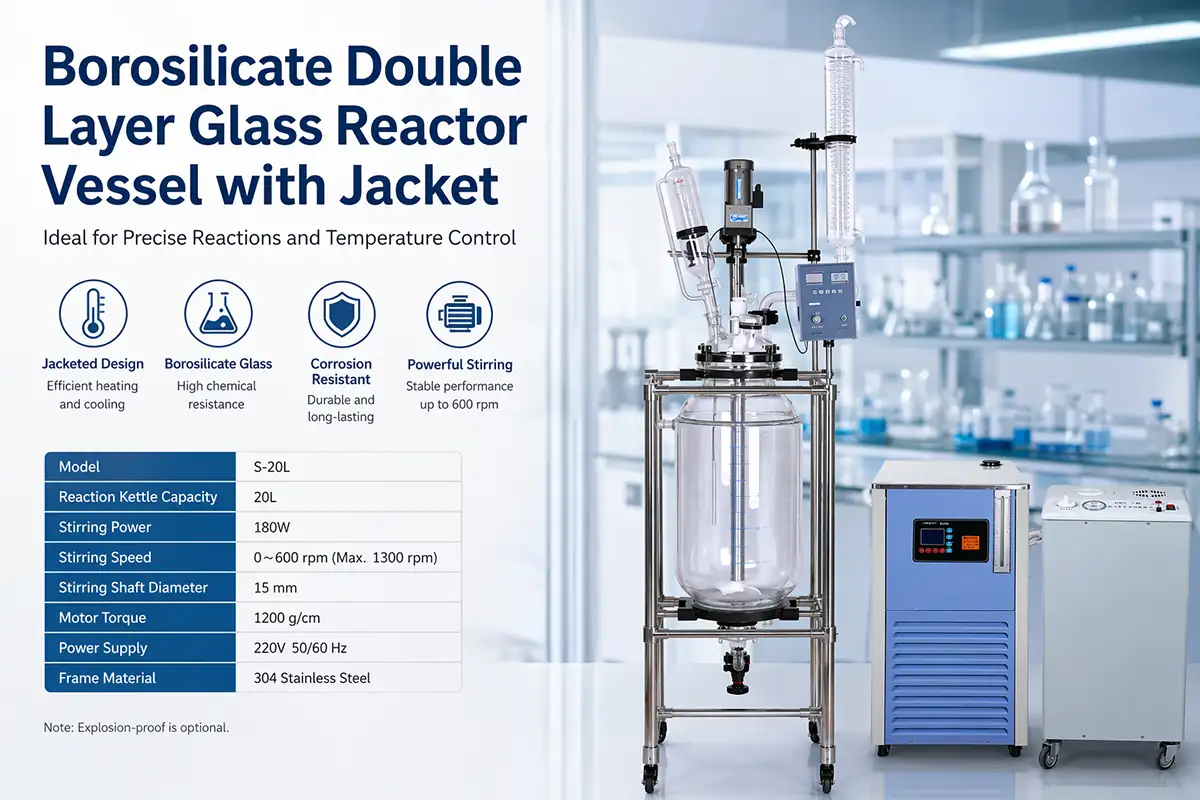
Borosilicate glass jacket and reaction vessel detail.
How to judge the best reactor before buying
A good research reactor should match your chemistry, your operators, and your lab utilities. Before choosing a size, answer the basic process questions first: What is the normal batch volume? Will the reaction foam? Does it need vacuum? What temperature range is required? Is the material low viscosity like ethanol, or thick like a resin or polymer solution?
- Match capacity to real working volume. If your normal batch is 2L to 3L, a 5L reactor is usually more comfortable than a 3L reactor because it gives useful headspace.
- Check stirring needs. Low-viscosity liquids are easy to mix, while slurries and viscous samples may need stronger torque, the right impeller, and slower stable operation.
- Plan temperature equipment. The reactor jacket works only as well as the chiller, heater, or circulator connected to it.
- Confirm seals and accessories. For vacuum distillation, solvent recovery, reflux, or inert gas protection, make sure the reactor ports, condenser, vacuum pump, and tubing are compatible.
- Think about cleaning and safety. A clear vessel, reliable frame, proper clamps, and correct operator training make daily research faster and safer.
How much does a research double layer glass reactor cost?
Prices vary by size, configuration, accessories, explosion-proof requirements, and whether the system includes supporting equipment such as a vacuum pump, chiller, heating circulator, condenser, or collection flask. Based on the provided price sheet, small research models can start around a few hundred dollars, while larger pilot models rise into the several-thousand-dollar range.
| Model / Size | Typical Research Use | Reference Price Used | Buyer Note |
|---|---|---|---|
| 1L | Small tests, teaching, expensive materials | About $560 | Best for tiny batches, not for scale-up data. |
| 5L | Daily lab research and formulation | About $850 | Often the best value for a first research reactor. |
| 10L | Process development | About $1,499 | Good when 5L is too small but pilot scale is not needed. |
| 20L | Extraction, repeated trials, larger batches | About $1,700 | A strong middle choice for active research teams. |
| 50L | Pre-pilot research | About $2,200 | Needs more bench or floor space and stronger support equipment. |
| 100L | Pilot optimization | About $2,800 | Useful for scale-up; see more about a 100L glass reactor. |
When several listed prices were available for the same size, a middle, relatively economical price was selected as the reference. Final pricing should be confirmed by configuration, voltage, accessories, and shipping requirements.
Best ZZKD reactor by research situation
Best overall: ZZKD S-5L double layer glass reactor
The S-5L is the best overall choice for many research labs because it is not too small and not too demanding. It gives enough capacity for meaningful testing, while still keeping material cost, cleaning time, and operation difficulty under control. If your team is buying its first double layer glass reactor, the S-5L is a smart starting point.
Best for serious development: ZZKD S-10L or S-20L
If the lab already has stable methods and wants repeatable scale-up data, the S-10L or S-20L is better. These sizes are especially useful for extraction, crystallization, solvent mixing, polymer research, and process optimization. They provide more batch volume while remaining manageable for a research environment.
Best for pilot research: ZZKD S-50L or S-100L
For teams moving from laboratory testing toward small production validation, S-50L and S-100L models make sense. They require more planning: floor space, lifting and cleaning procedures, stronger heating or cooling circulation, and operator safety training. But for pilot work, they can reduce the gap between lab data and production behavior.
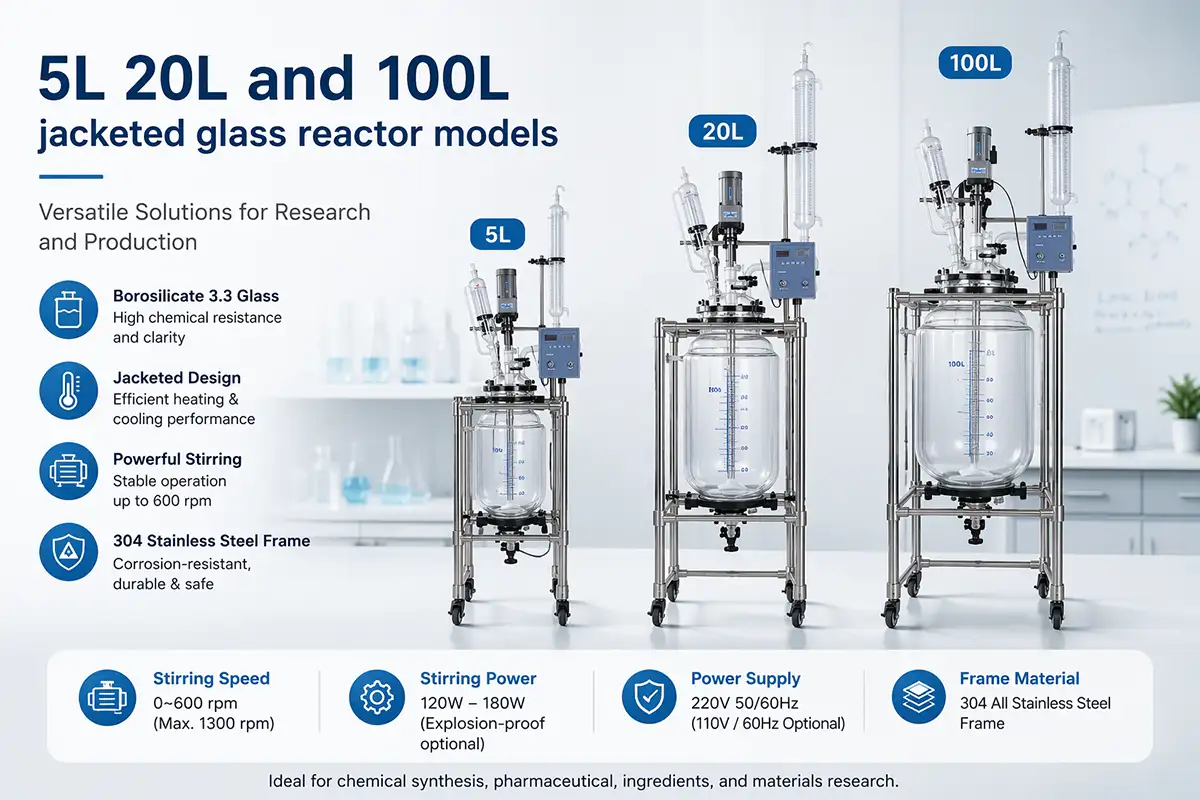
ZZKD reactor size comparison for research and pilot use.
FAQ about double layer glass reactors for research
Is a double layer glass reactor the same as a jacketed glass reactor?
Yes. In most laboratory equipment discussions, double layer glass reactor and jacketed glass reactor mean the same basic design: a reaction vessel with an outer jacket for heating or cooling liquid.
Can it be used under vacuum?
Many research configurations can work with vacuum for solvent removal, distillation, degassing, or controlled reaction conditions. The final vacuum level depends on the reactor seals, glassware connections, pump, tubing, and accessories.
Is the largest reactor always better?
No. Oversized reactors waste solvent and samples, take longer to heat and cool, and may mix poorly with small batches. Choose the smallest reactor that comfortably handles your normal working volume and headspace needs.
What accessories should be considered?
Common accessories include a circulating chiller, heating circulator, vacuum pump, condenser, collection flask, temperature probe, feeding funnel, PTFE stirring paddle, and explosion-proof motor when required by solvent safety rules.
So, what is the best double layer glass reactor for research?
The best double layer glass reactor for research is the model that fits your working volume, temperature range, mixing difficulty, and safety requirements. For a practical answer, choose ZZKD S-5L for general research, ZZKD S-10L or S-20L for process development, and ZZKD S-50L or S-100L for pilot research. If you are unsure, start from your real batch volume and choose a reactor that gives enough headspace, stable stirring, reliable jacket temperature control, and room for the accessories your process needs.