



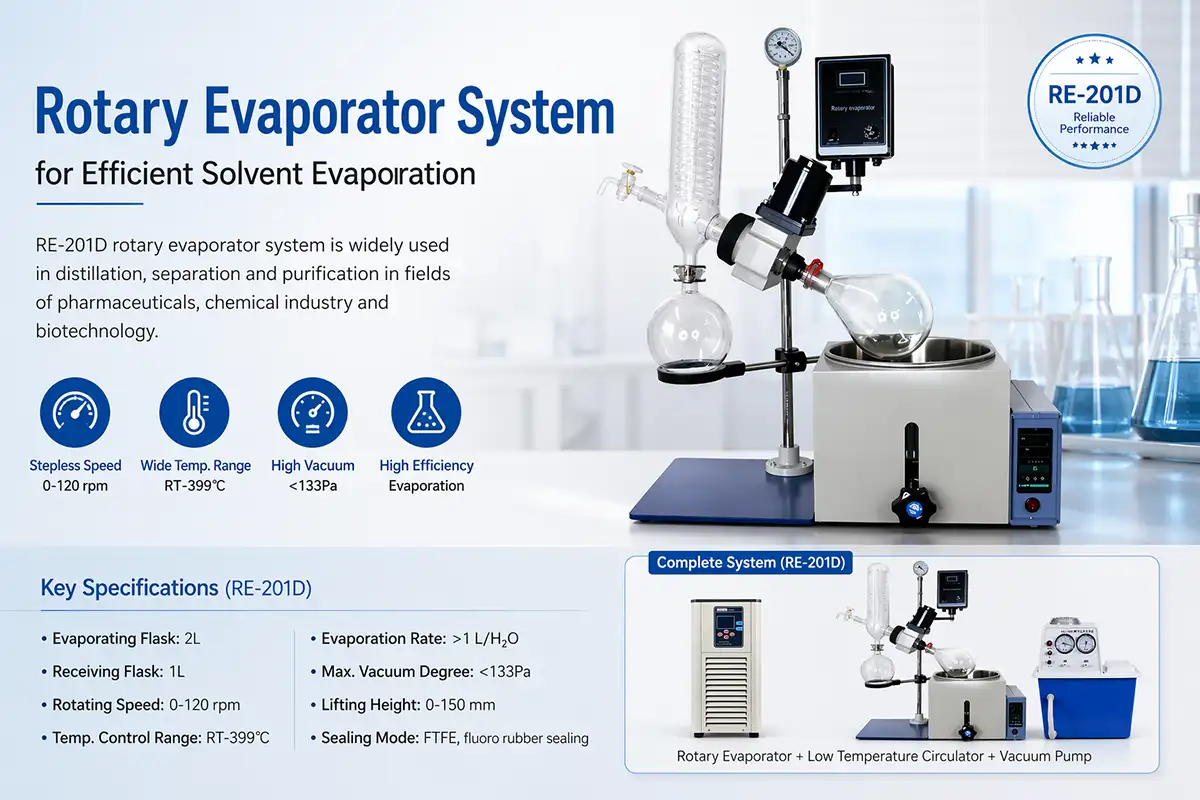
Rotary Evaporator System for Efficient Solvent Evaporation
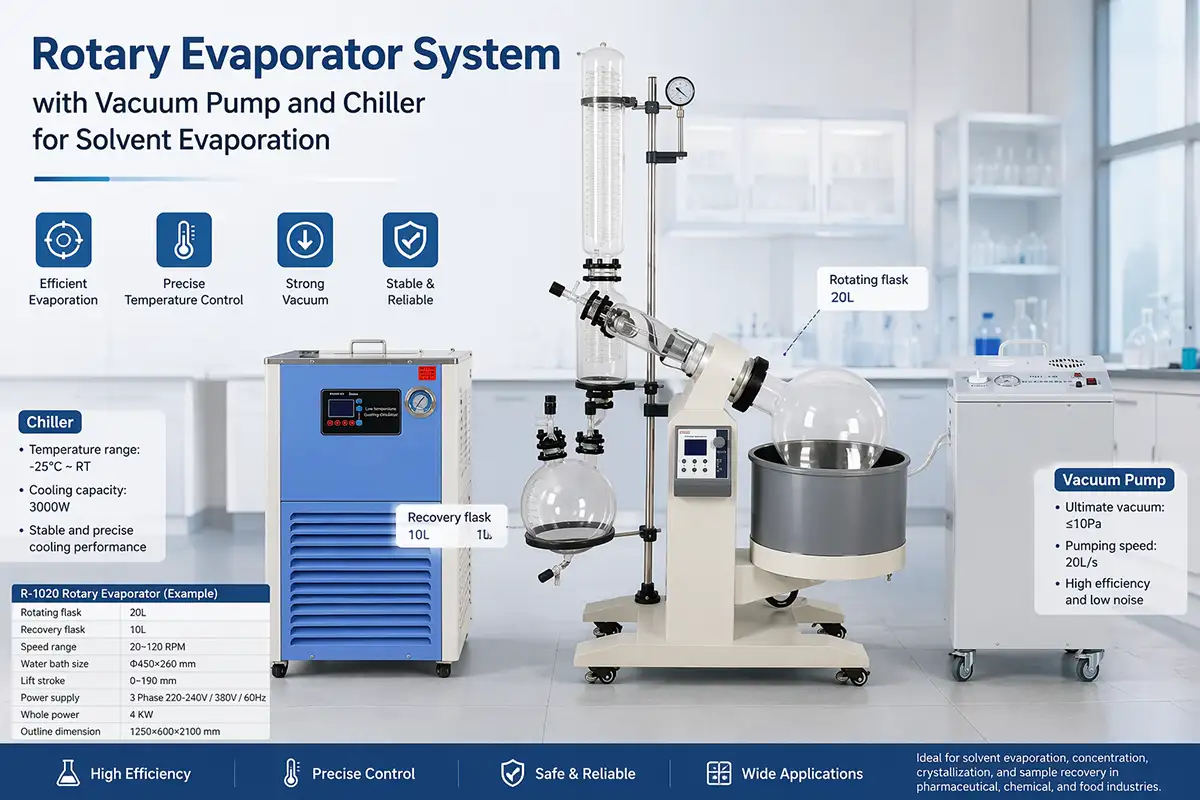
An efficient rotary evaporator system is not only a glass flask spinning in a warm bath. It is a matched evaporation setup that combines heating, vacuum, rotation, condensation, and solvent collection so a lab or pilot plant can remove solvent faster, cleaner, and with better control.
Quick answer: for efficient solvent evaporation, choose the rotary evaporator capacity according to batch volume, then match it with the right vacuum pump, chiller, condenser, receiving flask, and temperature control. For many ZZKD users, 10L is ideal for scale-up testing, 20L is the most balanced pilot-scale choice, and 50L is best for higher solvent recovery throughput.
What is a rotary evaporator system?
A rotary evaporator system, often called a rotovap system, is used to evaporate and recover solvents under reduced pressure. The vacuum lowers the boiling point of the solvent, the rotating flask spreads liquid into a thin film, the bath adds controlled heat, and the condenser turns vapor back into liquid for collection. This is why rotary evaporation is popular in chemistry labs, extraction rooms, pharmaceutical testing, food research, and pilot plants.
The word “system” matters. A strong evaporator body cannot work efficiently if the chiller is too weak, the vacuum pump is unstable, or the condenser cannot handle the vapor load. For efficient solvent evaporation, each component must support the same processing target. A 20L flask paired with a small lab chiller may look complete, but it may recover solvent slowly because vapor is not condensed fast enough.
If you want a simple technical introduction to the process, ZZKD also explains how a rotovap works in practical terms. In this article, the focus is system selection: how to configure the equipment so evaporation is efficient in real use.
The five parts that decide evaporation efficiency
Solvent evaporation speed is not controlled by one setting. It comes from the balance between heat input, vacuum depth, vapor movement, condensation capacity, and operator workflow. When these parts are matched, the system evaporates steadily. When they are mismatched, the operator may see slow recovery, bumping, vapor loss, poor vacuum, or long batch times.
- Evaporator The rotating flask creates a thin liquid film, increasing surface area and improving heat transfer.
- Heating bath Stable bath temperature gives the solvent enough energy to evaporate without overheating the sample.
- Vacuum pump Proper vacuum lowers boiling temperature and helps protect heat-sensitive materials.
- Condenser and chiller Efficient cooling captures vapor as liquid and improves solvent recovery.
- Receiving flask Enough collection volume reduces interruptions and keeps batch operation smooth.
How ZZKD rotary evaporator sizes fit different evaporation jobs
ZZKD rotary evaporators cover small laboratory work through pilot-scale solvent evaporation. The right size depends mainly on how much liquid you need to process per batch and how often the batch is repeated. A 2L, 3L, or 5L evaporator is useful for routine laboratory samples, but a larger system is usually needed once evaporation becomes part of production testing or solvent recovery.
The 10L class is a good first scale-up machine. The ZZKD RE-1002 uses a 10L evaporating flask, 5L receiving flask, 180W rotating motor, 0-120 r/min speed range, and 3000W bath power. It is a practical choice when the material is costly or the process is still being adjusted.
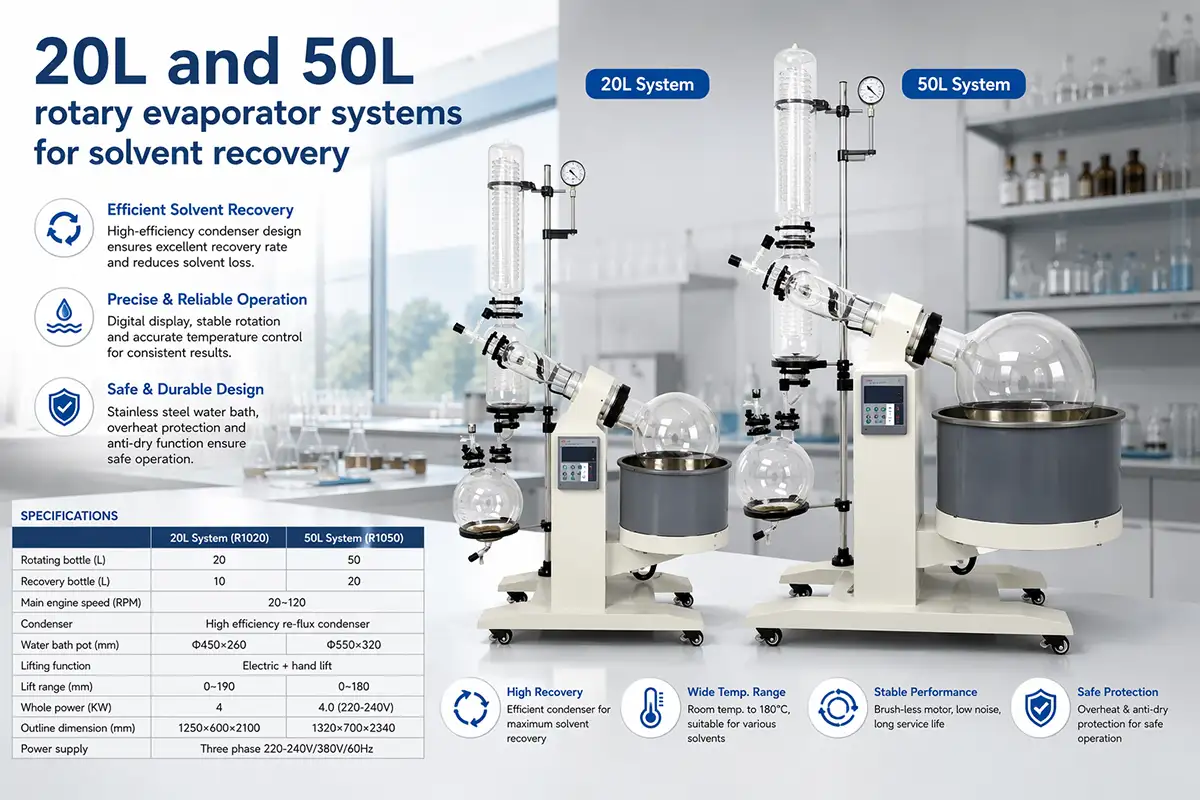
The 20L class is often the best balanced system for pilot evaporation. The ZZKD RE-2002 has a 20L evaporating flask, 10L receiving flask, 250W rotating motor, 0-90 r/min speed range, 5000W bath power, and evaporation above 5L/h for water under suitable conditions. If your work involves repeated concentration or recovery batches, the 20L rotary evaporator is usually easier to justify than a smaller lab unit.
The 50L class is for higher throughput. ZZKD RE-5002 and R1050 class systems use a 50L evaporating flask and 20L receiving flask. The RE-5002 offers 7000/9000W bath power and evaporation above 9L/h for water under suitable conditions. This level is suitable when solvent evaporation has become a regular bottleneck and the facility has enough cooling, vacuum, space, and trained operators to support it.
ZZKD system selection table
The table below compares practical rotary evaporator system choices for efficient solvent evaporation. The reference prices come from the provided ZZKD rotary evaporator price sheet. Where multiple prices were available, the selected value follows the requested middle and relatively economical price rule.
| System size | Typical ZZKD model | Flask capacity | Bath power | Evaporation reference | Best application | Reference price |
|---|---|---|---|---|---|---|
| 10L system | RE-1002 class | 10L evaporating / 5L receiving | 3000W | >3L/h H2O | Small pilot runs, R&D scale-up, expensive samples | $1,900 |
| 20L system | RE-2002 / R1020 class | 20L evaporating / 10L receiving | 5000W or 4KW class | >5L/h H2O | Pilot plant solvent recovery and repeated evaporation | $2,200 |
| 50L system | RE-5002 / R1050 class | 50L evaporating / 20L receiving | 7000/9000W or 4KW class | >9L/h H2O | High-volume recovery, larger extraction concentration, pilot production | $2,600 |
Actual evaporation speed depends on solvent type, vacuum level, condenser temperature, bath setting, flask loading ratio, ambient conditions, and system configuration.
How to make solvent evaporation more efficient
Leaving enough headspace helps prevent bumping and improves vapor flow. A larger flask does not mean every batch should fill the flask completely. For smooth evaporation, choose a system that gives working volume plus safety margin.
Efficient solvent recovery depends on condensation. If vapor reaches the pump or room instead of condensing, the process becomes slower, less safe, and less economical. Match the chiller temperature and cooling power to the solvent and batch size.
A sudden deep vacuum can cause foaming or bumping, especially with mixed solvents or concentrated extracts. A controlled vacuum ramp often gives faster real operation because the process becomes stable and repeatable.
Higher bath temperature may increase evaporation, but it is not always better. Heat-sensitive materials need a balance of lower temperature, stronger vacuum, and effective condensation. The goal is efficient evaporation without damaging the product.
Where an efficient rotary evaporator system is used
A well-matched rotary evaporator system can be used in many solvent evaporation tasks. In chemical labs, it removes reaction solvents and concentrates samples. In botanical extraction, it recovers ethanol or other solvents after extraction. In pharmaceutical and university research, it supports method development and small-batch preparation. In pilot plants, it helps engineers study batch time, solvent recovery rate, and scale-up behavior before moving to larger production equipment.
For extraction facilities, rotary evaporation is often part of a wider solvent management workflow. If your operation is focused on ethanol, you may also want to compare the rotovap stage with an ethanol recovery machine or other recovery equipment, depending on volume and process requirements. For many small and mid-sized operations, a ZZKD rotary evaporator system remains a flexible and affordable solution because it handles different solvents and batch sizes without complex installation.
Buyer questions before choosing a system
Is the evaporator alone enough?
No. For efficient solvent evaporation, the evaporator should be treated as part of a system. You need a suitable vacuum pump, chiller, condenser, receiving flask, and safe connections. A balanced system is usually more efficient than a large evaporator with undersized support equipment.
Which size gives the best value?
For many users, the 20L system gives the best value. It is large enough for pilot-scale work but still easier to handle than a 50L system. If the work is mainly early R&D, choose 10L. If the process is stable and the daily solvent volume is high, choose 50L.
Can one system handle different solvents?
Yes, but settings and accessories may need adjustment. Low-boiling solvents, high-boiling solvents, water, ethanol, acetone, and solvent mixtures may require different vacuum levels, bath temperatures, condenser temperatures, and operating procedures.
What is the main reason to choose ZZKD?
ZZKD offers multiple rotary evaporator sizes for lab, scale-up, and pilot applications, making it easier to choose a system that matches the real process. The 10L, 20L, and 50L options give users a clear path from test evaporation to higher-throughput solvent recovery.
Final recommendation
For efficient solvent evaporation, choose the rotary evaporator as a complete system, not as a single machine. A 10L ZZKD system is suitable for early scale-up and flexible testing. A 20L ZZKD system is the most practical choice for many pilot plant and repeated solvent recovery jobs. A 50L ZZKD system is suitable when the process is already proven and higher throughput matters most.
ZZKD Rotary Evaporator Systems: 10L, 20L, and 50L Options