




1. Why Stainless Steel Reactors Are a Safe Default Choice
Stainless steel reactors are widely used in pharmaceuticals, fine chemicals, food, and cosmetics because they are strong, corrosion‑resistant, and relatively easy to clean. Compared with glass, stainless steel can handle higher pressures and is much more resistant to thermal shock and mechanical damage.
According to a survey published by the European Federation of Chemical Engineering, over 60% of pilot‑scale stirred reactors in fine chemical plants now use stainless steel or special alloys as the primary material, largely due to improved safety and easier scale‑up from lab to production.
Question: Is a glass reactor always cheaper and better for lab work than a stainless steel reactor?Author’s answer: Not necessarily. Glass is excellent for low‑pressure, visually monitored reactions, but once higher temperature (above about 200 °C), pressure, or abrasive slurries are involved, stainless steel becomes safer and often more economical over the full life cycle because it fails less often and requires fewer replacements.
Stainless steel reactors become especially attractive when:
-
Operating above 150–200 °C or under vacuum / overpressure
-
Handling slurries or solids that could scratch glass
-
Requiring frequent cleaning, CIP/SIP, or sterile operation
-
Scaling from small R&D to pilot batches with similar equipment design
2. 304 vs 316 Stainless Steel: What Really Matters
The most common reactor grades are 304 and 316 stainless steel. In practical terms:
-
304 stainless steel – good general corrosion resistance, suitable for many aqueous and food‑grade systems.
-
316 stainless steel – contains molybdenum, offering improved resistance to chlorides, many acids, and saline or marine environments.
For example, the compact 5 L model SS‑5L uses:
-
Reactor material: 316 stainless steel
-
Frame and piping: 304 stainless steel
-
Operating temperature: −100 to 250 °C
-
Working pressure: −0.098 MPa to 0.5 MPa (vacuum to positive pressure)
This configuration keeps the product‑contact surface in higher‑grade 316, while the support structure uses cost‑effective 304. It is a typical design for high‑value lab and pilot reactors.
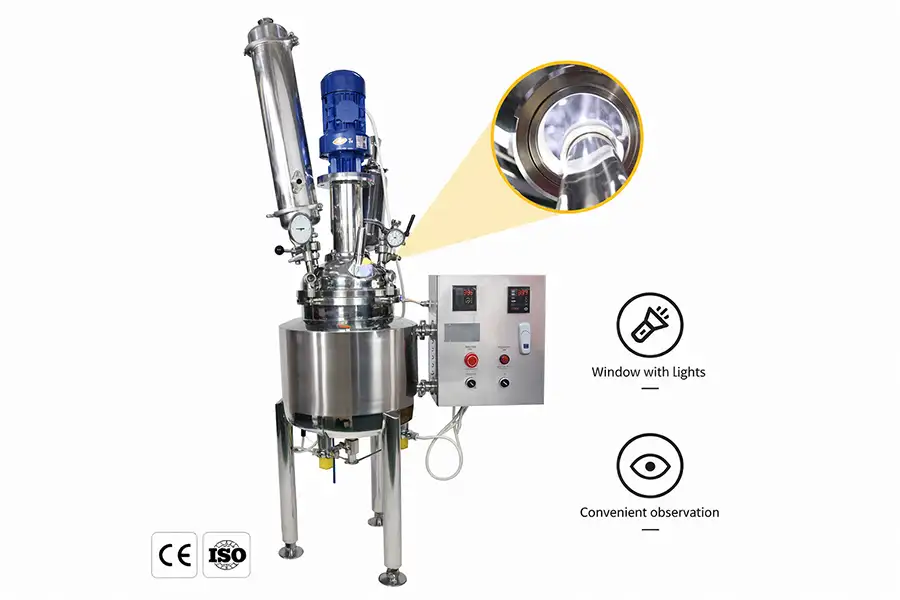
When choosing a stain steel reactor vessel for sale, 316 is usually recommended if:
-
There are chloride‑containing media (e.g., many hydrochloride salts, brine, some cleaning agents)
-
There are organic acids at elevated temperature
-
There is a need for better pitting and crevice corrosion resistance
3. How to Choose Reactor Volume: 5 L, 20 L, 50–300 L
Volume is usually the first parameter everyone looks at, but simply choosing “bigger” is rarely optimal. The key is matching the effective working volume to typical batch sizes and allowing enough headspace for foaming, gas evolution, and safe agitation.
For example, the 20 L unit SS‑20L (single‑jacket style) has:
-
Effective capacity: 20 L
-
Material: 304 stainless steel
-
Stirring power: 550 W with 0–100 rpm frequency control
-
Heating power: 6 kW
-
Shell thickness: 3 mm
In practice, a 20 L vessel is typically run at about 30–80% of its nominal volume (roughly 6–16 L) to maintain mixing quality and allow for any expansion or foaming.
Question: Is it safe to run a stainless steel reactor completely full to maximize throughput?Author’s answer: It is strongly discouraged. A safety margin is always required for expansion, gas generation, and effective agitation. Many process safety guidelines recommend an upper filling limit of about 70–80% of total reactor volume for normal operation, depending on the process.
For more flexible scale‑up, there is also a series of double‑wall stainless steel reactors (SS‑10L to SS‑300L). These share similar design concepts but with different kettle volumes:
Representative Jacketed Stainless Steel Reactor Series (SS‑10L to SS‑300L)
| Model | Kettle Volume | Mezzanine Volume | Temperature Range | Stirring Speed | Material | Working Pressure |
|---|---|---|---|---|---|---|
| SS‑10L | 10 L | ≈3.8 L | −100 to 299 °C | 0–600 rpm | SUS316/304 | −0.1 MPa to 0.5 MPa |
| SS‑20L | 20 L | ≈5 L | −100 to 299 °C | 0–600 rpm | SUS316/304 | −0.1 MPa to 0.5 MPa |
| SS‑50L | 50 L | ≈15 L | −100 to 299 °C | 0–600 rpm | SUS316/304 | −0.1 MPa to 0.5 MPa |
| SS‑100L | 100 L | ≈20 L | −100 to 299 °C | 0–600 rpm | SUS316/304 | −0.1 MPa to 0.5 MPa |
| SS‑200L | 200 L | ≈70 L | −100 to 299 °C | 0–600 rpm | SUS316/304 | −0.1 MPa to 0.5 MPa |
| SS‑300L | 300 L | ≈95 L | −100 to 299 °C | 0–600 rpm | SUS316/304 | −0.1 MPa to 0.5 MPa |
Note: All models in this series use double‑wall stainless steel construction, digital display frequency‑conversion speed control, and mechanical PTFE‑based stir seals for reliable operation from deep vacuum to positive pressure.
4. Temperature, Pressure, and Mixing: The Core Performance Trio
When considering a stainless steel reactor vessel for sale, the most critical performance factors are:
-
Temperature range & control method
-
Vacuum & pressure rating
-
Stirring system (power, speed, impeller type)
4.1 Temperature and Heating/Cooling
In the SS‑5L reactor, the kettle reaction temperature range is −100 to 250 °C, using circulation heating (typically via thermal oil or other heat‑transfer fluid in the jacket). The jacket volume is about 1.5 L in this small unit, while in larger models it grows from ≈3.8 L up to ≈95 L.
A PT100 sensor with digital display provides accurate temperature feedback, which is essential when working close to product decomposition temperatures or crystallization points.
4.2 Pressure and Vacuum Capability
Both SS‑5L and the larger jacketed series support high vacuum down to about −0.098 MPa and up to 0.5 MPa positive pressure (check specific model and local code limits). This makes them suitable for:
-
Vacuum distillation or solvent removal (often combined with a rotary evaporator for sale downstream)
-
Reactions sensitive to oxygen or moisture
-
Moderate pressure hydrogenations or gas‑liquid reactions (within rated design limits)
Industry accident data from major chemical safety boards repeatedly emphasizes that most serious reactor incidents involve pressure excursions. Therefore, selecting a vessel certified for the desired pressure range, with appropriate safety valves and instrumentation, is not optional—it is fundamental.
4.3 Stirring System and Sealing
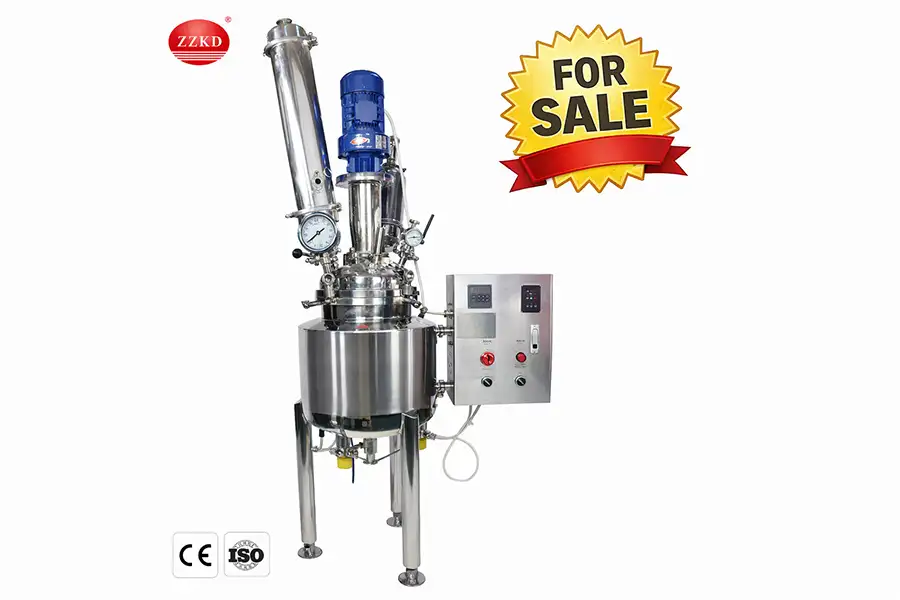
The SS‑5L unit uses a 120 W drive (with power increased by about one‑third over standard motors) and allows 0–600 rpm adjustment via a frequency converter, with digital speed display. The shaft is sealed via a mechanical seal, and discharge is through a ball‑type quick discharge valve.
Larger jacketed models (e.g., SS‑50L, SS‑100L) use 200–400 W drives, still with 0–600 rpm variable speed. They feature:
-
SUS304 ceramic combined mechanical seals on the kettle
-
New PTFE mechanical seals on the stirrer shaft
-
Paddle‑type impellers made from stainless steel
Mechanical seals plus PTFE components significantly reduce leakage risk compared with simple packing glands, especially under vacuum or when handling volatile solvents.
5. Ports, Connections, and Ergonomics: Details That Decide Daily Usability
The usefulness of a reactor is heavily influenced by how easy it is to charge, sample, control, and clean in real‑world operation.
5.1 Reactor Lid Ports
The SS‑5L reactor lid includes multiple functional ports, such as:
-
Stirring port
-
Solid material charging port
-
Temperature probe port
-
Pressure gauge port
-
Constant‑pressure funnel port
-
Condensation reflux port
In the larger series, there are typically 8 body ports (optional), with dedicated feeding ports (51 mm to 100 mm), viewing windows, and chuck‑type pressure gauge connections. This layout allows multiple accessories—reflux condensers, dosing funnels, pressure transducers, or sampling lines—to be installed simultaneously.
5.2 Connections and Mobility
On the SS‑5L, interface connections are via threaded unions, making it straightforward to integrate with standard lab piping. The movement method uses braked swivel casters, which is significant in practice: the reactor can be moved for cleaning or reconfiguration but locked safely during operation.
Question: Are casters really necessary on a small stainless steel reactor?Author’s answer: In a crowded lab or pilot plant, yes. Being able to unlock and move a 5–50 L stainless steel reactor out of the way, or closer to utilities, often saves significant time and reduces the risk of lifting accidents, especially when cleaning or changing setups.
6. What Drives the Price of a Stainless Steel Reactor Vessel
Pricing for a stain steel reactor vessel for sale is influenced by a handful of major technical factors:
-
Material grade: 316 stainless steel and special alloys cost more than 304, but often justify the premium if corrosion is a concern.
-
Wall thickness & pressure rating: Reactors designed for higher pressure need thicker walls, stronger flanges, and stricter certification.
-
Volume and jacket design: Larger kettles and double‑wall (jacketed) designs use more steel and require more complex fabrication.
-
Mixing and sealing system: High‑speed agitation, ceramic‑mechanical seals, and PTFE components add cost but improve safety and lifetime.
-
Instrumentation: Digital displays, advanced controllers, multiple probes, and automation interfaces increase upfront price but save operator time.
A dedicated analysis of 316 stainless steel reactor pricing, including material and global alloy cost trends, is available in the article SS‑316 reactor price: factors, variations, and considerations.
7. Typical Applications for Stainless Steel Reactors
Stainless steel reactors cover a wide range of processes:
-
Pharmaceutical and biotech: synthesis, crystallization, buffer preparation, intermediate storage
-
Fine chemicals: multi‑step organic synthesis, hydrogenation, nitration (within pressure and temperature limits)
-
Food & beverage: flavor extraction, emulsification, controlled heating and mixing
-
Cosmetics & personal care: emulsions, surfactant blending, fragrance incorporation
For an overview focusing specifically on chemical manufacturing, see the role of stainless steel chemical reactors in modern industry.
According to data shared at recent chemical engineering conferences, more than 70% of new pilot plants choose stainless steel for their main stirred reactors, mainly to simplify scale‑up and reduce downtime caused by glass breakage or corrosion damage.
8. Practical Checklist Before Buying a Stainless Steel Reactor Vessel
Before committing to a specific model, the following checklist helps avoid costly mismatches:
-
Process requirements clearly defined
Reaction type, solvents, pH, typical and maximum temperature, pressure, vacuum level, batch size, and residence time. -
Correct material selection
Decide between 304 and 316 based on corrosion data and cleaning agents. If in doubt, small coupon tests in the expected medium can be run to verify compatibility. -
Appropriate volume and headspace
Ensure effective working volume is within 30–80% of kettle volume for most batches, and check if any foaming or gas evolution needs extra space. -
Temperature and jacket design
Confirm the required temperature range and whether a single jacket or double‑wall design with controlled circulation is needed. -
Pressure rating and certification
Match the reactor’s rated pressure (−0.1 to 0.5 MPa in the examples above) with the process worst‑case scenario, including blocked vents or runaway conditions, following plant safety standards. -
Stirring system & seals
Check motor power (120–400 W in the shown models), speed range, impeller type (paddle, three‑blade, etc.), and seal technology (mechanical, PTFE) against viscosity and solid‑loading requirements. -
Ports, instrumentation, and expandability
Verify that the lid ports cover current and foreseeable needs: dosing, reflux, inert gas, sampling, extra sensors. -
Cleaning, maintenance, and mobility
Ensure access for manual cleaning or CIP, availability of spare seals, and whether casters or skid mounting are more suitable.
Need a Stainless Steel Reactor Vessel for Your Next Project?
From compact 5 L units like SS‑5L to 300 L jacketed systems, stainless steel reactors can be tailored with the right material, ports, seals, and controls for specific chemistry and scale.
Sharing a brief description of the process (solvent, temperature, pressure, batch size) usually allows a supplier to propose a short list of suitable models and an estimated budget within one working day.
Explore Stainless Steel Reactors for Sale