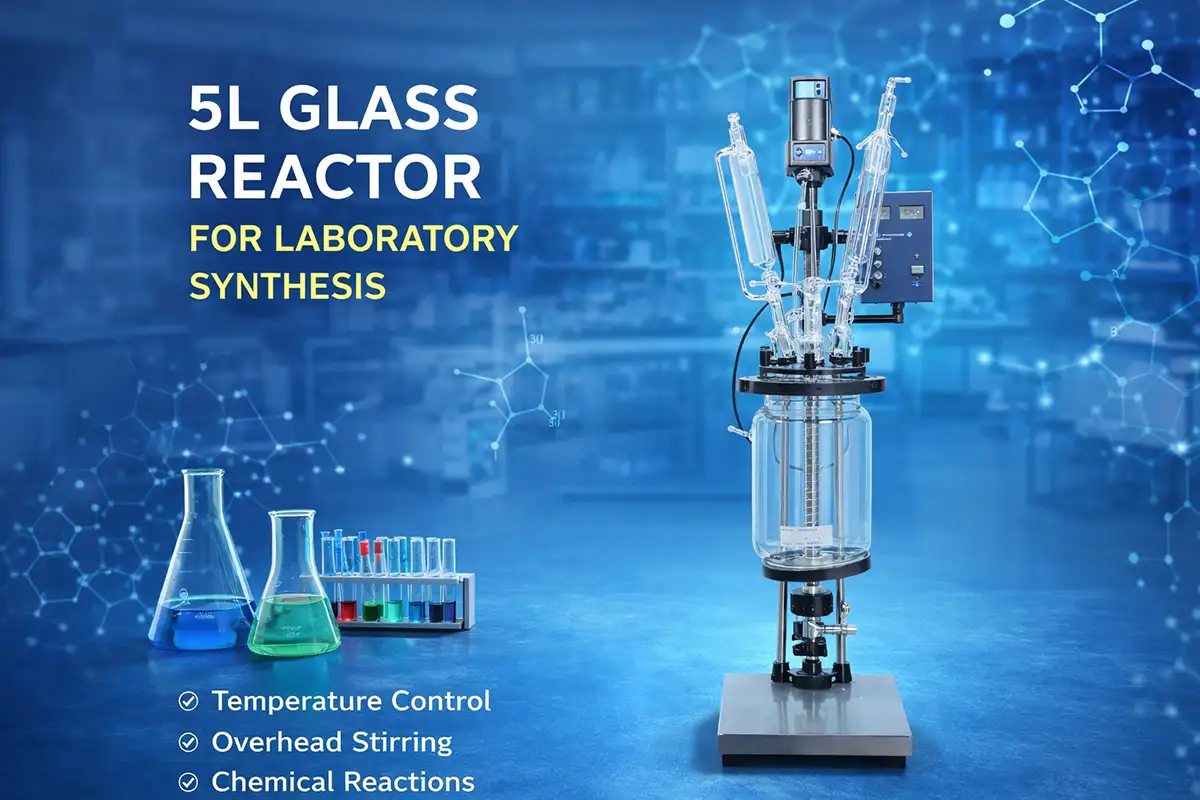
A 5L glass reactor is one of the most popular sizes for R&D labs and pilot‑scale process development. It is large enough to handle meaningful batches, but still compact, affordable and easy to control. This guide focuses on what matters most when selecting and using a 5L glass reactor, based on real lab requirements rather than just catalog numbers.
1. What Exactly Is a 5L Glass Reactor?
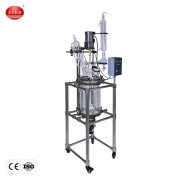
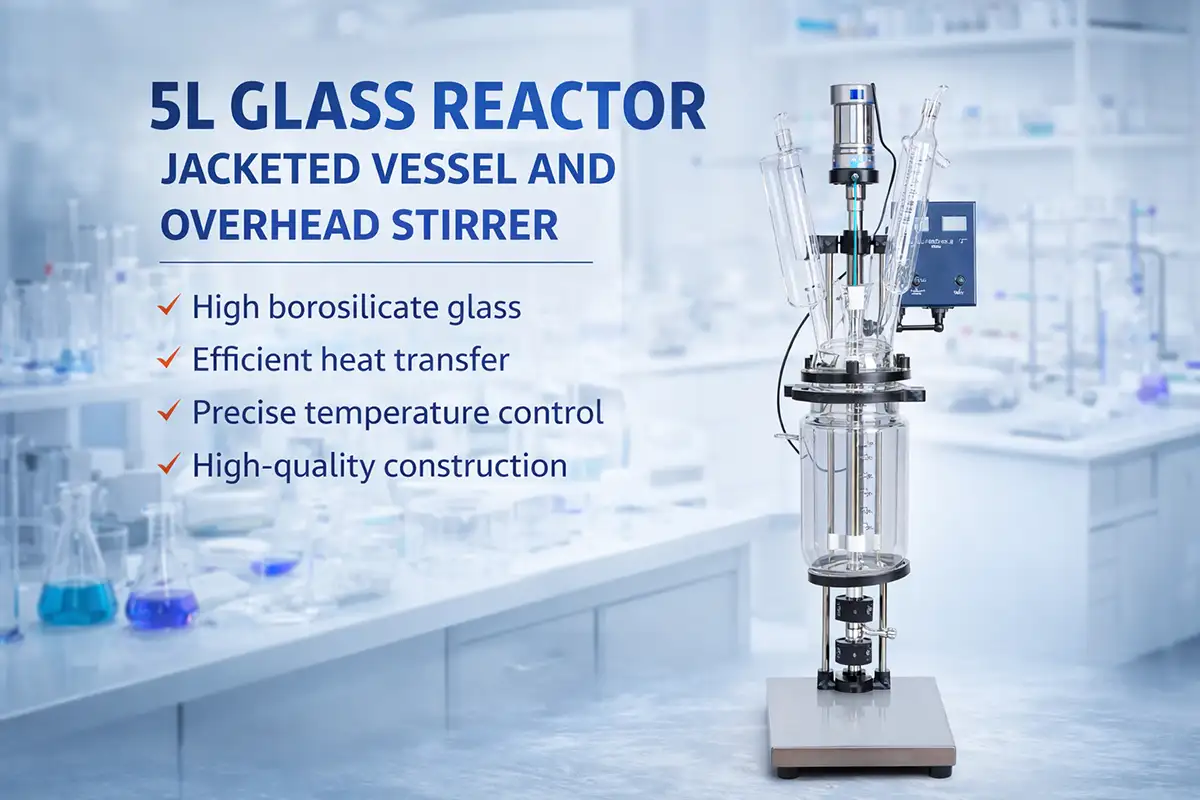
A 5L glass reactor is a jacketed borosilicate glass vessel with a nominal working volume of 5 liters. It is usually mounted on a steel frame and equipped with:
-
Overhead mechanical stirring (variable speed)
-
A double‑layer jacket for heating and/or cooling fluid
-
Sealed glass lid ports for condensers, dosing funnels, sensors, etc.
-
Bottom discharge valve for easy product removal
The “5L” rating refers to the maximum reaction kettle capacity, not necessarily the recommended working volume. In practice, most chemists operate between 30–70 % of nominal capacity for good mixing and safety, so a 5L glass reactor often handles 1.5–3.5 L reaction charges comfortably.
Author’s note: For many labs that have outgrown a 1–2 L setup but are not yet ready for a full pilot plant, 5L is a sweet spot in terms of solvent usage, heat‑transfer efficiency and scalability.
2. Key Technical Parameters of a 5L Glass Reactor
To make this guide concrete, the table below summarises typical parameters for a common series that includes 1, 2, 3 and 5L glass reactor models (S‑1L to S‑5L). The 5L model shares most specifications with the smaller sizes, which simplifies scale‑up.
S‑Series Small Glass Reactors (1–5 L)
|
Model |
Reaction Kettle Capacity (L) |
Stirring Power (W) |
Stirring Speed (rpm) |
Stirring Shaft Diameter (mm) |
Motor Torque (g·cm) |
Power Supply |
Notes |
|
S‑1L |
1 |
60 |
0–600 (Max. 1300) |
12 |
2000 |
220 V, 50/60 Hz |
Floor type, explosion‑proof options |
|
S‑2L |
2 |
60 |
0–600 (Max. 1300) |
12 |
2400 |
220 V, 50/60 Hz |
Stirring power alternatives: 180/250/370 W |
|
S‑3L |
3 |
60 |
0–600 (Max. 1300) |
12 |
4800 |
220 V, 50/60 Hz |
110 V / 60 Hz customizable |
|
S‑5L |
5 |
60 (typical; 180–370 W available) |
0–600 (Max. 1300) |
12 |
4800 |
220 V, 50/60 Hz or 110 V / 60 Hz |
Floor‑standing, explosion‑proof version optional |
Larger models in the same family (10–100 L) typically upgrade to 120–250 W motors, 15 mm shafts and 304 stainless‑steel frames, while keeping a similar speed range. This makes it easier to extrapolate mixing conditions when scaling up.
Why these numbers matter for day‑to‑day work
-
Stirring speed (0–600 rpm, max 1300): Enables both gentle mixing (for heat‑sensitive APIs or crystals) and high‑shear dispersion (for slurries or suspensions).
-
Motor torque (up to 4800 g·cm): Critical for viscous media or crystallization. Higher torque means the motor can maintain speed even as viscosity increases.
-
Shaft diameter (12 mm): Robust enough to handle standard four‑blade or anchor impellers without excessive shaft deflection.
-
Explosion‑proof options: Important when working with flammable solvents at elevated temperature.
Which parameter has the biggest impact on whether a 5L glass reactor can handle high‑solid or viscous reactions?
In practice, motor torque and impeller design matter more than the nominal speed. A 5L glass reactor with ~4800 g·cm torque and a correctly sized anchor or pitched‑blade impeller can mix surprisingly thick slurries, while a low‑torque setup may stall even at modest viscosity.
3. Typical Applications of a 5L Glass Reactor
According to a survey by the American Chemical Society, over 60 % of process‑development labs use 1–10 L reactors as their main workhorse scale before moving to pilot plants. A 5L glass reactor sits right in this range, and is commonly used for:
-
Organic synthesis: Multi‑step reactions, Grignard chemistry (with appropriate safety measures), coupling reactions, and small‑scale process optimization.
-
Crystallization studies: Controlling cooling rates and seeding strategies in a volume that is large enough to mimic pilot behaviour.
-
Polymerization: Emulsion or solution polymerization where precise temperature control is critical.
-
Extraction & phase separation: Liquid–liquid extractions and solvent exchanges when combined with a condenser and, in some setups, a rotary evaporator for solvent recovery.
-
Biochemical and fermentation tests: With appropriate seals and accessories, 5L glass reactors can also support small fermentations or enzyme reactions.
4. How a 5L Glass Reactor Works: The Short Version
The working principle of a 5L glass reactor is straightforward:
-
A heating/cooling fluid (oil, water–glycol, etc.) circulates through the jacket, setting the reactor wall temperature.
-
The overhead stirrer agitates the reaction mixture, improving heat and mass transfer.
-
Condensers, addition funnels and gas inlet tubes are connected via the reactor lid to manage vapours, dosing and inerting.
-
Temperature and sometimes pH or pressure are monitored with sensors inserted through dedicated ports.
-
After reaction, the product is discharged via the bottom valve into a receiving container or filtration setup.
Because the vessel is transparent, it is easy to observe colour changes, phase separation, foaming, or crystal growth in real time. This is a major advantage over stainless‑steel reactors at the same scale.
Is a 5L glass reactor enough to simulate behaviour in a 50–100 L glass or stainless reactor?
For many kinetic, solubility and crystallization questions, the answer is yes—provided that similar mixing regimes and temperature profiles are maintained. Many labs run parallel 5L experiments to map design space before committing to 100 L jacketed glass reactors at pilot scale.
5. Choosing the Right 5L Glass Reactor: What to Look At First
When evaluating a 5L glass reactor, the following practical factors usually matter more than small differences in published “power” numbers.
5.1 Temperature range and jacket design
-
Typical range: –80 °C to +200 °C (depends on glass quality and gasket materials).
-
Jacket volume & connections: Adequate jacket volume and standard inlet/outlet fittings are essential for efficient heat transfer and easy integration with chillers or oil baths.
-
Thermal shock resistance: High‑quality borosilicate glass can handle rapid temperature ramps better, reducing the risk of cracking.
5.2 Stirring system and impeller flexibility
-
Motor type: Explosion‑proof or at least solvent‑resistant motor housing if flammable solvents are used.
-
Speed control: Digital display and feedback control are helpful for reproducibility.
-
Interchangeable impellers: Being able to switch between anchor, turbine, or propeller impellers allows the same 5L reactor to handle thin solutions and thick slurries efficiently.
5.3 Frame, mobility and footprint
A floor‑standing frame with lockable casters is convenient when space is shared between projects. Higher‑volume models (10–100 L) in the same series typically use a 304 stainless‑steel frame for rigidity and corrosion resistance; matching your 5L glass reactor with the same family makes future scale‑up smoother.
5.4 Safety and compliance
-
Pressure rating: Standard 5L glass reactors are intended for atmospheric or slight overpressure operation. For higher pressures, a dedicated high‑pressure glass reactor is required.
-
Explosion‑proof options: Motors, control boxes and switches should meet relevant standards (e.g., ATEX, UL) for hazardous environments.
-
Emergency venting and rupture discs: Recommended if exothermic reactions or gas‑evolving steps are planned.
Evidence‑based note: A study published in Organic Process Research & Development reported that using well‑controlled, jacketed glass reactors at the 5–10 L scale reduced scale‑up safety incidents by more than 40 % compared with relying only on 250–500 mL flasks and ad‑hoc pilot trials. This underlines the value of a robust 5L platform in de‑risking industrial processes.
6. Operating Tips for Reliable Results
Based on repeated use of 5L systems in multi‑step synthesis and crystallization work, several practical tips consistently make the difference between “works on paper” and “robust in real life”.
6.1 Filling volume and anti‑foam strategy
-
Operate between 30–70 % of rated volume to maintain good mixing and headspace.
-
Reserve extra headspace for gas‑evolving reactions or foaming systems (fermentations, surfactants, etc.).
-
Use baffles or appropriate impeller design if vortexing is excessive at higher speeds.
6.2 Temperature control best practices
-
Use separate sensors for jacket fluid and internal reaction temperature.
-
For exothermic reactions, pre‑cool the jacket to the lower bound of the desired range and add reagents slowly via an addition funnel.
-
Insulate exposed glass and tubing to minimise heat losses and condensation in humid environments.
6.3 Cleaning and changeover
Glass surfaces are chemically resistant but can be scratched or weakened mechanically. Recommended practices include:
-
Use non‑abrasive brushes and compatible solvents or detergents.
-
Rinse with deionised water and finally with a volatile solvent (e.g. ethanol) to speed up drying.
-
Inspect joints and gaskets regularly for chips, cracks or swelling.
Can a 5L glass reactor realistically support “multi‑project” use in a busy lab without excessive cleaning time?
Yes, especially if the setup uses quick‑release clamps, standardized ground‑glass joints, and a well‑planned cleaning protocol. Many QC and R&D labs operate a single 5L glass reactor across several projects per week by standardising solvent sequences and documenting validated cleaning procedures.
7. When to Move Beyond 5L
Although a 5L glass reactor is highly versatile, there are clear signals that a larger system is justified:
-
Batch sizes consistently exceed 3–3.5 L reaction charge.
-
Viscosity or solid content becomes high enough that mixing at 5L is borderline, even with a strong motor.
-
Project timelines require closer alignment with plant volumes (10–100 L or more).
In such cases, moving to a 10–100 L glass reactor with a 120–250 W drive and thicker 15 mm shaft is the next logical step, while using the 5L glass reactor for early screening and risk‑reduction work.
8. Summary: Why a 5L Glass Reactor Is a Smart First Investment
-
Right‑sized for development: Big enough for meaningful data, small enough to be economical and agile.
-
Excellent visibility and control: Transparent jacketed design makes it easier to understand and optimise reactions.
-
Scalable platform: Shared parameters with 10–100 L series reactors facilitate scale‑up.
-
Safe and flexible: Explosion‑proof and high‑torque options allow work with flammable and viscous systems.
For labs aiming to move beyond small flasks into robust, data‑rich process development, a well‑configured 5L glass reactor is often the most impactful single piece of equipment to add.


 Products