




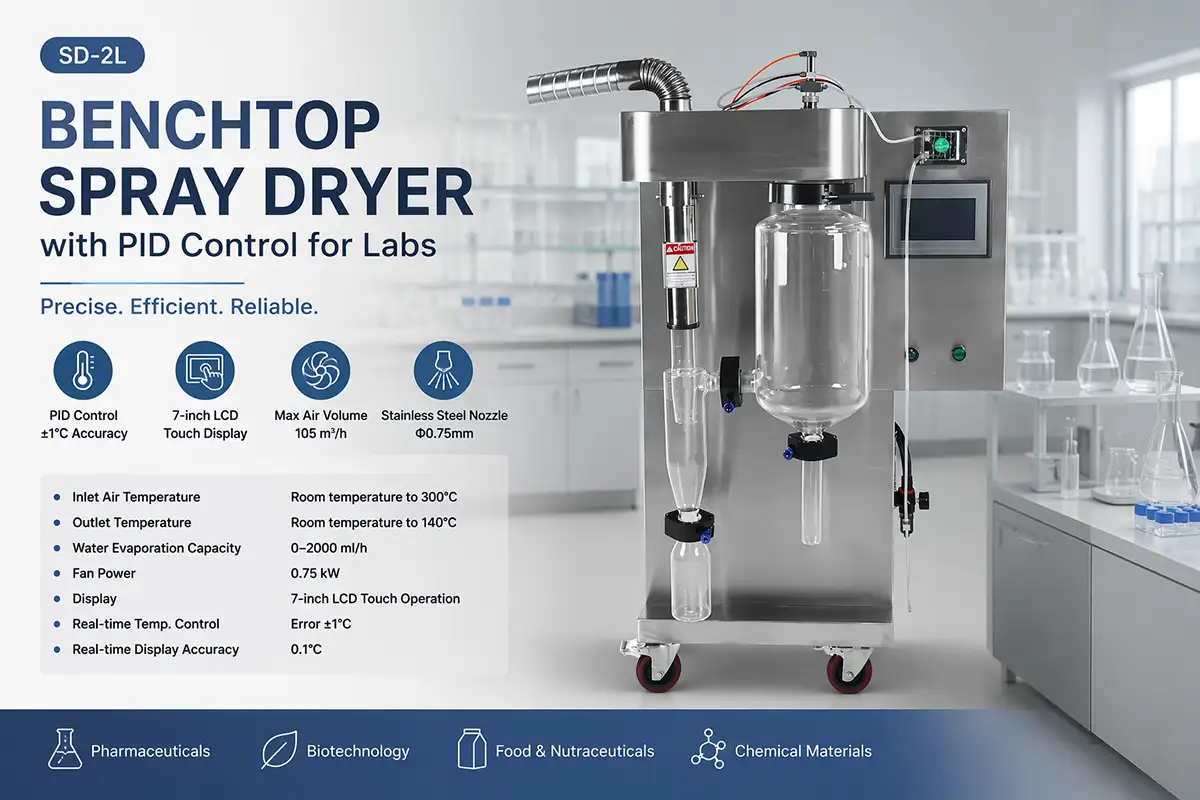
Benchtop Spray Dryer with PID Control for Labs
A benchtop spray dryer with PID control helps laboratory teams convert liquid samples into dry powder while keeping inlet and outlet temperatures steady. For food, herbal extract, chemical, ceramic, and pharmaceutical research, this control is often the difference between a usable powder and a sticky, overheated, or inconsistent batch.
What Does PID Control Do?
PID control is a temperature control method that continuously compares the set temperature with the real temperature, then adjusts the heating output to reduce fluctuation. In simple words, it helps the spray dryer stay close to the target temperature instead of heating too aggressively or reacting too slowly. For lab spray drying, this matters because most samples are sensitive to heat, moisture, and residence time.
In a ZZKD benchtop spray dryer, stable temperature control supports repeatable experiments. If the inlet air temperature is set at 160°C, the system should respond smoothly as feed rate, air volume, and sample concentration change. A stable outlet temperature also helps researchers judge whether the powder is drying correctly. If the outlet temperature drops too much, the feed may be too high. If it rises too much, the sample may be drying too fast or being overheated.
For readers who are new to the process, ZZKD also explains the broader basics of spray drying, including how hot air, atomization, and powder collection work together.
- Better repeatability: PID control keeps temperature changes smoother during short laboratory runs.
- Easier optimization: Operators can adjust feed speed, air temperature, and atomization pressure step by step.
- Lower sample waste: A controlled run helps protect small batches of expensive or hard to prepare materials.
Why Labs Choose a Benchtop Spray Dryer
A laboratory does not always need a large industrial dryer. Many teams only need to test a formula, compare carriers, study powder flow, or prepare a few hundred grams of powder for analysis. A compact benchtop spray dryer is easier to install, easier to clean, and easier to operate than a production scale drying line.
ZZKD lab spray dryers are suitable for solutions and some suspension liquids. Typical applications include milk powder trials, instant coffee development, fruit juice powder, plant extract, enzyme preparation, ceramics, detergent base powder, collagen, flavors, and other liquid to powder experiments. The operator can begin with a small feed quantity, observe powder collection, then change the process settings until the result looks stable.
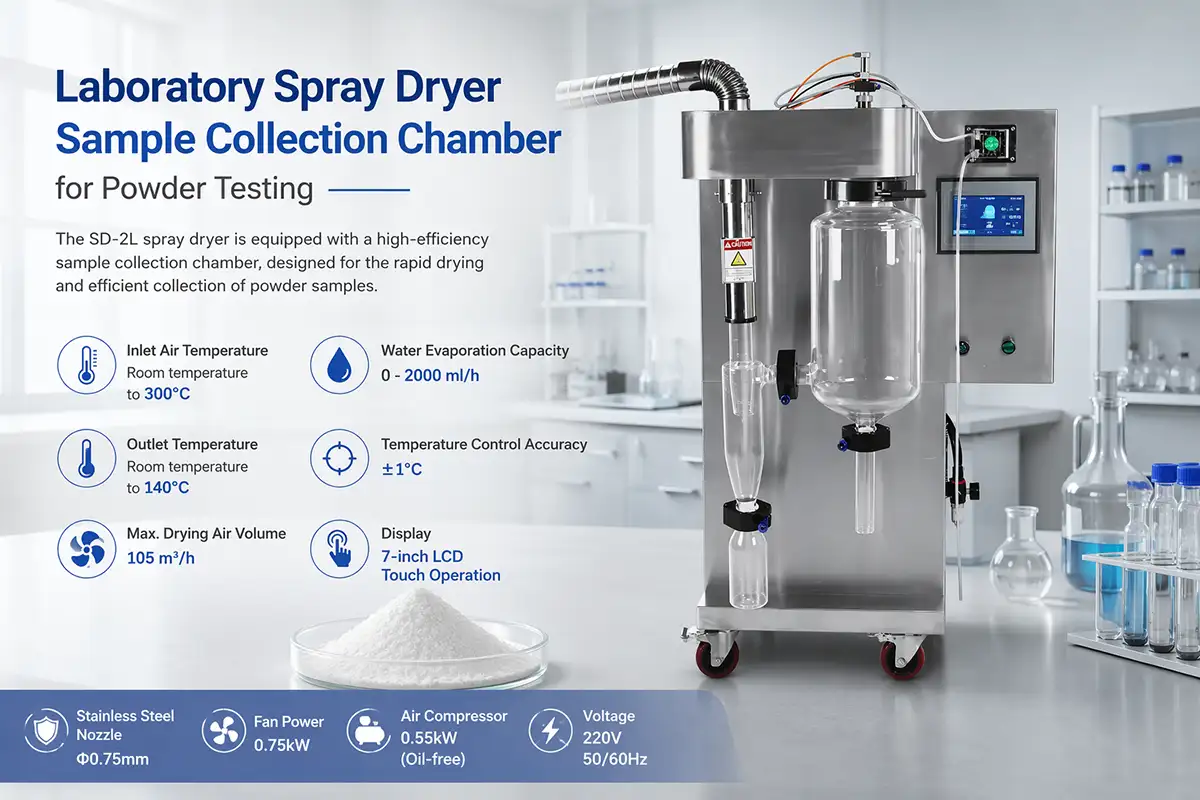
The biggest advantage is speed. ZZKD 2L and 3L laboratory models list an average drying time of about 1.0 to 1.5 seconds. That short exposure helps many heat sensitive samples dry before they spend too long in hot air. It also makes the machine useful for quick formula screening before a buyer moves to a 5L or 10L pilot unit.
ZZKD Model Selection
The right model depends on sample volume, target evaporation rate, available power, and whether the lab needs a compact test machine or a higher capacity pilot dryer. The SD-2L and LPG-3L are practical choices for small batch research. The LPG-5L and LPG-10L are better when the team needs more output, centrifugal atomization, or pilot scale process data.
| Model | Evaporation or Feed Capacity | Temperature Range | Key Features | Reference Price |
|---|---|---|---|---|
| SD-2L | Evaporated water 1500 to 2000 ml/h; max feed 2000 ml/h | Inlet 30 to 300°C; outlet 30 to 150°C | Peristaltic pump feed, 1.00 mm nozzle, 220V single phase, 600 x 700 x 1200 mm | About $2,748 |
| LPG-3L | Evaporated water 1500 to 3000 ml/h; max feed 3000 ml/h | Inlet 30 to 300°C; outlet 30 to 140°C; accuracy ±1°C | Peristaltic pump feed, optional nozzle sizes, 5 kW / 220V, 800 x 800 x 1350 mm | About $3,500 |
| LPG-5L | About 5 to 6 L/h water evaporation | Inlet room temperature to 330°C; outlet room temperature to 140°C | Centrifugal atomization, 304 stainless steel, electric heating, 380V, indoor installation | About $7,428 |
| LPG-10L | About 10 kg/h maximum moisture evaporation | Designed for pilot scale spray drying with electric heat source | High speed centrifugal spray head, 20 kW electric heating, 3.2 x 1.5 x 2.4 m footprint | About $10,000 |
Reference prices are taken from the provided ZZKD product price list. When a product had a price range, a practical lower middle reference was used for budget planning. Final pricing may change with voltage, atomizer type, accessories, shipping, and customization.
How to Judge Whether a Sample Can Be Spray Dried
The first question is simple: can the sample flow through the feed pump and atomizer? A low viscosity solution is usually easier than a thick slurry. Some suspension liquids can be processed, but they need enough stability so the solids do not settle quickly in the feed line. The second question is whether the material can tolerate short contact with warm air. Even when the inlet temperature looks high, the droplet surface cools by evaporation, so many materials can be dried at reasonable outlet temperatures.
Atomization is another key point. Smaller droplets dry faster and usually create finer powder. Larger droplets may be easier to collect but can remain wet inside. If you want to understand droplet formation in more detail, ZZKD has a related guide on spray drying atomization.
Common Questions from Buyers
Is a benchtop spray dryer suitable for real research, or only demonstrations?
It is suitable for real laboratory research. A 2L or 3L unit can help test carrier ratios, inlet temperature, feed concentration, powder recovery, and product behavior before the formula is moved to a larger dryer. Many buyers use this stage to reduce risk before pilot production.
What materials are usually used in the drying chamber?
ZZKD laboratory spray dryers use stainless steel structures for durability and clean operation. The LPG-5L specification lists 304 stainless steel, which is widely used for food, chemical, and general laboratory equipment.
How much sample is needed for a first test?
The SD-2L and LPG-3L specifications list a minimum feed quantity of 50 ml. In practice, more sample is helpful for stable operation and powder collection, but the low minimum feed amount is useful when the material is expensive.
Can one machine handle milk, coffee, plant extracts, and ceramics?
One machine can test many water based formulas, but each material needs its own process settings. Sugary fruit extracts may stick to the chamber unless carrier material is added. Ceramic suspensions may need careful mixing. Milk and coffee powders usually depend on solid content, inlet temperature, and atomization quality.
Practical Operating Tips
Before feeding liquid, preheat the spray dryer and confirm that the air path, cyclone, collection bottle, and nozzle are installed correctly. Start with water if the operator is new to the machine. After the temperature becomes stable, switch to the sample and increase feed speed slowly. The goal is to keep the outlet temperature stable while avoiding wet powder on the chamber wall.
Cleaning is just as important as drying. Residual powder can absorb moisture, block the atomizer, or affect the next sample. For food and pharmaceutical related experiments, operators should clean contact parts carefully and dry the system before storage. Good cleaning habits also help protect the PID control result because blocked airflow or a dirty nozzle can make the temperature response look unstable.
When to Choose 2L, 3L, 5L, or 10L
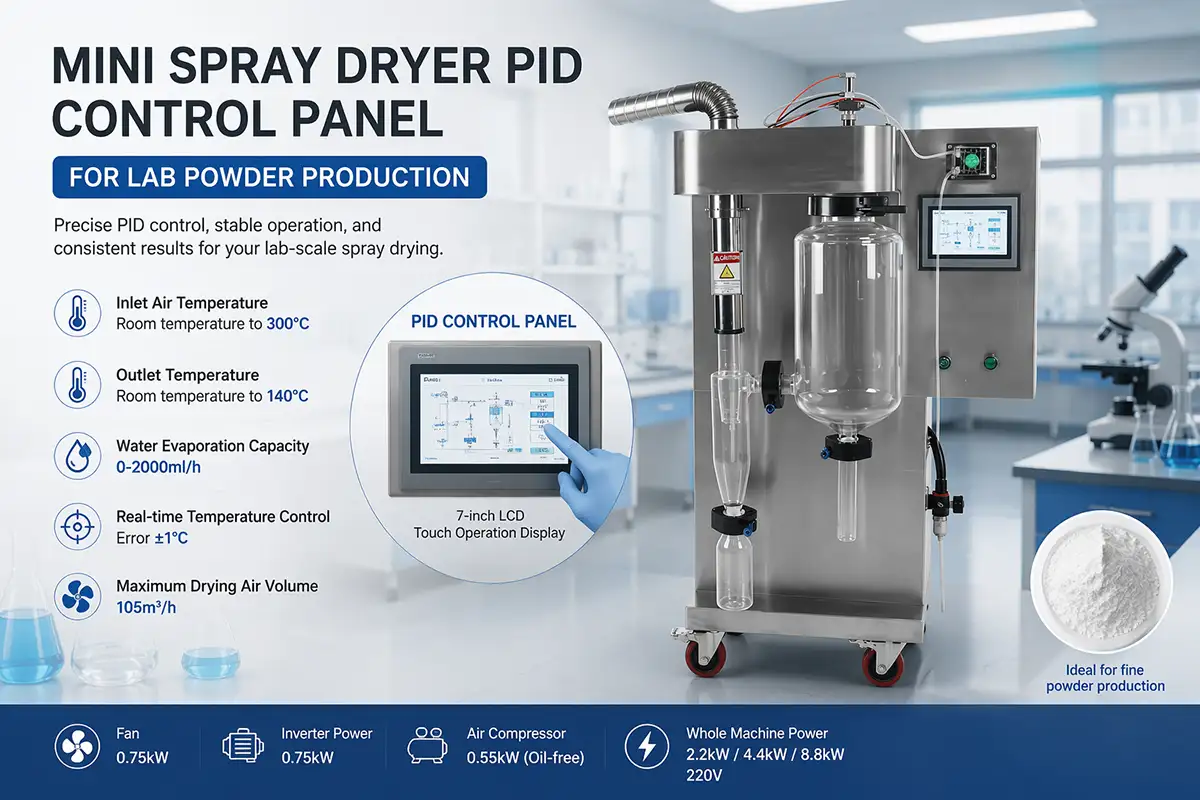
Choose a 2L benchtop model when the lab mainly works with small samples, formula screening, or teaching. It is compact, uses 220V single phase power, and has enough capacity for many early experiments. Choose a 3L model when you want a little more evaporation capacity, optional nozzle sizes, and tight temperature accuracy. The LPG-3L is a balanced choice for laboratories that run frequent powder trials.
Choose a 5L model when the lab needs pilot style data. With centrifugal atomization, 304 stainless steel material, and about 6 L/h host evaporation capacity, the LPG-5L is more suitable for process development than a very small unit. A 10L model is usually selected when the team is already thinking about scale up, continuous trials, or larger sample campaigns.
For buyers comparing equipment categories, the ZZKD lab scale spray dryer page is the most relevant internal product reference from the current keyword ranking list.
Final Recommendation
A ZZKD benchtop spray dryer with PID control is a smart choice when a laboratory needs reliable liquid to powder testing without the space, cost, and complexity of a large production dryer. PID control supports stable temperature behavior, while compact models help teams test small batches quickly. For most lab buyers, the best starting point is the SD-2L or LPG-3L. For pilot research, the LPG-5L gives more capacity and centrifugal atomization in a stainless steel system.
The best model depends on the sample, target powder quality, required output, and available power supply. If the project involves heat sensitive extracts, sticky food formulas, or high value materials, choose a machine that gives precise temperature control, adjustable feed rate, suitable atomization, and simple cleaning. That combination will make each experiment easier to repeat and easier to scale.
Build a More Repeatable Lab Drying Process with ZZKD
ZZKD supplies compact and pilot spray drying equipment for laboratories that need controlled powder preparation, clear operation, and practical model choices from small sample testing to scale up trials.
View ZZKD Lab Spray Dryer